 Bellingham
 What Fairhaven's Coastline Actually Asks of a Siding System
Fairhaven sits close enough to Bellingham Bay that its homes deal with a specific combination of stress most siding products were never designed around: salt-tinged marine air moving through the neighborhood most of the year, rain that gets driven sideways by wind off the water instead of falling straight down, and a moss season that can run nearly year-round on shaded, tree-covered lots. None of those three things is dramatic on its own. Together, over years, they're what separate a wall that still looks and performs well after a decade from one that's showing rust bleed, soft trim, and moss streaks well ahead of schedule.
This page is specifically about James Hardie fiber cement siding installed on Fairhaven homes — not siding in general, and not our full range of exterior services. If you want a wider look at exterior work in the neighborhood, that's a separate page. Here, we're going deep on the one product we install, why it fits this stretch of coast, and what actually has to happen on install day for it to perform the way it's engineered to.
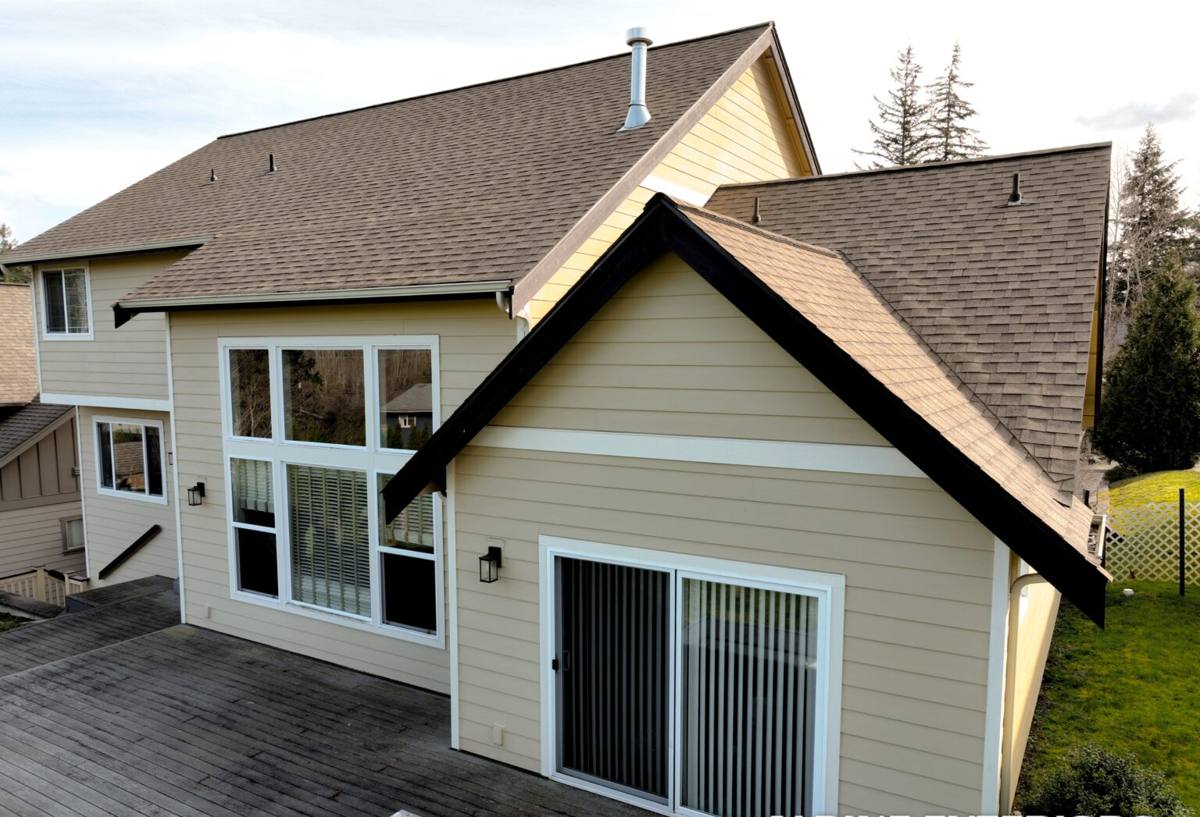
Why James Hardie Is the Only Siding We Put on Fairhaven Homes
We install James Hardie fiber cement siding exclusively. We don't offer LP SmartSide, vinyl, Cemplank, Allura, primed spruce, or cedar as alternatives at a lower price point. That's a professional standard, not a sales pitch — fiber cement's cement, sand, and cellulose fiber composition doesn't swell, rot, or feed a fire the way wood-based products can, and it holds its shape through the wet-to-dry cycling that's constant in a marine climate like Bellingham's. Standing behind one system we understand completely, and can install to spec every time, serves Fairhaven homeowners better than juggling several product lines with different failure points.
The James Hardie Product System
"James Hardie siding" isn't one product — it's a system of complementary pieces designed to work together, and choosing the right combination for a given house matters as much as the material itself.
HardiePlank Lap Siding
The most common choice on Fairhaven's mix of early-century homes and newer hillside infill. It installs in overlapping horizontal boards and comes in several textures, including a smooth finish and a wood-grain cedarmill texture for homes that want a more traditional look without the maintenance a real wood board carries.
HardiePanel Vertical Siding
Used for board-and-batten styling or as an accent on gables and dormers. It's a common pairing on Fairhaven homes that mix a primary lap-siding field with a vertical accent section to break up a facade, especially on the craftsman and cottage-style housing common in the neighborhood.
HardieTrim
Fiber cement trim boards used around windows, doors, corners, and fascia. Pairing Hardie trim with Hardie siding matters more than it sounds like it should — mismatched trim and field materials expand and contract at different rates and are a common source of the caulk joint failures that let water in around openings.
HardieShingle
A shingle-profile panel used for accent gables or full shingle-style facades, giving the cedar-shake look that's popular on some of Fairhaven's older housing without the maintenance schedule real cedar shingles require in a climate this wet.
HZ5 Engineering: Built for This Kind of Coast
James Hardie manufactures its siding in different formulations tuned to different climate zones. Coastal Whatcom County falls into the HZ5 zone, engineered for regions with heavy sustained moisture and freeze-thaw cycling, as opposed to the HZ10 formulation built for hot, humid climates further south. That distinction isn't marketing language — it affects the product's moisture resistance and how it holds up through Bellingham's wet winters and the freeze-thaw swings that show up on colder nights near the water. We install the HZ5 line on Fairhaven homes because it's the formulation actually engineered for the conditions the house will face, not a generic national spec.
ColorPlus Finish: Why Factory Color Matters Here
Every board we install carries Hardie's ColorPlus finish, a color coat that's baked on and cured under controlled factory conditions rather than brushed on after the siding is already on the wall. In a neighborhood dealing with steady salt air and strong coastal UV exposure, that difference shows up directly in how long a color holds before it fades, chalks, or needs to be repainted. ColorPlus finishes carry their own dedicated warranty coverage against fading and peeling, separate from the substrate warranty on the siding itself.
Hardie's ColorPlus palette runs from coastal neutrals and warm grays to deeper, more saturated tones, giving Fairhaven homeowners real flexibility whether they're matching a historic-district aesthetic or updating a newer build. We walk through the options in person, against the actual house and its light exposure, rather than asking anyone to pick a color off a small swatch card.
What a Correct Installation Involves in This Climate
A Hardie installation that's off-spec on fastening, clearance, or flashing will eventually show the same problems people associate with cheaper siding, regardless of how good the material itself is. In a location dealing with sustained salt air and wind-driven rain, the margin for error is smaller than it would be forty miles inland.
| Installation Detail | What Correct Installation Does | Risk in Fairhaven's Climate If Skipped |
|---|---|---|
| Fastener selection | Uses corrosion-resistant fasteners rated for the exposure | Standard fasteners can develop rust bleed and weaken faster in sustained salt air |
| Clearance from grade and roofline | Maintains manufacturer-specified gaps at the bottom edge and roof intersections | Insufficient clearance lets wind-driven rain and splash-back wick into the board's cut edge |
| Joint and seam treatment | Laps, caulks, and seals joints per Hardie's fastening and sealing spec | Poorly sealed joints are a direct entry point for water pushed sideways by coastal wind |
| House wrap and flashing integration | Ties the siding into a continuous water-management plane behind it | Gaps let moisture track behind the siding invisibly for years before it's visible from outside |
| Cut-edge sealing | Seals field-cut board edges that expose the fiber cement core | Unsealed cut edges are more vulnerable to moisture uptake in a consistently damp climate |
None of this is unusual or specialized knowledge in the trade. It's simply detail work that's easy to rush and hard to catch once the wall is closed up, which is exactly why it matters who's doing the installing, not just what material is going on the wall.
Our Process for a Fairhaven Hardie Installation
- Walk the property. We look at the existing siding, trim, flashing, and any visible moisture damage, and check how the house sits relative to sun, shade, and prevailing wind off the bay.
- Assess tear-off versus overlay. On homes with older siding, we check what's happening underneath before recommending a path, since covering existing moisture damage just delays a bigger repair.
- Select product lines and color. We match HardiePlank, HardiePanel, HardieTrim, and HardieShingle to the home's style and go through ColorPlus options against the actual house.
- Prep and install. This includes correcting any substrate or flashing issues found during tear-off before the new siding goes up, not after.
- Final walkthrough. We go over the finished job with you directly, including how to spot the early signs of any issue down the road.
The James Hardie Warranty, in Plain Terms
James Hardie backs its siding products with a substantial non-prorated limited warranty on the substrate, and a separate warranty on the ColorPlus finish covering fading and peeling. Both are transferable to a subsequent homeowner within the coverage period, which matters for resale value in a neighborhood like Fairhaven where buyers increasingly ask about exterior condition and materials up front. The warranty is conditioned on installation following Hardie's published specifications, which is one more reason correct fastening, clearance, and flashing detail isn't optional — it's what keeps the warranty itself intact if you ever need to use it.
Signs a Fairhaven Home's Existing Siding Needs a Closer Look
- Moss or dark staining that comes back quickly after cleaning, especially on shaded or north-facing walls
- Soft, spongy, or delaminating siding near the base of the wall or around window and door trim
- Rust streaking around fasteners or flashing, an early sign of marine air exposure
- Visible gaps at seams, corners, or trim joints where wind-driven rain can track in
- Paint or finish that's chalking, peeling, or fading noticeably faster than expected
- Cracked or missing sections after a windstorm off the bay
What to Ask Before Hiring Anyone to Install Hardie Siding
- Ask which specific Hardie product lines and HZ formulation they're proposing, and why
- Ask what fastener type they use and whether it's rated for coastal salt air exposure
- Ask how they handle house wrap and flashing integration at windows, doors, and roof intersections
- Ask what happens if tear-off reveals hidden moisture damage — is that priced separately and disclosed before work continues
- Confirm an active Washington state contractor license and current insurance
Why a Bellingham-Based Crew That Knows Fairhaven Matters
A crew that installs Hardie siding across Whatcom County regularly, rather than occasionally, has already seen how salt air, wind-driven rain, and moss actually play out on real Fairhaven houses over full seasons, not just how the product looks on a spec sheet. That shows up in small decisions on install day — where extra flashing attention is worth the time, which wall orientations stay damp longest, and which corners genuinely can't be cut in this climate even when they'd be low-risk somewhere drier. Fairhaven's proximity to Bellingham Bay and its mix of older and hillside housing aren't identical to conditions elsewhere in Bellingham, and a crew with real local experience installs accordingly instead of treating every wall the same.
If you're considering James Hardie siding for a Fairhaven home, we're happy to walk the property and talk through what it would actually involve — no pressure, no generic square-footage quote. Reach out using the form below to schedule a free estimate.