 Bellingham
 Homeowners ask us this a lot, usually while we're bidding a job next to a stack of samples: vinyl, LP SmartSide, cedar, maybe a fiber cement product from another manufacturer. The honest answer is that we don't install any of those anymore. We install James Hardie fiber cement siding, exclusively, on every home we side in Bellingham and across Whatcom County. This page explains how we got there and why we're not going back.
This Wasn't a Marketing Decision
We didn't pick James Hardie because it was the easiest product to sell. Fiber cement costs more up front than vinyl, and it takes longer to install correctly than either vinyl or LP. If margin or speed were the priority, standardizing on Hardie would be the wrong move. We made the switch because of what we were seeing on callbacks and tear-offs — houses where the siding was doing exactly what its warranty said it would do, and houses where it wasn't, and a pattern in which was which.
Bellingham's climate is not gentle on exterior building materials. Salt air off Bellingham Bay, driving rain that comes sideways off the Sound in the winter, and a moss season that can run eight months out of the year all put steady pressure on whatever's on your walls. Some products handle that pressure well. Others need a level of ongoing maintenance that most homeowners don't sign up for, or don't find out about until year six or seven.
What "Standardizing" Actually Means for Your Bid
When you get an estimate from us, you're not getting a menu of siding brands with different price points. You're getting one system — James Hardie, in the product line and color that fits your house — installed to Hardie's published specifications. That's a narrower conversation than some homeowners expect, but it means every job we do, we do the same way, and we stand behind it the same way.
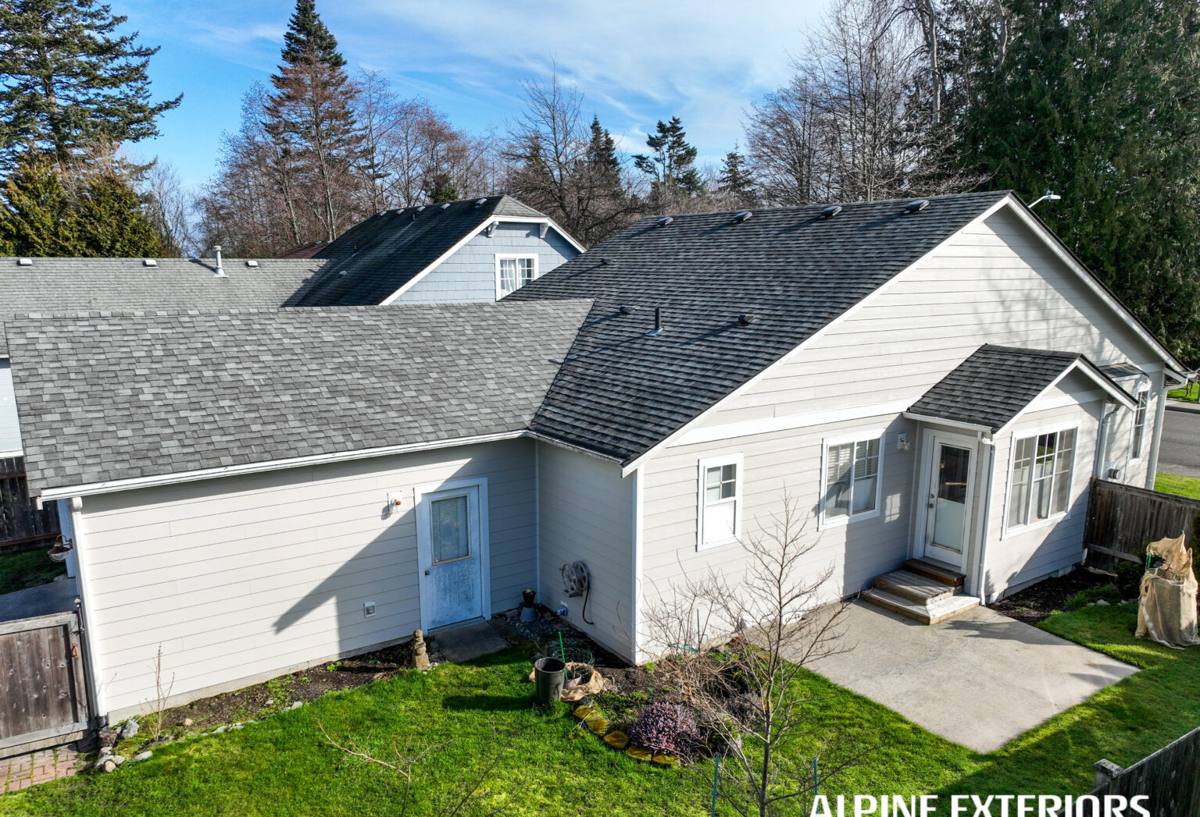
Why We Stopped Installing Vinyl
Vinyl siding has a real place in the market — it's inexpensive, it's fast to install, and for a lot of climates it holds up fine. Our issue with vinyl in Whatcom County specifically comes down to a few things:
- Wind and impact resistance: Vinyl panels are thin and can crack or blow off in the wind events we get off the Sound, especially on exposed sites near the water.
- Heat distortion: Dark vinyl colors can warp against south- or west-facing walls that get direct afternoon sun, even in our relatively mild climate.
- It hides moisture problems, it doesn't stop them: Vinyl is a rain-screen product by nature — water gets behind it. That's fine if the wall assembly behind it is detailed correctly, but it means the siding itself isn't doing much to protect the sheathing. In a wet climate, we'd rather the cladding itself be part of the moisture management, not just a shell in front of it.
- Fade and brittleness over time: UV exposure over 15-20 years leaves most vinyl looking chalky and brittle, and color-matching a repair panel gets harder every year after installation.
None of that means vinyl is a bad product for every situation. It means we stopped putting it on Bellingham homes.
Why We Stopped Installing LP SmartSide
LP SmartSide is an engineered wood product — strand board with a resin-saturated overlay, not a raw wood siding. It's a legitimate step up from old-style hardboard siding, and it installs faster than fiber cement because it's lighter and cuts easier. Our reservations are specific:
- It's still wood-based. The overlay and resin treatment resist moisture far better than untreated wood, but the core material is still an organic substrate. In a region with our rainfall totals and moss growth, any breach in the factory coating — a cut edge, a nail hole, a scratch during installation — creates a path for moisture into a wood-based core.
- Edge and cut-end sealing is not optional, and it's easy to shortcut. LP's warranty requires field-applied sealant on every cut end. That's a step that depends entirely on installer diligence, every piece, every time. We didn't like that our long-term liability was riding on that discipline being perfect on every job, forever.
- Long-term moss and moisture exposure. Whatcom County's combination of shade, humidity, and rainfall is close to a worst-case scenario for any wood-based product if maintenance lapses even briefly.
Why We Stopped Installing Cedar and Primed Spruce
Real wood siding, whether it's cedar or primed spruce boards, has genuine appeal — it's a traditional look, and cedar in particular has natural rot resistance that other woods don't. But wood siding asks a lot of a homeowner:
- Repainting or restaining on a cycle of roughly 5-8 years, sooner on sun- and rain-exposed elevations.
- Caulk joints and end grain that need regular inspection, especially after our wet winters.
- Vulnerability to woodpeckers and insects, which we see regularly on older cedar homes in this area.
- A higher long-term cost once you count repainting labor over a 20-30 year ownership period, even though the material itself may be cheaper than fiber cement upfront.
Wood siding can look great and last a long time — but only with maintenance most homeowners underestimate when they're choosing a product at the bidding stage.
Why We Stopped Installing Other Fiber Cement Brands
This one surprises people, because fiber cement is fiber cement, right? Not quite. We narrowed to James Hardie specifically because of a few practical differences we experienced in the field:
| Factor | What We Look For | Why It Matters Here |
|---|---|---|
| Factory finish | Baked-on, multi-coat ColorPlus finish vs. field-applied paint | Field-painted fiber cement needs repainting on a normal paint cycle; factory finish is warrantied separately and holds color longer against UV and salt air |
| Climate engineering | Product formulated for regional moisture/temperature conditions | Hardie's HZ5 line is engineered for the freeze-thaw and moisture cycling patterns of the Pacific Northwest |
| Supply and product consistency | Consistent plank dimensions, batch quality, and availability for repairs | Matching a replacement plank 10 years later is far easier with a widely distributed, consistent product line |
| Warranty structure | Transferable, clearly defined coverage | Matters at resale, and matters when a claim actually needs to be filed |
What James Hardie Gets Right
Fiber cement itself is a mix of cement, sand, and cellulose fiber, pressed and cured into planks or panels. It's non-combustible, which matters more each year as wildfire smoke seasons stretch further north into Washington, even if direct wildfire exposure isn't the primary risk in Bellingham the way it is east of the Cascades. It doesn't attract insects, it doesn't rot, and it holds paint (or in Hardie's case, its factory finish) far longer than wood.
The Product Lines We Use
- HardiePlank lap siding — the most common choice, available in several exposure widths and textures (smooth, cedarmill).
- HardiePanel vertical siding — often used for accent sections, gables, or modern designs.
- HardieShingle — a shingle-profile option for homes wanting a Craftsman or coastal look without real wood shingles.
- HardieTrim — matching trim boards so fascia, corners, and window trim age at the same rate as the field siding.
ColorPlus Technology
Rather than site-painting the siding after install, Hardie's ColorPlus finish is baked on in multiple coats at the factory under controlled conditions. It comes with its own finish warranty, separate from the substrate warranty, and it's part of why we can tell a homeowner they're not looking at a repaint in year 7 or 8 the way they might with field-applied paint on wood or other fiber cement.
What Correct Installation Actually Involves
Fiber cement's real-world performance depends heavily on installation quality — arguably more than any of the products we stopped using. A few specifics that matter on every job:
- Correct nailing pattern and fastener type — blind-nailed vs. face-nailed per Hardie's specification, not shortcuts.
- Proper clearance from grade, roofing, and decks — Hardie specifies minimum gaps to keep the bottom edge away from standing water and splash-back.
- Rain-screen or drainage plane behind the siding, appropriate for our rainfall.
- Correctly flashed and caulked joints at windows, doors, and butt joints — the most common source of moisture intrusion when siding is installed by crews unfamiliar with the product.
- Factory-cut edges left exposed as much as possible, with any field cuts properly sealed.
A lot of the "fiber cement had problems" stories in this region trace back to installation shortcuts, not the material itself. That's a big part of why we don't treat siding installation as interchangeable labor across products — our crews install one system, and they install it the same way every time.
The Trade-Offs, Honestly
Standardizing on one product has real downsides for us as a business, and we don't pretend otherwise:
- We can't compete on price with a vinyl bid — fiber cement material and labor cost more.
- Installation takes longer, since fiber cement is heavier and requires more precise cutting and fastening than vinyl or LP.
- We lose some homeowners who've already decided on cedar or vinyl before they call us.
We think that trade is worth it. A siding job is a 20-30 year decision for most homeowners, and we'd rather do fewer jobs on one product we trust completely than a wider range of jobs on products we have reservations about.
What This Means If You're Getting Bids
If you're comparing quotes for a Bellingham or Whatcom County home, it's worth asking every contractor two questions: what product are they proposing, and why. If the answer is "whatever you want" with no real opinion, that's worth noting — installation quality varies a lot by product, and a contractor who installs everything may not have deep expertise in any one system. We only install James Hardie, so our crews are proposing, cutting, and fastening the same product on every job, which is exactly the kind of repetition that leads to a clean installation.
If you're weighing a full re-side or planning ahead for one, we're glad to walk your house with you, look at your current siding's condition, and give you a straightforward estimate for James Hardie fiber cement — no pressure, and no pitch for a product we don't actually install.