 Bellingham
 What Whatcom County Weather Does to Siding in Lynden
Lynden sits in the same weather system that shapes the rest of Whatcom County: long stretches of damp, overcast days, driving rain that comes in sideways off storms moving through the Salish Sea region, and a moss and algae season that can run most of the year on shaded or north-facing walls. Add in the open farmland and flat terrain around Lynden, and homes here often catch more direct wind-driven rain on their siding than houses tucked into denser, more sheltered neighborhoods closer to the water.
That combination is hard on exterior materials that weren't built for it. Wood-based products absorb moisture at cut edges and fastener holes, then swell, crack, and eventually rot from the inside out. Vinyl can hold up structurally but tends to fade, warp in temperature swings, and rarely does much to disguise the moisture problems happening behind it. Over years, homeowners end up dealing with soft spots at the bottom courses, staining, and paint that won't hold — all symptoms of siding that was never really matched to this climate in the first place.
We've built our business around one answer to that problem: James Hardie fiber cement siding, installed correctly, every time.
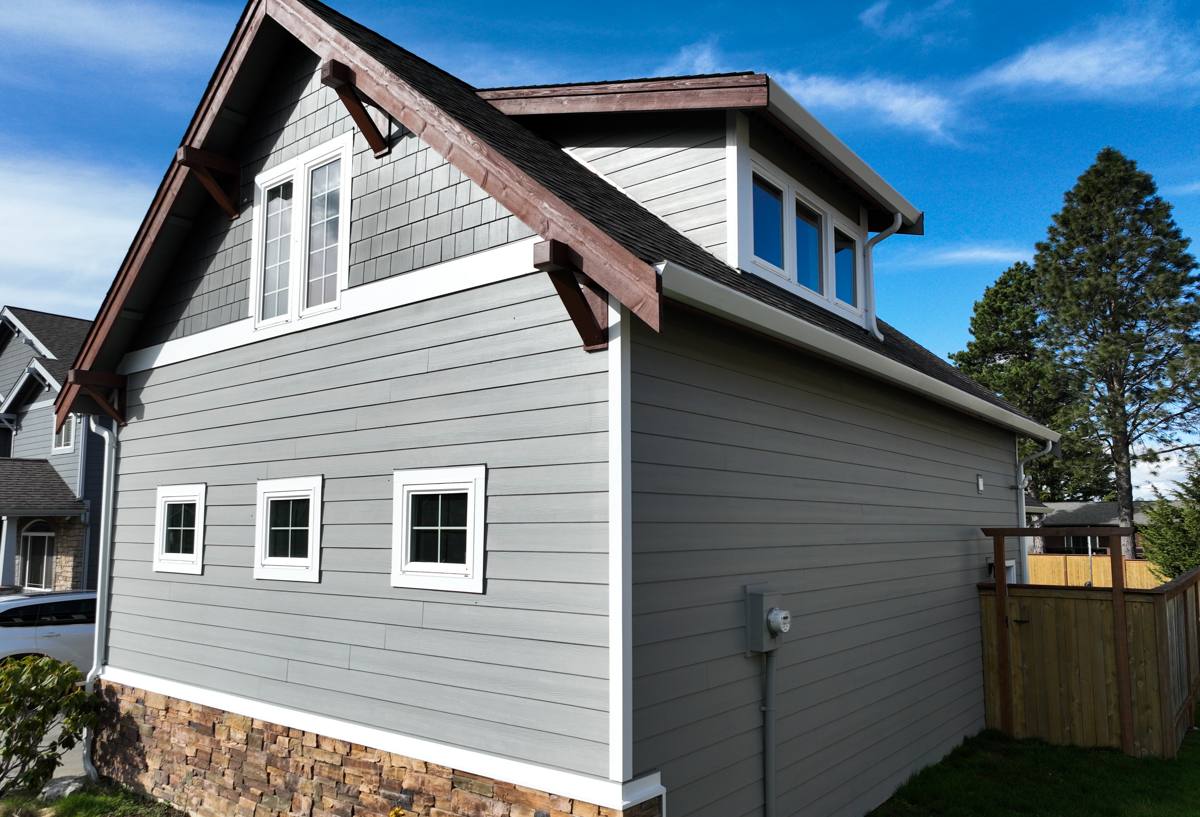
Why We Only Install James Hardie
We don't install LP SmartSide, vinyl, Cemplank, Allura, primed spruce, or cedar. That's a deliberate standard, not a sales pitch, and it's worth explaining honestly rather than just asserting it.
Each of those alternatives has legitimate strengths — cedar has real natural beauty, vinyl is inexpensive and low-maintenance in mild climates, engineered wood products install quickly and take paint well. But every one of them shares a vulnerability that matters in a place like Lynden: they're either wood-based (and therefore capable of absorbing and holding water) or they're a thin plastic skin that does nothing to address moisture at the wall assembly itself. In a climate with this much sustained dampness and moss growth, that vulnerability shows up faster than it would somewhere drier.
James Hardie fiber cement is made from cement, sand, and cellulose fibers. It doesn't absorb water the way wood does, it doesn't support rot, and it's non-combustible — a real advantage during wildfire smoke seasons that have become more common across Washington. Hardie's factory-applied ColorPlus finish is baked on under controlled conditions, which means better UV and color retention than field-applied paint, and their HZ5 product line is engineered specifically for climates like ours — freeze-thaw cycling, sustained moisture, and coastal-influenced weather.
It's also backed by a genuinely strong, transferable limited warranty, which matters if you sell the house before you'd otherwise need to think about siding again.
What Hardie Doesn't Fix By Itself
We'll be straight with you: the product is only half the equation. Fiber cement siding installed with the wrong gaps, missing flashing, or fasteners driven into the wrong plane will still let water into the wall behind it. Most of the siding failures we get called out to inspect in Whatcom County aren't material failures — they're installation failures. That's why our focus is as much on the install as it is on the product.
What Correct Hardie Installation Looks Like
- Proper weather-resistive barrier and rainscreen or drainage gap behind the siding, so any moisture that gets past the cladding has somewhere to go
- Correct flashing at every window, door, and roof-to-wall intersection — the majority of leaks start here, not in the field of the siding
- Manufacturer-specified fastener placement, spacing, and embedment depth, following Hardie's own installation guidelines rather than shortcuts
- Proper clearance between siding and grade, decks, patios, and roof lines to keep the bottom edge from sitting in standing moisture
- Caulked and sealed joints at butt seams and trim, using products rated for the exposure
- Field-cut edges primed or sealed before installation, since raw cut edges are the most vulnerable part of any fiber cement board
None of this is exotic. It's disciplined, unglamorous craftsmanship — the kind of work that doesn't show up in a walk-around inspection the week the job finishes, but shows up in whether the siding still looks and performs the same way ten and twenty years later.
Roofing, Windows, and Decks — Treating the Whole Exterior
Siding doesn't work in isolation. Water that gets past a roof, a poorly flashed window, or a deck ledger board attached directly to the wall will find its way behind even a well-installed siding job. We handle roofing, window replacement, and deck construction alongside siding because in a wet climate, the building envelope has to be thought of as one connected system rather than four separate trades that don't talk to each other.
This matters especially at transition points: where a deck meets the house, where a roof valley drains onto a wall below, where old single-pane windows have started leaking around the frame. Addressing siding without looking at those connection points is a common way for a good product to still end up with a wet wall behind it.
Comparing Common Siding Options
| Material | Moisture Behavior | Maintenance | Typical Lifespan |
|---|---|---|---|
| James Hardie fiber cement | Does not absorb or swell; resists rot | Occasional wash; factory finish reduces repainting | Multiple decades with correct install |
| Vinyl | Doesn't rot itself, but doesn't stop moisture reaching the wall behind it | Low, but can fade and warp with heat/cold cycling | Variable; often replaced for appearance before failure |
| LP SmartSide / engineered wood | Wood-based; vulnerable at cut edges and fasteners if seals fail | Requires diligent caulk and paint upkeep | Shorter than fiber cement if moisture gets in |
| Cedar | Natural wood; absorbs moisture, needs breathable finishes | High — regular refinishing and inspection | Can be long-lived with rigorous upkeep, shorter without it |
This isn't a claim that the alternatives are worthless products — plenty of them perform fine in the right climate and with diligent upkeep. It's why, given what Whatcom County weather does to exterior walls, we've chosen to stand behind one system rather than sell whatever's cheapest for a given budget.
Signs Your Current Siding May Need Attention
- Soft or spongy spots when you press on the siding near the bottom courses or below windows
- Persistent moss, algae, or dark staining that comes back shortly after cleaning
- Paint that's peeling, bubbling, or won't hold for more than a couple of years
- Visible gaps, warping, or boards that have pulled away from the wall
- Musty smell or damp patches on interior walls that back up to exterior siding
- Cracking at butt joints or around fastener heads
Any one of these on its own isn't necessarily an emergency, but they're worth having looked at before a small moisture problem becomes a framing problem.
What Affects the Cost of a Siding Project
We don't publish blanket per-square-foot pricing because it genuinely depends on the specifics of the house, but a few factors consistently drive the number up or down:
| Factor | Why It Matters |
|---|---|
| Existing wall condition | Rot or sheathing damage found during tear-off adds repair scope before new siding goes on |
| Home size and shape | More corners, dormers, and cutouts mean more labor and material waste |
| Number of stories | Taller walls require more scaffolding/staging and slow the work |
| Trim and siding profile choice | Board-and-batten, shingle-style accents, and custom trim add labor beyond lap siding |
| Window and door count | Each opening needs flashing and trim work, which adds time |
A proper estimate involves someone actually looking at your house, not a phone quote based on square footage alone.
Why a Local Crew Matters
A crew that works this county regularly knows which walls in Lynden take the worst of the wind-driven rain, which older homes were built with siding details that don't hold up to current expectations, and how the moss season here behaves differently than it does even a couple hours south. That local knowledge shapes real decisions — where to add extra flashing attention, which product line makes sense for a given exposure, how to sequence a project around Whatcom County's wet stretches. It also means someone who's still local and reachable if a question comes up five or ten years after the job is done, not a crew that worked the area for one season and moved on.
If you're weighing a siding project in Lynden — whether it's a full replacement, repair work after storm damage, or you're just trying to figure out what's going on with a wall that won't stop growing moss — we're happy to come take a look. The estimate is free, there's no pressure attached to it, and you'll get a straight answer about what your house actually needs.