 Bellingham
 Siding Built for Cordata's Weather, Not Just Its Curb Appeal
Cordata sits in the north end of Bellingham, close enough to the water and the low marine cloud deck that its homes take on a steady diet of moisture almost year-round. Between the salt-tinged air blowing in off Bellingham Bay, the driving rain that Whatcom County sees from fall through spring, and a moss season that can stretch for months on shaded north- and west-facing walls, exterior siding here is working harder than most homeowners realize. We install siding, roofing, windows, and decks across Bellingham, and Cordata is one of the neighborhoods where we see the clearest evidence of what happens when a siding product isn't matched to the climate it's asked to survive.
This page walks through what Cordata homes typically face, how we approach siding replacement in this specific area, and why we've standardized on one product system instead of offering the full menu of options most contractors carry.
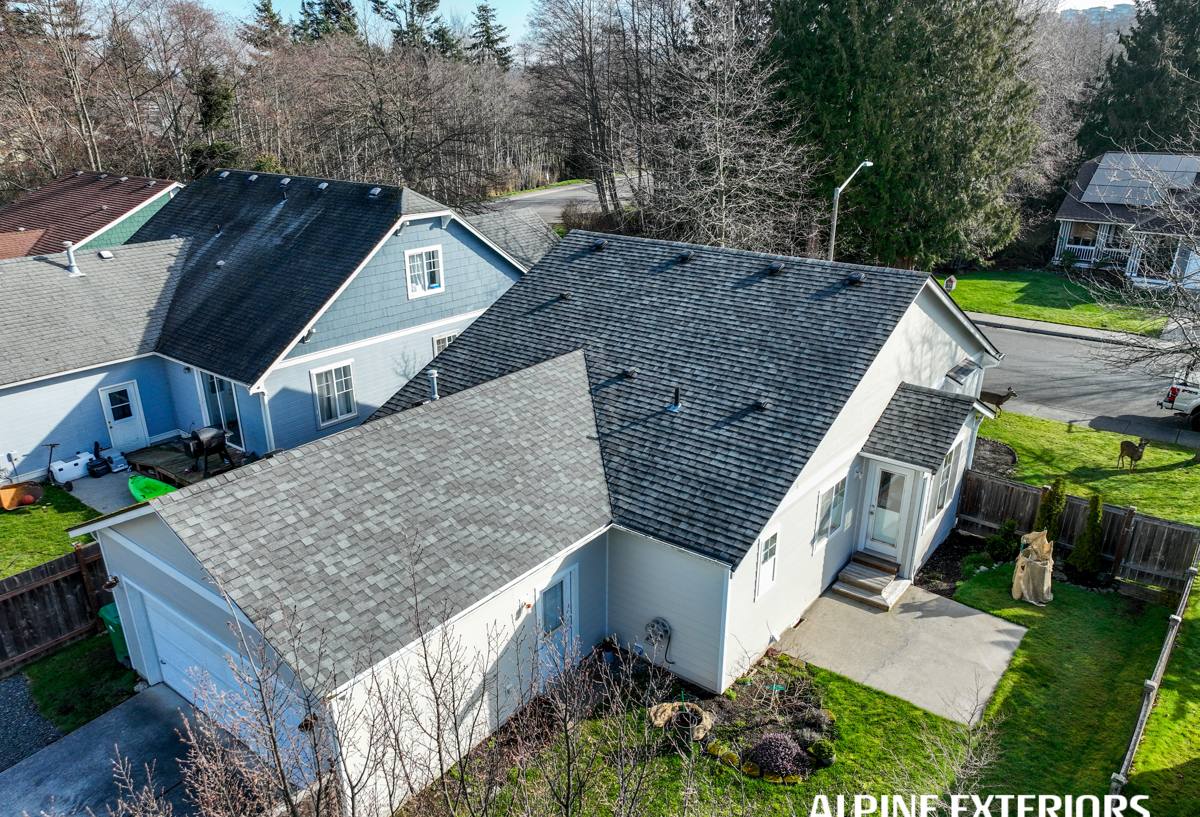
What Cordata's Climate Does to Exterior Siding
Salt Air and Moisture Cycling
Cordata isn't waterfront, but it's close enough to Bellingham Bay and the broader Salish Sea that airborne salt and humidity reach exterior walls, especially on homes with more open exposure. Salt-laden moisture accelerates corrosion on fasteners and trim hardware, and it keeps siding surfaces damp longer than they'd stay in a drier inland climate. Materials that swell, wick moisture, or rely on paint film alone for protection tend to show wear faster in this kind of environment.
Driving Rain
Whatcom County doesn't get the heaviest rainfall totals in Western Washington, but what falls often comes sideways, pushed by wind off the water. Driving rain finds every gap in flashing, every unsealed seam, and every joint that wasn't lapped correctly. It's less about total inches of rain and more about wind-driven exposure hitting vulnerable details — inside corners, window returns, and butt joints between siding boards.
Moss, Algae, and Shade
Cordata has a good tree canopy in parts of the neighborhood, and mature landscaping means plenty of homes have walls that rarely see direct sun. Combine that shade with consistent moisture and you get ideal conditions for moss and algae growth on siding, trim, and roofing. Organic growth isn't just cosmetic — it holds moisture against the wall assembly and can accelerate rot in wood-based products if it's left unaddressed.
How These Conditions Show Up on Different Siding Materials
Not every siding product responds to Cordata's climate the same way. Here's a general comparison of how common materials tend to hold up under sustained coastal moisture, salt exposure, and moss pressure:
| Material | Moisture Behavior | Moss/Algae Resistance | Long-Term Maintenance |
|---|---|---|---|
| Vinyl | Doesn't rot, but seams and panels can warp or gap with age, letting moisture behind the assembly | Grows on surface, harder to keep clean without pressure damage | Low upfront, but color fades and panels degrade in UV/salt air over decades |
| Primed wood/spruce | Absorbs moisture readily; end grain and joints are especially vulnerable | High susceptibility if coating fails | Frequent repainting and caulking required to stay ahead of rot |
| Engineered wood (LP SmartSide and similar) | Resin-treated to resist moisture, but edges and cut ends need diligent field sealing | Moderate; surface treatment helps but isn't permanent | Ongoing inspection of seams and fastener points |
| James Hardie fiber cement | Cement-based composition doesn't absorb and swell the way wood-based products do | Factory finish resists staining better than field-painted surfaces | Occasional washing; no repainting cycle with ColorPlus finish |
This isn't a claim that every non-Hardie product fails in Cordata — plenty of homes around Bellingham have vinyl or engineered wood siding that's holding up fine. It's a statement of what we've chosen to stand behind as installers, given what we see repeatedly in this climate.
Why We Only Install James Hardie Fiber Cement
We used to offer a broader range of siding products. We don't anymore, and it's worth explaining why in plain terms rather than just stating it as policy.
What Drove the Decision
- Moisture behavior: Fiber cement doesn't absorb water and swell the way wood-based and some engineered products can, which matters directly in a climate with this much sustained dampness.
- Non-combustible material: Hardie's cement composition gives homeowners a fire-resistance profile that wood-based sidings simply can't match, which is increasingly relevant as Washington insurers pay closer attention to exterior materials.
- Factory-applied finish: ColorPlus finish is baked on under controlled conditions, which holds color and resists the fading and peeling that field-applied paint deals with when it's fighting salt air and UV exposure.
- Climate-engineered product lines: Hardie makes HZ5 and HZ10 formulations specifically for the moisture and temperature patterns of the Pacific Northwest, rather than a one-size-fits-all product sold nationally.
- Warranty structure: Hardie's warranty terms and transferability give homeowners real protection, which matters when a house changes hands within the product's service life.
None of this means other products are unusable everywhere. It means that after years of installing and repairing siding in Bellingham and Whatcom County specifically, we decided we'd rather install one product well than several products with varying degrees of confidence. Standardizing also means our crews are deeply practiced on Hardie's installation specifications, not spread thin across five different manufacturers' requirements.
What Correct Installation Looks Like in a Neighborhood Like Cordata
Fiber cement performs the way it's supposed to only when it's installed to spec. In a coastal, high-moisture area like this, a few details matter more than they might in a drier climate:
- Proper weather-resistive barrier and flashing behind every siding course, not just at obvious penetration points
- Correct fastener spacing and type, since undersized or improperly placed fasteners are a common source of long-term callbacks
- Adequate clearance between siding and grade, decks, and roof lines to keep splash-back and standing moisture away from the bottom edge of the boards
- Sealed and primed cut ends on-site, since factory finish doesn't extend to field cuts
- Attention to inside corners and butt joints, the exact spots where wind-driven rain tends to find its way in
A product with excellent moisture resistance can still fail prematurely if these details are skipped. This is where a crew that installs Hardie exclusively, and knows this specific neighborhood's exposure patterns, has an advantage over a generalist installer working from a spec sheet for the first time.
Roofing, Windows, and Decks: The Rest of the Envelope
Siding doesn't work in isolation. On most Cordata homes, the roof, windows, and any exterior decking are dealing with the same salt air, driving rain, and moss pressure as the walls. A roof with failing moss control can shed organic debris and moisture straight down onto siding below. Windows with degraded flashing or seals push water into wall cavities regardless of how good the siding is. Decks attached to the house create transition points where flashing and drainage details need to match up with the siding installation, not fight against it.
Because we handle all four — siding, roofing, windows, and decks — we look at a Cordata home's exterior as one connected system rather than a set of unrelated projects. That matters most at the details where two of those systems meet.
Why a Local Crew Matters Here
Cordata's mix of tree cover, proximity to the water, and typical home orientation means two houses a few blocks apart can have genuinely different exposure profiles. A crew that works across Whatcom County regularly has a feel for which walls in this kind of neighborhood need extra attention to flashing and drainage, and which moss patterns are cosmetic versus which ones signal moisture already working its way into the wall assembly. That local pattern recognition doesn't replace a proper inspection, but it does mean fewer surprises once a project is underway.
What a Siding Project Typically Involves
Every home is different, but a general checklist for what to expect during a Hardie siding replacement:
- On-site inspection of existing siding, sheathing, and any signs of moisture intrusion
- Removal of old siding and assessment of the wall assembly underneath
- Repair of any damaged sheathing or framing found during tear-off
- Installation of weather-resistive barrier and flashing at all penetrations, corners, and transitions
- Installation of James Hardie siding per manufacturer specification, with attention to fastening, clearances, and joint treatment
- Final inspection and cleanup
Homeowners often ask how long this takes. Timelines vary with home size, existing wall condition, and weather windows, which is part of why an in-person estimate is more useful than a generic number.
Ready for a Straightforward Look at Your Home
If you're in Cordata and dealing with aging, damaged, or moss-covered siding, or you're just planning ahead before it becomes a problem, we're happy to come take a look. We'll give you an honest read on what your home's exterior actually needs — whether that's full siding replacement, roofing work, window attention, or all three — with a free, no-pressure estimate and no obligation to move forward.