 Bellingham
 The Columbia neighborhood sits close enough to Bellingham Bay that homeowners here deal with a specific mix of weather most inland parts of Whatcom County don't see as intensely: salt-tinged air off the water, wind-driven rain that hits siding at an angle instead of falling straight down, and a moss season that can stretch from October well into spring. Any exterior material installed on a Columbia home has to hold up to all three at once, year after year, without a lot of babysitting. That's the lens we use when we talk to homeowners in this area about siding, roofing, windows, and decks — what will actually perform here, not just what looks good in a showroom.
What Columbia's Climate Does to a Home's Exterior
Bellingham's marine climate is mild compared to a lot of the country, but "mild" doesn't mean easy on a building. The combination of near-constant moisture and proximity to salt water creates a few recurring problems we see on houses throughout Columbia and the surrounding waterfront-adjacent neighborhoods.
Salt Air and Coastal Moisture
Homes closer to the bay pick up airborne salt that settles on siding, trim, and metal fasteners. Over time this accelerates corrosion on anything not rated for coastal exposure and can degrade paint finishes faster than they'd wear inland. It's not dramatic — it's a slow, cumulative effect that shows up as chalky paint, rust streaking, or premature material failure five or ten years earlier than a homeowner might expect.
Driving Rain
Storms coming off the Salish Sea don't just drop rain — they push it sideways into wall assemblies. That means water finds every gap, seam, and poorly flashed joint on a building's exterior. Siding systems in this part of Whatcom County need to manage bulk water at the surface and still let any moisture that gets behind the cladding dry out. Products that absorb water readily, or that rely on paint film alone to stay watertight, are working against the climate instead of with it.
Moss and Sustained Dampness
Bellingham's long wet season and heavy tree cover in and around Columbia give moss and algae plenty of time to establish themselves on north-facing walls, roof edges, and anywhere shaded and slow to dry. Moss holds moisture against a surface, which is bad news for wood-based products and can shorten the life of a roof if it's left unaddressed. It's a maintenance issue on any material, but some hold up to repeated cleaning far better than others.
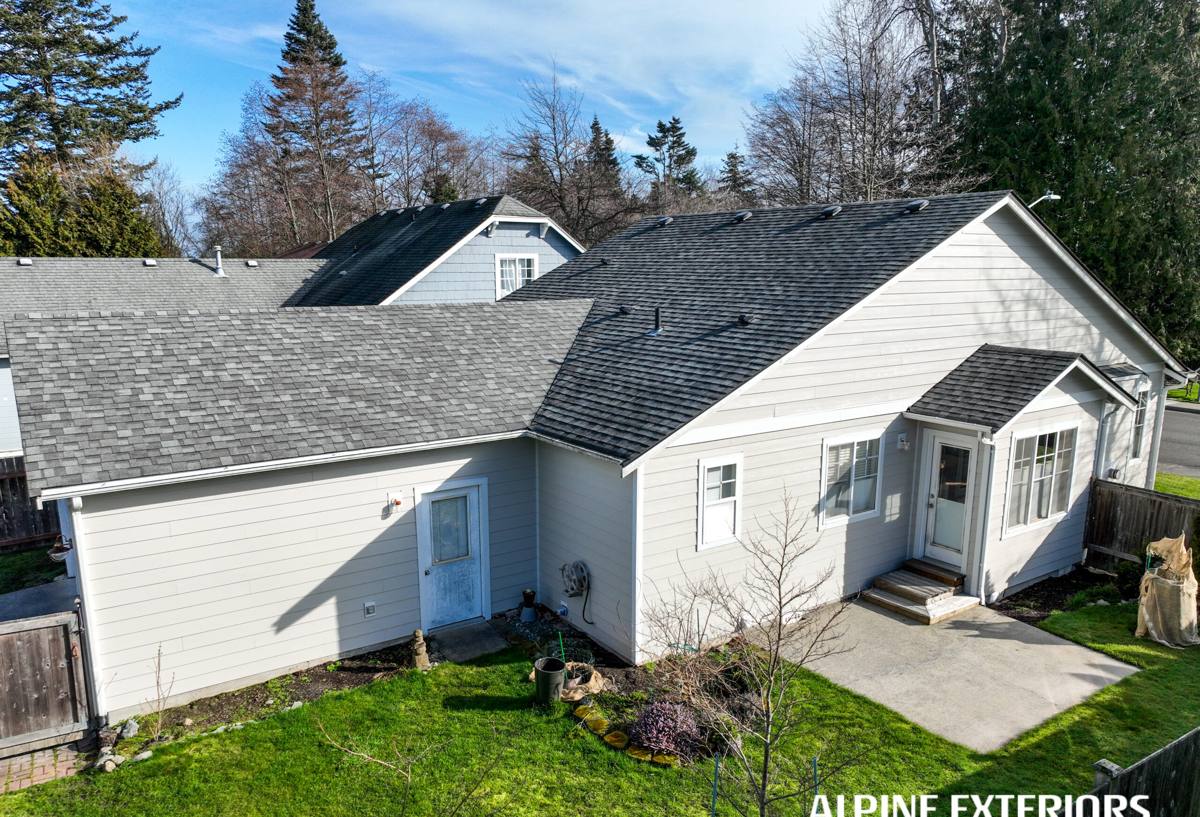
Why We Only Install James Hardie Fiber Cement Siding
We made a decision a while back to standardize on James Hardie fiber cement siding and stop installing everything else — no vinyl, no LP SmartSide, no Cemplank, no Allura, no primed spruce or cedar. That's a real limitation on what we offer, and we think homeowners deserve to know why before they hire us.
The Trade-Offs With Other Products
- Vinyl siding is inexpensive and low-maintenance, but it can warp or crack in wide temperature swings, fades over time with no way to repaint it back to original color, and doesn't offer the same fire resistance or resale perception as fiber cement.
- LP SmartSide and other engineered wood products perform reasonably well when installation and caulking are perfect and stay perfect — but they're wood-based, and wood-based siding is more vulnerable to the sustained dampness and moss exposure common in Columbia. Any breach in the factory coating opens the door to moisture absorption and eventual swelling or rot.
- Cemplank and Allura are also fiber cement products and share many of Hardie's core strengths. Our reasons for standardizing on one manufacturer come down to product line depth for this specific climate, the consistency of the factory finish, and warranty structure — not a claim that competing fiber cement is unsafe or defective.
- Primed spruce or cedar gives you a natural wood look, but it demands the most ongoing maintenance of any option — regular repainting, caulk inspection, and vigilance against moisture, rot, and pest damage. In a climate with as much sustained wet weather as Bellingham's, that maintenance burden is real and recurring.
Why Hardie Fits This Climate
James Hardie fiber cement is non-combustible, dimensionally stable across temperature and humidity swings, and doesn't absorb water the way wood-based products can. The ColorPlus factory finish is baked on under controlled conditions rather than field-applied, which means better fade resistance and a cleaner look over a longer stretch of years without repainting. Hardie also engineers specific product lines (HZ10 and HZ5) around regional climate zones, and the Pacific Northwest — including Whatcom County — falls squarely in the range those lines are built for. Add a strong transferable warranty on top of that, and it's the product we're comfortable standing behind on Columbia homes.
Comparing Siding Options for a Columbia Home
| Factor | James Hardie Fiber Cement | Vinyl | Engineered Wood / Cedar |
|---|---|---|---|
| Moisture resistance | Strong — doesn't absorb water like wood | Good — but seams can leak | Moderate — dependent on coating integrity |
| Fire resistance | Non-combustible | Combustible | Combustible |
| Coastal/salt air durability | Strong | Moderate — hardware can corrode | Weaker — more upkeep needed |
| Maintenance | Low — occasional wash, no repainting for years | Low — but can't be refinished if faded | High — regular painting/caulking |
| Typical lifespan | Multiple decades with proper install | 20-30 years, variable | Shorter without diligent upkeep |
How We Approach Siding Work in Columbia
Every home we look at in this neighborhood gets assessed for its specific exposure — how close it sits to the bay, how much shade and tree cover it has, which walls take the brunt of storm-driven rain, and what condition the existing siding, trim, and flashing are in. Proper installation matters as much as the product itself: correct fastening, flashing at every window and door opening, and adequate clearance at grade and roofline are what actually keep water out of a wall assembly. Hardie siding installed poorly can still fail; installed to spec, it's built to handle exactly what this climate throws at it.
What a Siding Project Typically Involves
- An on-site inspection of current siding, trim, and any moisture or moss damage
- A written estimate outlining scope, product line, and color options
- Removal of old siding and inspection of the sheathing and weather barrier underneath
- Repair of any water-damaged framing or sheathing found during tear-off
- Installation of new house wrap or weather-resistant barrier where needed
- Hardie siding installation with correct flashing, fastening, and clearances
- Final cleanup and a walkthrough of the finished work
Beyond Siding: Roofing, Windows, and Decks
Siding doesn't work in isolation — it's one part of a home's exterior envelope. A roof that's shedding moss and holding moisture undermines even well-installed siding by keeping the wall assembly damp longer than it should be. Windows with failed seals let water track down into wall cavities behind the cladding. Decks exposed to the same driving rain and shaded, slow-to-dry conditions need materials and fastening details suited to this climate just as much as siding does. We handle all four — siding, roofing, windows, and decks — because addressing them together, rather than one at a time in isolation, is usually what actually solves a moisture problem instead of just moving it around the house.
Why a Local Crew Matters Here
A crew that works throughout Bellingham and Whatcom County day in and day out knows which walls in a neighborhood like Columbia take the worst of the weather, how local permitting and inspection works, and what installation details actually hold up against this specific combination of salt air, driving rain, and moss. That's different from a crew that installs siding in a dry inland climate and treats every job the same way. Local experience shows up in the small decisions — flashing details, fastener choice, where to add extra weather protection — that determine whether a siding job lasts fifteen years or fifty.
Signs Your Columbia Home May Need Exterior Work
- Visible moss or algae buildup on siding, especially on shaded or north-facing walls
- Cracking, warping, or bubbling siding panels
- Peeling or chalky paint that wasn't repainted recently
- Soft spots or discoloration around window and door trim
- Rust staining near fasteners or metal trim pieces
- Rising energy bills that may point to a compromised exterior envelope
If you're noticing any of these on a home in Columbia or elsewhere in Bellingham, it's worth getting a professional look before small issues turn into structural repairs. We offer free, no-pressure estimates — we'll walk your home's exterior with you, point out what we see, and give you a straightforward assessment of what siding, roofing, window, or deck work actually makes sense for your situation.