 Bellingham
 Why Happy Valley Roofs Wear Differently Than Roofs Inland
Happy Valley sits close enough to Bellingham Bay and the surrounding waterways that homes here deal with a specific combination of stressors most inland Whatcom County neighborhoods don't face in the same intensity: salt-laden air moving off the water, long stretches of driving rain pushed in by Pacific storm systems, and a moss and lichen season that can run nearly nine months out of the year in shaded, north-facing sections of a roof. None of these factors is dramatic on its own. Together, over a decade or two, they determine whether an asphalt shingle roof ages gracefully or fails early.
Salt air accelerates the corrosion of exposed metal fasteners, flashing seams, and drip edges. Driving rain finds its way into laps and transitions that would stay dry in a calmer climate, which is why fastener placement and underlayment choices matter more here than they would in a drier region. And moss doesn't just look bad — its root structures lift shingle tabs, hold moisture against the roof deck, and shorten the life of even a well-installed roof if it's left unmanaged for years at a time.
A roofing job done right for Happy Valley accounts for all three of these realities from the first day of planning, not as an afterthought once problems show up.
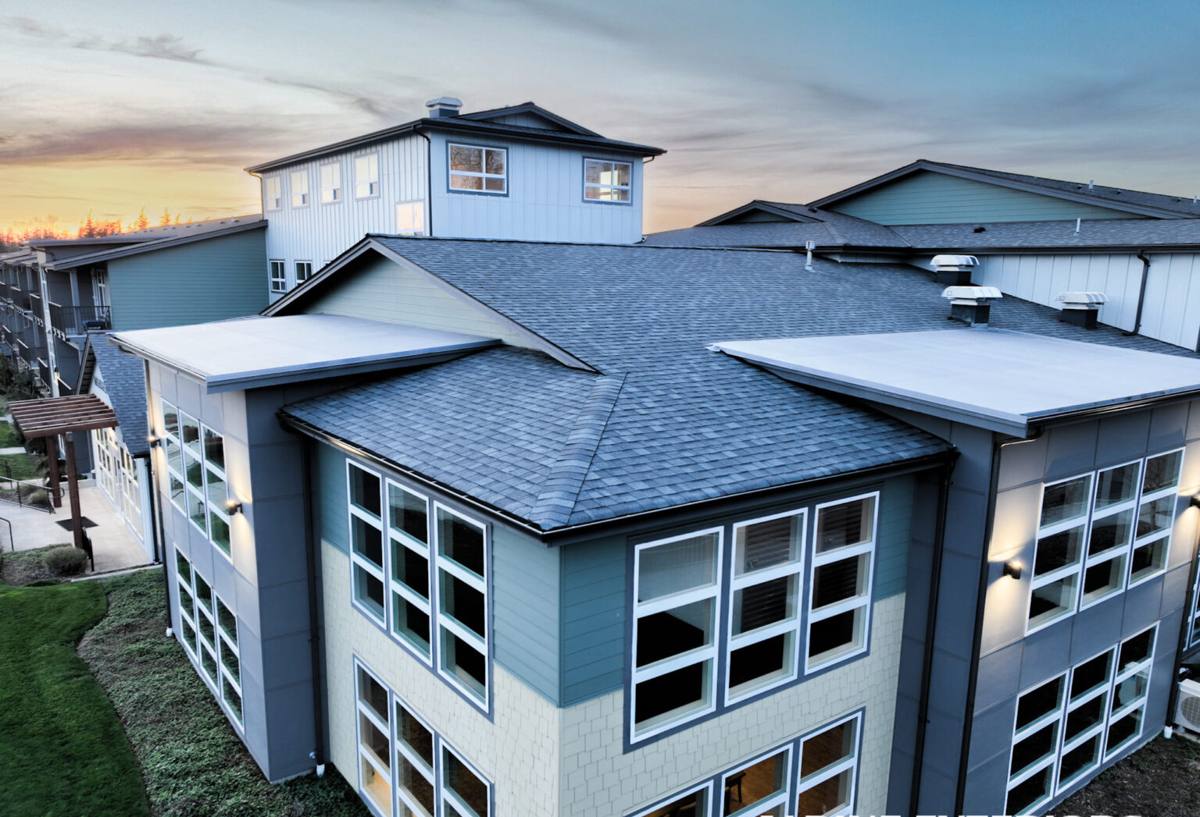
What a Correct Asphalt Shingle Installation Actually Involves
Asphalt shingles are a mature, well-understood roofing product, but the quality of an installation depends almost entirely on the details most homeowners never see once the roof is finished. In a marine climate like Bellingham's, those details carry more weight than they would somewhere drier.
Deck Inspection and Repair
Before a single shingle goes down, the roof deck needs to be checked for soft spots, delamination, or rot — especially around valleys, chimneys, and any area where moss has been sitting for years. Installing new shingles over a compromised deck just hides a problem that will resurface, often as an interior leak.
Underlayment
In a region with sustained driving rain, a synthetic underlayment with strong water-shedding performance, combined with self-adhered ice-and-water membrane in vulnerable zones (valleys, eaves, penetrations), is the difference between a roof that sheds wind-driven rain and one that lets it wick backward under the shingles.
Flashing
Flashing around chimneys, skylights, vent pipes, and roof-to-wall transitions is where most leaks actually originate — not through the shingle field itself. Corrosion-resistant flashing materials and correct step-flashing technique matter more near the bay, where salt air shortens the service life of lower-grade metals.
Fastening and Nail Placement
Manufacturer nailing patterns exist for a reason — improper nail placement or over-driven nails are a leading cause of premature shingle failure and voided warranties. In high-wind exposure near open water, correct fastening is what keeps tabs from lifting during winter storms.
Ventilation
A balanced intake-and-exhaust ventilation system keeps the underside of the roof deck dry and temperature-stable, which reduces condensation, extends shingle life, and slows moss regrowth by keeping the deck less hospitable to moisture.
Choosing a Shingle That Holds Up Near the Water
Not every asphalt shingle product is built with the same priorities. For a home in Happy Valley, the features worth weighing are algae resistance, wind rating, and how the shingle handles repeated wet-dry cycling rather than pure aesthetics.
| Shingle Class | Typical Wind Rating | Algae/Moss Resistance | Best Fit For |
|---|---|---|---|
| 3-Tab (Economy) | 60–70 mph | Standard, unless algae-resistant granules specified | Budget-conscious projects, secondary structures |
| Architectural / Laminate | 110–130 mph | Often available with algae-resistant (AR) granules | Most primary homes in wind- and rain-exposed areas |
| Premium/Designer Laminate | 130 mph+ | Typically includes copper- or zinc-infused AR granules | Homes with heavy tree cover or north-facing, shaded roof planes prone to moss |
For most Happy Valley homes, an architectural shingle with algae-resistant granules is the practical middle ground — it holds up to wind gusts off the water better than a basic 3-tab, and the AR granules slow the algae and moss growth that shaded, damp roof sections are prone to. Homes with heavy tree cover or persistent shade benefit from the added moss resistance of a premium line, since regrowth on those roof planes tends to be the fastest.
Ventilation and Moisture Management: The Part That Gets Skipped
Ventilation is the single most under-discussed part of a roofing job, and it's one of the biggest factors in how long a roof lasts in a wet climate. Without balanced intake at the eaves and exhaust at the ridge, warm, moist air gets trapped in the attic, condenses against the underside of the roof deck, and creates the exact damp conditions that moss, mold, and premature shingle aging all depend on.
A roof can be installed with excellent shingles and still underperform if the ventilation underneath it wasn't corrected at the same time. Whenever we replace a roof, we check soffit intake, baffle placement, and ridge or box vent exhaust as part of the same project — not as a separate upsell.
Signs of a Ventilation Problem
- Frost or condensation visible on the underside of the roof deck in the attic during cold months
- Musty odor in the attic space
- Ice damming along the eaves in freezing weather
- Shingles that appear to be aging faster on one roof plane than others
- Visible mold or dark staining on attic sheathing
How Our Process Works
Every roof replacement follows the same sequence, adjusted for the specifics of the home:
- Inspection and assessment. We walk the roof, check the deck condition, look at ventilation, and evaluate flashing points before recommending anything.
- Written estimate. A clear scope of work covering materials, tear-off, deck repair allowances, and ventilation corrections — no vague line items.
- Tear-off and deck prep. Old roofing is removed down to the deck so it can be inspected and repaired properly, rather than roofing over hidden damage.
- Underlayment and flashing installation. Ice-and-water membrane in vulnerable areas, synthetic underlayment across the field, new flashing at every penetration and transition.
- Shingle installation. Installed to manufacturer specification for nailing pattern and exposure, with attention to wind-exposed edges and rakes.
- Ventilation correction. Intake and exhaust balanced to the attic volume and roof design.
- Cleanup and final walkthrough. Magnetic sweep for stray fasteners, debris removal, and a final review of the finished roof with the homeowner.
Maintenance That Actually Extends Roof Life
A well-installed asphalt shingle roof in this climate is not maintenance-free, but the maintenance it needs is manageable if it's done on a regular schedule rather than after problems appear.
- Clear gutters at least twice a year — clogged gutters back water up under the shingle edge, which is a common source of eave-level leaks
- Remove moss buildup on shaded roof planes before it spreads, using methods appropriate for shingle roofs rather than pressure washing, which can strip granules
- Trim back overhanging branches to reduce shade, debris buildup, and abrasion from limbs moving in wind
- Check flashing around chimneys, skylights, and vent pipes annually for signs of lifting or corrosion
- Address minor issues — a lifted tab, a small flashing gap — promptly rather than waiting for a full winter storm season
Repair or Replace? Reading the Signs
Not every roofing problem in Happy Valley means a full replacement. The honest answer depends on the age of the roof, how widespread the issue is, and what's happening underneath the shingles.
| Situation | Usually a Repair | Usually a Replacement |
|---|---|---|
| Isolated leak at a single flashing point | Yes | No |
| Moss coverage on one shaded section | Yes, with cleaning | No |
| Widespread granule loss across multiple roof planes | No | Yes |
| Roof deck soft spots or rot found during inspection | Sometimes, if localized | Yes, if widespread |
| Roof nearing or past its expected service life with recurring issues | No | Yes |
The most reliable way to know which category a roof falls into is a physical inspection, not a guess from the ground. A short conversation with someone who's looked at the actual condition of the deck and flashing is worth more than any general rule of thumb.
Why Local Experience in Happy Valley Matters
Roofing crews who work regularly in this part of Whatcom County get familiar with how homes here actually behave over a wet season — which roof orientations moss up first, which flashing details tend to fail near the water, and how much ventilation a given attic style really needs. That familiarity shows up in fewer callbacks and roofs that hold up the way they were supposed to.
It also matters for something more practical: scheduling around weather windows. Bellingham's rain patterns mean a roofing project sometimes needs a few dry days in a row to go smoothly, and a crew that works this area regularly knows how to plan around that instead of rushing a tear-off into a forecast that doesn't cooperate.
Get a Straightforward Look at Your Roof
If your Happy Valley home has a roof that's showing its age, dealing with recurring moss, or just due for an honest assessment, we're happy to take a look. The estimate is free, there's no pressure attached to it, and you'll get a clear explanation of what we see and what your real options are — use the form below to get started.