 Bellingham
 Building Decks That Actually Hold Up in Barkley
Barkley is one of Bellingham's more distinct neighborhoods — a planned community with a mix of newer construction and homes now old enough to need their first or second deck replacement. Whatever stage your home is at, a deck built here has to deal with the same conditions every outdoor structure in Whatcom County deals with: salt-laden air off the Sound, long stretches of driving rain, and a moss season that can run from fall through spring. A deck that looks great going in but wasn't built with those three things in mind will show it within a few years — soft spots, black streaking, loose railings, and boards that never quite dry out.
Custom decks done right for this area aren't fundamentally different in style from decks anywhere else. What's different is the attention paid to fasteners, flashing, drainage, and surface choice — the parts you don't see in a photo but absolutely see in a five-year-old deck that's still solid versus one that isn't.
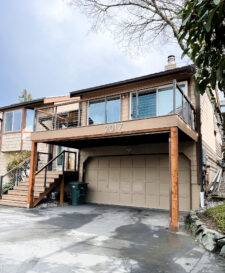
What the Local Climate Actually Does to a Deck
Bellingham's marine climate is mild, which is part of why people love living here — but mild and dry are two different things. A few specific stressors matter for decks:
- Salt air corrosion: Even at a distance from the water, airborne salt accelerates rust on standard fasteners, hidden clips, and hardware over time.
- Driving rain: Wind-driven rain off the Sound doesn't just fall straight down — it gets pushed sideways into ledger connections, railing posts, and any gap in flashing.
- Moss and algae season: Shaded, north-facing, or tree-covered decks (common on wooded Barkley lots) can stay damp for weeks at a stretch, which is exactly what moss and mildew need to take hold on wood and even on some composite surfaces.
- Freeze-thaw cycling: Not extreme here, but frequent enough that trapped moisture in a joist or post base will eventually split or rot material that never gets the chance to dry out.
None of this means a deck can't last decades in Barkley. It means the construction details have to account for water that isn't going away quickly, not water that's an occasional inconvenience.
What Correct Construction Involves
Framing and Fasteners
We use stainless steel or high-grade coated fasteners rated for coastal, treated-lumber contact — not the standard hardware that's fine in drier inland climates but corrodes faster here. The same goes for joist hangers, post bases, and structural screws. It costs more up front and it's the single biggest difference between a deck that's tight in year one and loose in year five.
Ledger Board and Flashing
The ledger board — where the deck attaches to the house — is the single most common failure point on decks in wet climates. Proper flashing (metal flashing plus a water-resistant barrier behind it, not caulk alone) keeps driving rain from working its way behind the ledger and into the house framing. This is also one of the most common things we find done wrong or skipped entirely on older decks we're asked to rebuild.
Footings and Post Bases
Footings need to go below frost depth and posts need to sit on bases that keep end grain off concrete and out of standing water — wood sitting directly on or in concrete is one of the fastest ways to rot a post from the bottom up.
Board Spacing and Drainage
Proper gapping between deck boards lets water pass through instead of pooling, and it matters even more under tree cover or on shaded sides of a house where things dry slowly. We also grade and consider drainage under the deck itself, not just on top of it, so water doesn't just sit in the crawlspace below.
Choosing the Right Decking Material
There's no single "best" material — it depends on your budget, how much upkeep you want to do, and how much sun or shade the deck gets. Here's how the common options actually compare for this climate:
| Material | Moisture & Moss Resistance | Maintenance | Typical Lifespan |
|---|---|---|---|
| Pressure-treated wood | Good if sealed regularly; prone to moss in shaded spots without upkeep | Annual cleaning, periodic re-staining/sealing | 15–20 years |
| Cedar | Naturally rot-resistant but still needs sealing against constant wet | Regular sealing to keep color and resist graying/moss | 15–20 years |
| Capped composite (e.g. Trex, TimberTech) | Very good — capped surface resists moisture absorption and staining | Occasional washing, no sealing or staining | 25–30 years |
| PVC decking | Excellent — fully synthetic, doesn't absorb moisture | Lowest — soap and water as needed | 25–30+ years |
Wood costs less upfront but asks more of you every year. Composite and PVC cost more initially but hold up better against moss and constant damp with far less maintenance — which is a real consideration on a shaded Barkley lot where a deck might not see direct sun for days at a time.
Dealing With Moss and Algae Long-Term
Moss doesn't mean a deck was built wrong — it means it's exposed to what this climate delivers. What matters is whether the deck was designed to shed water and dry out reasonably fast, and whether the surface material resists staining once moss or algae does get a foothold. A few practical points:
- Textured or grooved composite surfaces can hold more moisture in the grooves than a smooth board — worth discussing if your deck sits in heavy shade.
- Wood decks in shaded areas benefit from a yearly wash and inspection before moss gets established, not after.
- Keeping nearby vegetation trimmed back so a deck gets some airflow and afternoon light makes a bigger difference than most homeowners expect.
- Under-deck drainage systems can be added to keep the ground below from staying saturated, which reduces moss pressure on the structure itself.
Railings, Guardrails, and Code
Any deck more than a couple feet off grade needs a code-compliant guardrail — generally 36 inches high for residential decks, with baluster spacing that won't allow a 4-inch sphere to pass through, per the residential code Whatcom County and the City of Bellingham enforce. Custom railings are one of the most visible design choices on a deck, and there are real options here beyond standard wood balusters: metal cable rail, glass panels, or composite railing systems that won't need refinishing. Whatever the style, the hardware connecting posts to the frame needs the same corrosion resistance as the rest of the structure — a beautiful railing on undersized or rusting connectors is a liability, not a feature.
Permits and Inspections
Most new decks and many deck replacements in this area require a building permit, and inspections typically happen at the footing stage and again at final. Depending on exactly where a property sits, permitting runs through either the City of Bellingham or Whatcom County, and requirements can differ slightly between the two. If your home is in a planned community, there may also be design guidelines from a homeowners' association covering materials, colors, or railing style — worth checking before finalizing a design so there are no surprises after the build starts. We handle the permit process as part of the job rather than leaving it to the homeowner to sort out.
How Our Process Works
A custom deck project runs in stages, and we walk homeowners through each one before moving to the next:
- On-site assessment: We look at grade, drainage, sun/shade exposure, and how the deck will tie into the house.
- Design and material selection: We go over wood versus composite versus PVC honestly, based on your maintenance tolerance and budget, not a one-size push toward the priciest option.
- Permitting: We prepare and submit what's needed for your jurisdiction and schedule required inspections.
- Construction: Framing, flashing, fastening, and decking installed to the standards this climate actually requires — not just code minimums.
- Final walkthrough: We go over the finished deck together, including basic care so it lasts as long as it should.
Before you sign off on any deck contractor, it's worth confirming a few basics:
- Current Washington contractor license and liability insurance
- Written scope of work covering framing, fasteners, flashing, and material specifics — not just "build a deck"
- A clear answer on who's pulling the permit and scheduling inspections
- Familiarity with local drainage and moss issues, not just general deck-building experience
- A written warranty on both labor and materials
Why Local Experience Matters for This Job
A deck crew that's worked in Barkley and around Bellingham already knows what a shaded, tree-lined lot does to a deck over a wet winter, what inspectors here are actually checking for, and which material choices hold up versus which ones look fine in the showroom and struggle after a few Whatcom County winters. That experience shows up in details — flashing choices, fastener grade, drainage planning — that don't show up in a sales pitch but absolutely show up in how the deck performs five and ten years down the road.
If you're planning a new deck or replacing one that's past its prime, we're happy to take a look and talk through honest options for your property. Fill out the form below for a free, no-pressure estimate.