 Bellingham
 Birch Bay Roofs Deal With a Different Kind of Wear
Birch Bay sits right on the water, and that changes what a roof has to survive. Homes a few miles inland in Bellingham catch plenty of rain, but Birch Bay roofs also take salt-laden air off the water, steady wind exposure with few windbreaks on the bay-facing side, and long stretches of shade and dampness once fall sets in. None of that is dramatic on its own. It's the combination, repeated year after year, that wears out flashing, fasteners, and shingles faster than a textbook lifespan would suggest.
Salt air is the one people underestimate most. It doesn't just sit on the surface — it works into any exposed metal on the roof, including nail heads, flashing seams, and vent stacks, and speeds up corrosion in ways that plain rain doesn't. Add wind-driven rain that can push water sideways under lifted shingle edges, and a roof that would otherwise hold up fine for another decade can start failing at its weak points years early.
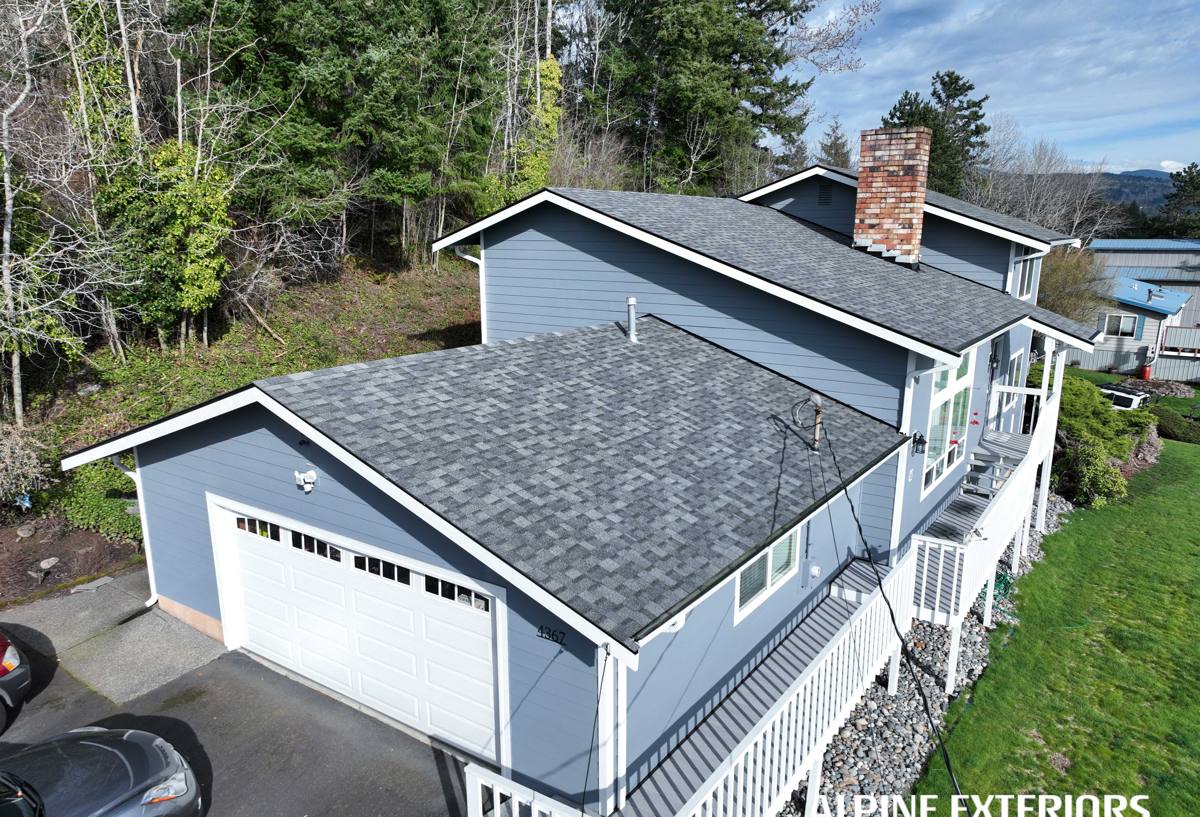
Signs a Birch Bay Roof Needs Repair Now, Not Later
Roof problems in this climate rarely start as leaks. By the time water is showing up inside the house, the damage underneath has usually been building for a while. Catching it earlier is what keeps a job a repair instead of a replacement.
- Granules collecting in gutters or at downspout outlets, which means shingles are losing their protective surface
- Curling, cupping, or lifted shingle edges, especially on the side of the roof that faces the wind
- Dark streaking or thick moss mats, particularly on north-facing or shaded slopes
- Rust staining running down from flashing, vent boots, or metal valleys
- Soft spots or sagging when walked on, which often means the decking underneath has taken on moisture
- Daylight visible through the roof deck when viewed from inside the attic
- Ceiling stains, musty attic smell, or peeling paint on an exterior wall below the roofline
- Missing or torn shingles after a windstorm, even if nothing looks wrong from the ground
Any one of these on its own might be minor. Two or three together usually mean it's worth having someone look before the next round of driving rain finds the gap.
Moss Isn't Just Cosmetic — It's a Moisture Problem
Why moss season matters here
Whatcom County's wet season runs long, and shaded roof sections near trees or on the north side of a house can stay damp for weeks at a stretch. That's exactly what moss and algae need to take hold. Once established, moss doesn't just sit on top of shingles — its root structure holds moisture against the surface and lifts shingle edges as it grows, which is how a moss problem turns into a leak problem over a couple of seasons.
Removal done right versus removal done fast
Pressure washing moss off a roof is one of the fastest ways to shorten its life. High-pressure water forces granules off the shingle surface and can drive water up under the laps. A correct moss removal is done by hand or with low-pressure methods, followed by treatment to slow regrowth, and — where it makes sense — zinc or copper strips installed near the ridge, which release trace metal with rainfall that discourages new moss from establishing. It's a slower process, but it's the difference between removing moss and removing years off the roof along with it.
What a Correct Roof Repair Actually Involves
Flashing comes first
Most roof leaks in this area trace back to flashing, not the field of the roof itself — valleys, chimney flashing, vent boots, and the transitions where a roof meets a wall or dormer. In salt air, these metal points corrode faster than the shingles around them, so a repair that only patches shingles and ignores tired flashing is a repair that leaks again within a season or two.
Matching materials, not improvising
A patch that doesn't match the existing shingle's profile, color batch, or granule type stands out and can also create a slightly different water path than the surrounding material. We match shingle type and, where possible, batch as closely as the market allows, and we replace underlayment in the repair area rather than reusing whatever's underneath — underlayment that's been wet and dried repeatedly loses its ability to seal around fasteners.
Checking ventilation while we're up there
A roof that's failing in one spot sometimes has a ventilation problem driving it — trapped attic moisture accelerates decking rot and shortens shingle life from underneath. Since we're already on the roof for the repair, we check soffit and ridge ventilation and flag it if it's contributing to the problem, rather than treating the visible symptom and leaving the cause in place.
Repair or Replace? How to Think About It
Not every roof problem in Birch Bay needs a full replacement, and we're not going to tell you it does. The honest answer depends on the roof's age, how localized the damage is, and what's happening underneath the surface.
| Factor | Repair usually makes sense | Replacement usually makes sense |
|---|---|---|
| Roof age | Under 15–18 years, or a newer roof with isolated damage | Past the expected lifespan for the material, with wear showing broadly |
| Extent of damage | Limited to one section, one slope, or specific flashing points | Granule loss, curling, or moss present across most of the roof |
| Decking condition | Solid, dry decking under the affected area | Soft, delaminated, or water-damaged decking in multiple spots |
| Leak history | First occurrence, clear single cause | Recurring leaks in different spots, or a history of past patch jobs |
| Cost over time | Repair cost is a small fraction of full replacement | Repeated repairs are starting to add up toward replacement cost |
When we inspect a roof, we'll tell you honestly which column it falls into — including if that means a smaller job than you expected, or a bigger conversation than you were hoping for.
Material Choices We Stand Behind in a Salt-Air Environment
Not every roofing product performs the same way this close to the water, and we'd rather explain the trade-offs up front than let a homeowner find out the hard way. For fasteners and flashing, we favor corrosion-resistant metals — stainless steel or heavier-gauge galvanized with a proper coating — over standard hardware, because bare or lightly coated metal corrodes noticeably faster in salt air. It costs a little more up front and saves a repeat repair down the line.
For underlayment, we lean toward synthetic products over older felt options in this climate specifically because synthetic underlayment holds up better through repeated wet-dry cycling and doesn't absorb moisture the way felt can over a long, damp season. This isn't a knock on any particular brand — it's a maintenance and moisture-behavior call based on what actually holds up on roofs we service near the water year after year.
Our Repair Process, Start to Finish
- Inspection. We get on the roof (or use a camera where access is tight) and check the full roof, not just the spot you called about — flashing, valleys, vents, and decking condition, since one problem often points to another.
- Written scope and honest recommendation. You get a clear explanation of what's actually wrong, what needs to happen, and what it's likely to cost — including whether repair or replacement is the better call.
- The repair itself. Matched materials, corrosion-resistant fasteners and flashing, and new underlayment in the affected area — not a surface patch over a deeper problem.
- Cleanup and debris check. Old materials, nails, and moss debris are cleared from the roof and the ground around the house.
- Walkthrough. We show you what was done and what to keep an eye on, especially if moss or drainage issues near the repair area are ongoing.
Why a Crew That Already Works Birch Bay Matters
Roof repair isn't one-size-fits-all, and a crew that mostly works drier, inland neighborhoods can miss things that are obvious to someone who's on Birch Bay roofs regularly. Knowing which slopes take the worst of the wind, how fast moss comes back on a shaded north side this close to the water, and which flashing details tend to fail first in salt air isn't guesswork — it's pattern recognition built from doing this work in this specific place. We're a Bellingham-based crew, and Birch Bay's coastal conditions are part of what we plan for on every repair out that way, not an afterthought.
We also know that access and timing matter here — getting a repair done between storm systems, or getting a tarp on quickly after wind damage, isn't something that works well from a company that has to drive in from out of the area on their own schedule.
If you've noticed moss building up, a stain on the ceiling, or shingles that don't look right after the last windstorm, it's worth having a second set of eyes on it before the next round of rain finds the gap. Fill out the form below for a free, no-pressure estimate — we'll take a look, tell you honestly what's going on, and give you a straight answer on what it'll take to fix it.