 Bellingham
 Why Roofs in Birchwood Wear Faster Than the Brochure Says
Every roofing material comes with a manufacturer's expected lifespan, and almost none of those numbers were calculated with Whatcom County weather in mind. Birchwood sits close enough to Bellingham Bay to catch salt-laden air off the water, and it gets the same steady, driving rain that soaks the rest of western Washington for much of the year. Add tree cover typical of this part of Bellingham and you get long stretches of shade and dampness that never fully dry out, which is exactly what moss and moisture-loving algae need to take hold. None of that means a roof here is doomed — it means the materials, the underlayment, the flashing, and the ventilation all have to be chosen and installed with that combination in mind, not treated as an afterthought.
A roof that was installed correctly for a drier climate, or installed quickly to hit a budget number, tends to show its age in Birchwood years before it should. That's the gap we're solving for: not just "a new roof," but a new roof built for this specific neighborhood's weather.
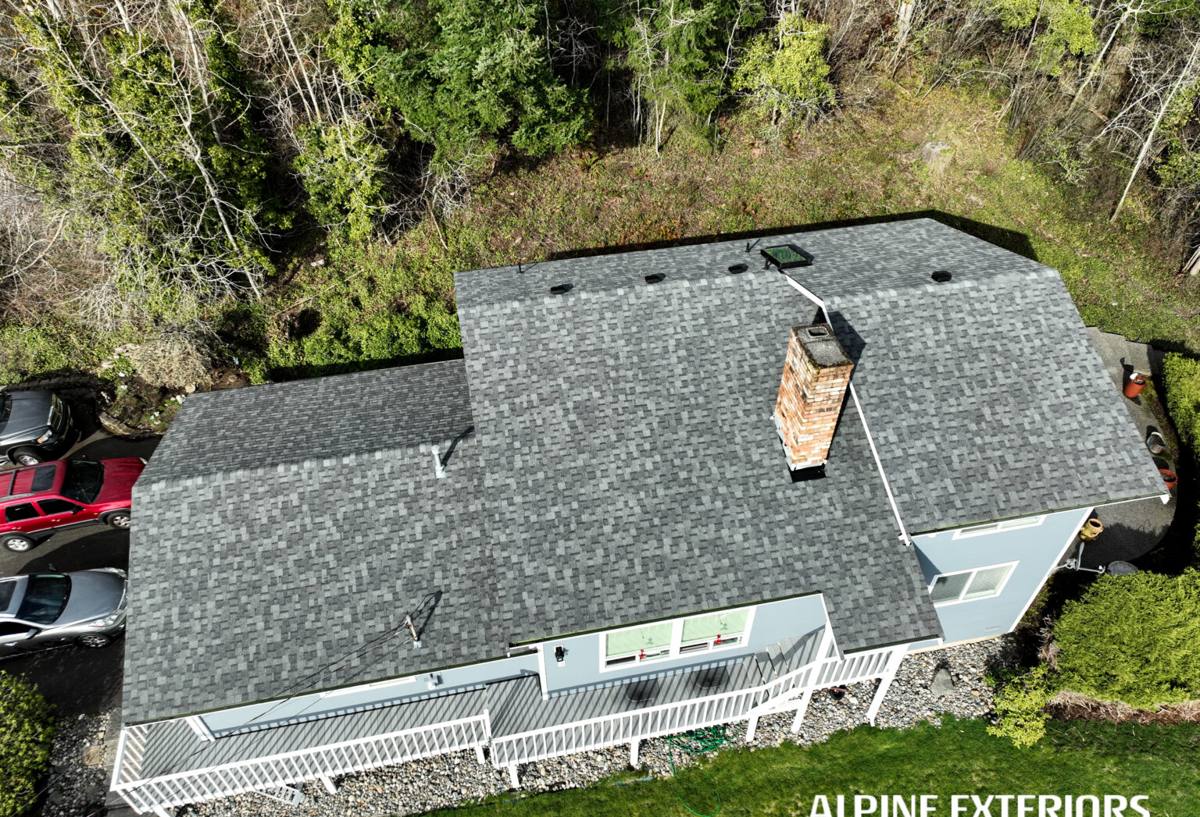
Signs Your Birchwood Roof Needs Replacement, Not Another Repair
Homeowners often ask us to look at a leak and end up learning the leak is a symptom, not the problem. A few signs point toward replacement rather than another patch:
- Granule loss heavy enough that gutters are collecting what looks like coarse sand after every hard rain
- Shingles that are curling, cupping, or cracking across multiple sections of the roof, not just one isolated spot
- Moss or algae staining that keeps returning within a season or two of cleaning, even after treatment
- Soft or spongy decking felt underfoot, or daylight visible through the attic roof boards
- Repeated leaks around the same valley, chimney, or vent boot despite prior repairs
- A roof that's already had one or more layers of shingles installed over the original and is now approaching or past 20 years old
If you're only seeing one of these on a roof that's otherwise mid-life, a repair is usually still the honest answer, and we'll tell you that. Replacement makes sense when the underlying materials — decking, underlayment, flashing — have aged out together, because patching one component while the others are failing just delays the same conversation.
Choosing a Roofing Material Built for Whatcom County Weather
There's no single "best" roofing material for Birchwood — there's a best fit for your home's exposure, your roof's pitch and shade pattern, and your budget. Here's how the common options actually perform under salt air, sustained rain, and moss pressure:
| Material | Moisture & Rain Performance | Moss Resistance | Typical Lifespan Here |
|---|---|---|---|
| Standard 3-tab asphalt shingle | Adequate when installed with proper underlayment | Low without treated granules; moss-prone in shaded areas | 15-20 years |
| Architectural (laminate) asphalt shingle | Strong; thicker profile sheds water well | Better with algae-resistant (AR) granules | 25-30 years |
| Standing seam metal | Excellent; sheds water and salt spray with minimal absorption | High — smooth surface gives moss little to grip | 40-50+ years |
| Cedar shake | Attractive but absorbs moisture; needs consistent airflow underneath | Low — natural wood is a moss magnet without diligent upkeep | 20-25 years with maintenance |
Architectural shingles with algae-resistant granules are the most common recommendation we make for Birchwood homes — they balance upfront cost against real moss and rain resistance. Metal is the stronger long-term performer for homes with heavy shade or a lot of salt exposure, at a higher installed cost. We don't push cedar shake as our standard recommendation here; it can look great, but the maintenance burden in a climate this wet is significant, and we'd rather you know that up front than find out after a couple of damp winters.
What a Correct New Roof Installation Actually Includes
"New roof" covers a lot of ground, and the parts you can't see from the ground are usually what determine whether the roof lasts 15 years or 30. Here's what we treat as non-negotiable on every installation.
Tear-Off and Deck Inspection
We remove the existing roofing down to the deck rather than layering over it. That's the only way to actually see the plywood or plank decking underneath — soft spots, rot, or old water staining don't show up until the old material is off. Any damaged decking gets replaced before anything new goes down; installing new shingles over a compromised deck just guarantees a shorter lifespan and a harder repair later.
Underlayment and Ice-and-Water Protection
Given how much rain Whatcom County sees, we don't treat underlayment as a formality. A synthetic underlayment goes down across the full roof, with self-adhering ice-and-water shield membrane at the eaves, valleys, and around penetrations — the spots where wind-driven rain and ice damming are most likely to force water backward under the shingles.
Flashing Details
Chimneys, skylights, sidewalls, and vent penetrations fail more often at the flashing than at the shingle field. We install new flashing rather than reusing old, bent, or rusted pieces, and we pay particular attention to step flashing at roof-to-wall transitions, which is one of the most common leak points on homes in this area.
Ventilation
A roof needs balanced intake and exhaust airflow to keep the attic dry and temperature-stable. Poor ventilation traps moisture, which accelerates decking rot from underneath and can actually encourage moss growth from the roof's own trapped humidity. We check existing ventilation as part of every install and correct it — adding intake vents, baffles, or exhaust venting — when it's undersized for the home.
Our Birchwood Installation Process
- On-site inspection and estimate. We walk the roof (or use a lift/drone when pitch or access requires it), check the attic for ventilation and moisture issues, and give you a written estimate with material options.
- Material selection. We walk through the trade-offs from the table above based on your home's shade, exposure, and budget — no pressure toward the most expensive option.
- Scheduling and material delivery. We build the schedule around Whatcom County's rain patterns as much as possible and stage materials on-site ahead of the crew.
- Tear-off and deck repair. Old roofing comes off, decking is inspected, and any needed repairs are made before new materials go on.
- Underlayment, flashing, and ventilation installation. The protective layer goes down first, followed by new flashing and any ventilation corrections.
- Roofing material installation. Shingles, panels, or shakes go on to manufacturer specifications, which is also what keeps the material warranty valid.
- Cleanup and final walkthrough. Job site and yard are cleared of debris and nails using magnetic sweeps, and we walk the finished roof with you before calling the job complete.
What a New Roof Costs to Install — And What Moves the Number
We won't quote a number without seeing the roof, because too many variables affect it. What we can tell you honestly is what drives cost up or down:
| Factor | Effect on Cost |
|---|---|
| Roof size and number of facets/valleys | More cuts and seams mean more labor and material waste |
| Roof pitch | Steeper roofs require more safety equipment and slow the work down |
| Tear-off layers | Removing multiple old layers costs more than a single-layer tear-off |
| Decking condition | Rotted or soft decking sections add material and labor to replace |
| Material choice | Standard asphalt is the lowest upfront cost; metal and cedar cost more installed |
| Access and site conditions | Limited driveway access, tall trees, or tight lot lines can add setup time |
Getting a quote in writing that breaks these out — rather than one lump number — is worth insisting on from any contractor, so you know what you're actually paying for.
Why Local Experience in Birchwood Matters
A crew that's worked roofs throughout Bellingham and Whatcom County has already seen how homes in this specific area age — which roof orientations hold moss longest, which older homes tend to have undersized attic ventilation, and how salt air and rain interact with different material choices over a real Pacific Northwest winter. That's not something you can fully substitute with a generic install checklist. It also means faster, more accurate estimates, because we're not guessing at local permitting requirements or typical construction in the area — we already know them.
Familiarity with a neighborhood also shows up in the small decisions during the job: knowing to double-check flashing on a shaded north-facing valley, or recommending algae-resistant shingles by default rather than as an upsell, because we've seen what happens without them here.
Keeping a New Roof Performing for Its Full Lifespan
A correctly installed roof still needs some basic upkeep to hit its full expected lifespan in this climate. A simple annual routine covers most of it:
- Clean gutters and downspouts at least twice a year, more often if there's heavy tree cover
- Have moss or algae growth treated before it spreads, rather than waiting until it's visibly heavy
- Trim back overhanging branches to reduce shade, debris buildup, and physical damage risk
- Check attic ventilation isn't blocked by insulation or storage that's been added after the roof was installed
- Schedule a visual inspection after major windstorms to catch lifted shingles or flashing early
None of this is expensive or time-consuming, but skipping it is how a well-installed roof still ends up losing years off its lifespan in a climate like this one.
If your Birchwood roof is showing its age, or you just want an honest read on whether it's a repair or a replacement, we're happy to take a look. Fill out the form below for a free, no-pressure estimate.