 Bellingham
 Why Columbia Homes Need a Siding Plan Built for This Climate
Columbia sits close enough to Bellingham Bay and the surrounding waterways that its homes deal with a specific combination of stresses most siding products were never engineered around: salt-laden air drifting in off the water, long stretches of driving rain pushed sideways by wind, and a moss season that can run most of the year in shaded, north-facing spots. Any one of these on its own is manageable. Together, over enough winters, they find every weak point in a siding system — every unsealed seam, every fastener that wasn't set right, every board that was hung too close to the ground or too tight against a soffit.
This page is about one job in one area: installing James Hardie fiber cement siding correctly on Columbia homes. Not a general rundown of siding options, not a sales pitch for a product line — a straight explanation of what this climate does to a home's exterior, what a correct fiber cement installation actually involves, and why hiring a crew that already knows this neighborhood's housing stock and conditions matters more here than it would somewhere drier and calmer.
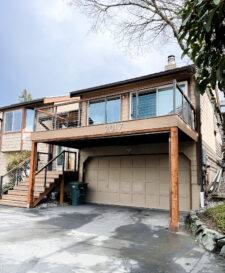
What Salt Air, Driving Rain, and Moss Actually Do to Siding
Salt Air
Homes within a few miles of Bellingham Bay are exposed to airborne salt that settles on exterior surfaces and accelerates corrosion of anything metal — fasteners, flashing, trim connectors. On wood and engineered wood products, salt exposure combined with moisture speeds up swelling, checking, and finish breakdown. It's a slow process, which is exactly why it's easy to underestimate until a wall section is compromised.
Driving Rain
Whatcom County doesn't just get a lot of rain — a meaningful share of it arrives horizontally, driven by wind off the water. Wind-driven rain finds its way behind siding at laps, seams, and penetrations that would stay dry in a straight-down rainstorm. Any siding system that depends on face-sealing (caulk and paint alone, rather than a properly lapped, drained assembly) is at a structural disadvantage in this kind of weather.
Moss and Sustained Moisture
Shaded lots, mature tree cover, and long damp stretches between dry spells give moss and algae plenty of time to establish on siding, trim, and anywhere water sits rather than sheds. Moss holds moisture directly against a surface for extended periods — which is a much bigger problem for materials that absorb water or swell than for materials that don't.
Why Fiber Cement Is the Right Material for This
James Hardie fiber cement is manufactured from cement, sand, and cellulose fiber — not wood, and not a wood-derived composite. That distinction matters directly for Columbia's conditions:
- It does not absorb water the way wood-based sidings do, so extended moss contact and driving rain don't lead to the same swelling, delamination, or rot risk.
- It's dimensionally stable across wet and dry cycles, which keeps seams, caulk lines, and paint film intact longer instead of working loose as the board moves.
- It's non-combustible, which matters regardless of coastline exposure but is a genuine added benefit on top of the moisture performance.
- The factory-applied ColorPlus finish is baked on under controlled conditions and holds up to UV and salt air significantly better than field-applied paint, which is the layer that fails first on repainted wood or composite siding in this environment.
We install Hardie's HZ5 product line, which is engineered specifically for climates like this one — regions with sustained moisture exposure and freeze-thaw cycling. It is not the same specification Hardie sells in dry, hot climates, and using the correct HZ rating for this region is one of the details that separates a job done right from a job done cheap.
What a Correct Installation Actually Involves
Fiber cement siding is only as good as the assembly behind it. A huge share of the siding failures we get called out to inspect in this area aren't material failures — they're installation shortcuts. On a Columbia home, given the rain exposure, these details aren't optional extras:
Water Management Behind the Siding
A weather-resistant barrier goes on the wall first, with all seams properly lapped and taped, and flashing integrated at every window, door, and horizontal transition — not caulked over as an afterthought. This is what actually keeps wind-driven rain out of the wall assembly; the siding itself is the second line of defense, not the only one.
Proper Fastening
Fasteners need to be the corrosion-resistant type Hardie specifies for coastal-influenced climates, driven at the correct depth and location on the board — not too high, not overdriven, not into the field of the panel where it isn't supported. Overdriven or misplaced fasteners are one of the most common causes of premature cracking.
Clearances and Gaps
Siding needs a minimum gap from grade, roof lines, decks, and adjoining trim to avoid capillary draw and standing moisture — the exact scenario that invites moss and prolonged dampness. These clearances get skipped more often than homeowners realize, especially on additions or partial re-sides where matching an existing (incorrect) line seems easier.
Caulking and Sealant
Sealant is used at penetrations and specific transitions, not as a substitute for proper flashing and lapping. Over-reliance on caulk is a red flag — it's the first thing to fail under sustained wet-dry cycling, and by then the water has often already gotten behind the assembly.
How Fiber Cement Compares for a Home Like This
| Material | Moisture / Moss Resistance | Salt Air Durability | Long-Term Maintenance |
|---|---|---|---|
| James Hardie Fiber Cement | High — does not absorb water or swell | Strong; factory finish resists salt exposure | Periodic washing; repainting typically not needed for many years |
| Vinyl Siding | Sheds water but seams and gaps are vulnerable; can warp | Can become brittle and fade faster near saltwater | Low upkeep but replacement (not repair) is often the only fix |
| Cedar / Primed Spruce | Absorbs moisture; prone to rot and moss growth | Salt accelerates checking and finish breakdown | Regular repainting/staining and moisture monitoring required |
| LP SmartSide | Engineered wood strand product; requires diligent sealing of cut edges and seams | Moderate; performance depends heavily on install and upkeep | Ongoing caulk and edge maintenance to prevent moisture entry |
This is why we standardized on James Hardie and don't install vinyl, LP SmartSide, Cemplank, Allura, or bare wood siding. Each of those products has legitimate uses elsewhere, but for a climate that combines salt air, sustained rain exposure, and moss pressure the way Whatcom County does, fiber cement done to spec is the material that holds up with the least long-term risk.
Our Process for a Columbia Siding Project
- On-site assessment — we look at sun/shade exposure, moss buildup on the current siding, drainage around the foundation, and any existing moisture damage before quoting anything.
- Tear-off and sheathing inspection — once the old siding is off, we check the sheathing underneath for rot or water damage that needs to be addressed before new siding goes on. Covering up a compromised wall is how small problems become expensive ones.
- Weather barrier and flashing — barrier installed and lapped correctly, flashing integrated at all penetrations and transitions.
- Hardie installation — HZ5 boards and panels installed to Hardie's fastening and clearance specifications, with attention to grade, deck, and roofline gaps.
- Trim, caulking, and touch-up — factory-finished trim installed, sealant applied only where specified, ColorPlus touch-up applied to any field cuts or fastener heads.
- Final walkthrough — we review the finished work with the homeowner and go over basic care before we consider the job done.
Keeping Fiber Cement Siding Performing in This Climate
Correctly installed Hardie siding is low-maintenance, not no-maintenance. In a moss-prone, high-rain area, a little routine attention goes a long way:
- Rinse siding periodically, especially on shaded and north-facing walls where moss and algae take hold fastest.
- Keep gutters clear so overflow isn't running down the wall face during heavy rain.
- Trim back vegetation and tree cover that keeps siding shaded and damp longer than it needs to be.
- Check caulk lines at trim and penetrations every year or two and have any cracked sealant replaced before it becomes a water entry point.
- Watch for staining or discoloration near grade, decks, or roof transitions — early signs of a clearance or drainage issue.
Why It Matters That We Already Work in This Area
Bellingham and the surrounding Whatcom County neighborhoods aren't uniform — a home a mile inland with strong tree cover has different moss pressure than one with a more open, wind-exposed elevation closer to the water. A crew that already works in Columbia and nearby areas has a working sense of how local lots drain, where moss tends to establish first, and what the area's housing stock — much of it built across a range of decades with different sheathing and flashing standards — is likely to need once the old siding comes off. That's not something a crew unfamiliar with the region picks up on the first job; it's built from doing this work here, repeatedly, and seeing what actually happens to a wall assembly after a few Whatcom County winters.
It also means fewer surprises during the project itself — permitting expectations, typical lot conditions, and the kind of underlying damage we're likely to find on a re-side in this specific area are things we've already seen rather than things we're learning on your home.
What Affects the Cost of a Fiber Cement Siding Project
| Factor | Why It Matters |
|---|---|
| Condition of existing sheathing | Rot or water damage found during tear-off adds repair scope before new siding can go on |
| Home size and wall complexity | More corners, penetrations, and trim details mean more labor and material |
| Siding profile and accessories | Lap siding, panels, and trim styles vary in material and installation cost |
| Access and site conditions | Slope, tree cover, and tight lot lines affect setup and crew time |
| Full re-side vs. partial replacement | Matching existing siding on a partial job can be more complex than a full tear-off |
We don't quote broad numbers on this page because every home is different — but we'll give you a clear, itemized estimate after seeing the property in person.
If you're planning a siding project in Columbia and want it done with materials and methods built for this specific climate, we're happy to take a look and walk you through what your home actually needs. Fill out the form below for a free, no-pressure estimate.