 Bellingham
 Why Happy Valley Decks Wear Out the Way They Do
Happy Valley sits close enough to Bellingham Bay and the Salish Sea that salt-laden air is a constant, low-grade factor in how exterior wood and metal age here. Add Whatcom County's long wet season, and a deck in this neighborhood is doing a different kind of work than a deck in a drier inland climate. It isn't one big storm that takes a deck down — it's months of standing moisture, freeze-thaw cycles in the coldest stretches, and shade from mature trees that keeps boards from ever fully drying out between rains.
That combination is why decks in this part of Bellingham often show their age well before the homeowner expects it: soft spots near ledger boards, black streaking on north-facing joists, and moss creeping across boards that rarely see direct sun. None of that means the deck was built badly. It usually means the deck was built for a normal amount of Pacific Northwest weather, and years of it have simply caught up with the wood.
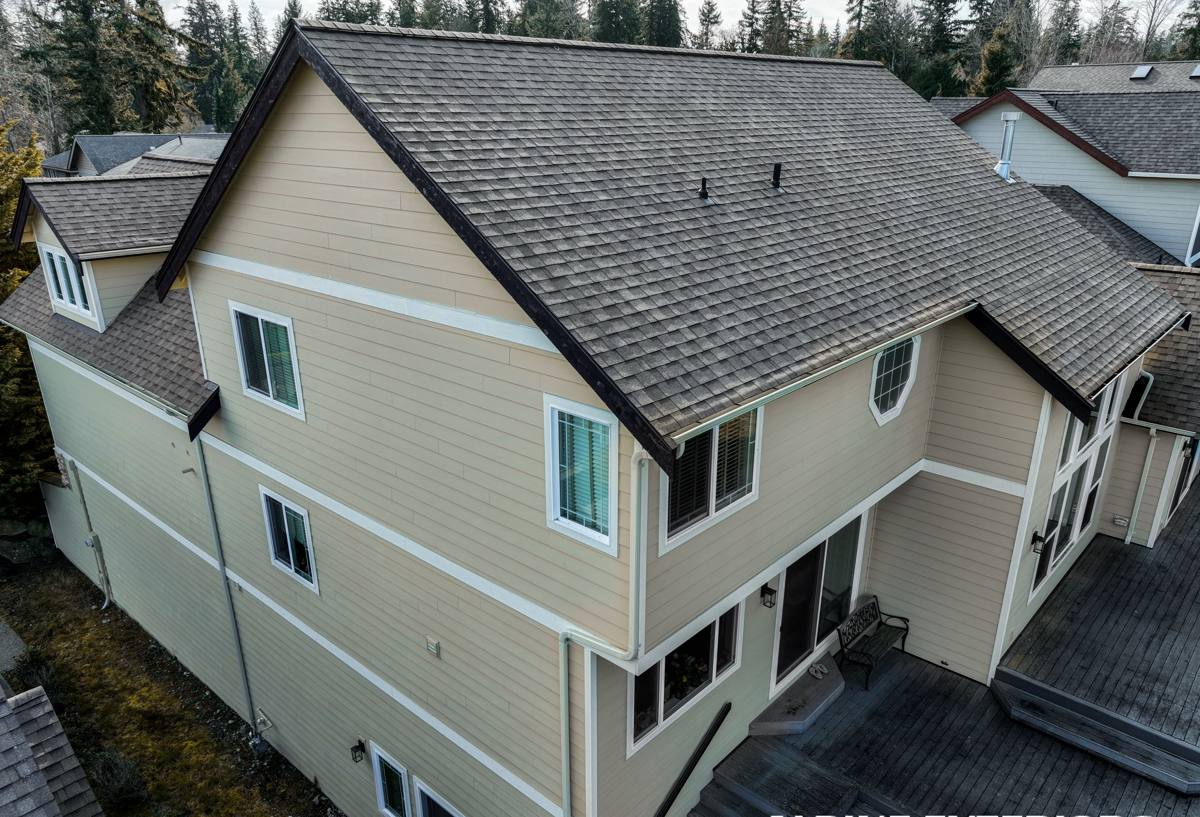
Repair or Replace? Reading the Signs
Not every tired-looking deck needs a full rebuild. But there's a point where patching boards is just deferring a bigger, more expensive problem. A few signs tend to separate a cosmetic fix from a structural one:
- Soft, spongy, or springy decking when you walk across it, especially near the house
- Rust streaks or crumbling wood around joist hangers and structural fasteners
- Gaps or separation where the deck meets the house (the ledger board connection)
- Persistent moss or dark staining that comes back within weeks of cleaning
- Wobble in the railing posts or stairs, which often points to a rotted post base
- Visible daylight or water pooling under the deck instead of draining away
A couple of loose boards or weathered surface wood is usually a repair. Soft framing, a failing ledger connection, or rot at the posts is a replacement conversation — patching those issues just relocates the failure point a season or two down the road.
What a Correct Deck Replacement Actually Involves
It starts underneath, not on top
The visible decking boards get all the attention, but the parts that determine how long a deck lasts in this climate are the parts you don't see once it's finished: the ledger board flashing where the deck attaches to the house, the footings, and the framing grade and spacing. A deck that looks identical to the old one on the surface but gets proper flashing, corrosion-resistant fasteners, and framing sized for wet-climate loads will simply outlast one that skips those details to save time.
Ledger flashing is where most failures start
In a climate with this much sustained rain, the single most common point of hidden rot is the ledger board — the piece that bolts the deck to the house. If that connection isn't flashed correctly, water works its way behind it year after year, and the rot often isn't visible until the wood is already compromised. Doing this correctly the first time is non-negotiable on any deck we replace.
Footings and drainage
Post footings need to be sized and set below frost depth, and the ground under and around the deck needs somewhere for water to go. On lots with heavier shade or clay-heavy soil, poor drainage under the deck is often what accelerates post and beam rot, even when the decking material itself is holding up fine.
Choosing Decking Material for This Climate
There's no single "right" material for every deck — it depends on budget, how much sun the deck gets, and how much upkeep you actually want to do. Here's how the common options compare for a shaded, damp Bellingham-area lot:
| Material | How It Handles Rain & Shade | Maintenance | Typical Lifespan |
|---|---|---|---|
| Pressure-treated wood | Good if kept sealed; can hold moisture in deep shade | Annual cleaning, periodic sealing/staining | 15–25 years with upkeep |
| Cedar | Naturally rot-resistant, but greys and needs care in wet shade | Regular sealing to hold color and resist moss | 15–20 years with upkeep |
| Capped composite | Very stable in constant moisture; won't absorb water like wood | Occasional washing; no sealing or staining | 25–30+ year warranties, common |
| PVC / cellular decking | Fully synthetic, unaffected by moisture absorption | Low; occasional washing | Similar to or longer than capped composite |
We're generally cautious about uncapped or budget composite products in a climate this wet and shaded — moisture behavior and how a product ages in low-light, high-moisture conditions vary a lot by manufacturer and product line, so we lean toward capped composite or PVC on decks that stay damp most of the year, and reserve real wood for owners who want that look and are committed to the maintenance it needs. That's a professional judgment call based on how these materials perform here, not a knock on any brand.
Our Deck Replacement Process
1. On-site assessment
We look at the existing deck from the ground up — ledger connection, framing condition, post footings, and drainage — not just the surface boards. This tells us whether it's a true replacement or whether parts of the structure can be reused safely.
2. Plan and permit
We put together a clear scope: framing, flashing details, decking and railing material, and any structural changes. If the project needs a permit through the City of Bellingham or Whatcom County (which most full deck rebuilds do, particularly anything attached to the house or above a certain height), we handle that process as part of the job.
3. Demo and framing
Old decking, and any framing that doesn't pass inspection, comes out. New ledger flashing goes in first, followed by framing built to current code for wet-climate loading.
4. Decking, railing, and finish details
Boards, railing, and stairs go in per the plan, with fastening and spacing that accounts for how the chosen material expands and contracts in our wet-to-dry seasonal swings.
5. Final walkthrough
We walk the finished deck with you, cover basic care for whatever material you chose, and make sure everything meets the agreed scope before we call it done.
Why a Crew That Already Works in Happy Valley Matters
Deck replacement in this neighborhood isn't dramatically different from deck work anywhere else in Bellingham, but there are local details that matter: familiarity with the City of Bellingham and Whatcom County permitting process, an understanding of how tree cover and lot grading in this area affect drainage under a deck, and knowing what framing and flashing standards actually hold up against this region's rain rather than just meeting a minimum. A crew that's done this work in the neighborhood before isn't guessing at how a shaded, damp lot will treat a given material — they've already seen how it plays out.
What Drives the Cost of a Deck Replacement
Every deck is different, but the same handful of factors move the price up or down on most projects:
| Cost Factor | Why It Matters |
|---|---|
| Deck size and shape | More square footage and more cuts (angles, curves) mean more material and labor |
| Decking material | Composite and PVC cost more upfront than wood, but need far less long-term maintenance |
| Height and stairs | Multi-level decks and stair runs add framing, railing, and code requirements |
| Framing condition | Rotted joists, beams, or posts add demo and rebuild work beyond the surface |
| Ledger and flashing repair | Fixing a compromised house connection is worth doing right, even if it adds cost |
| Railing style | Cable, glass, or custom railing costs more than standard wood or composite balusters |
We won't quote a price without seeing the deck, but we can give most Happy Valley homeowners a realistic ballpark range once we've looked at size, material choice, and the condition of what's underneath.
Questions to Ask Before You Hire
Whoever you hire for a deck replacement, a few questions upfront save headaches later:
- Are you licensed and insured to do deck construction in Washington State?
- Will you pull the permit, or is that on me?
- How will you flash the ledger board where the deck meets the house?
- What's the footing depth and spacing for the framing plan?
- What decking and railing material do you recommend for a shaded, damp lot, and why?
- What does the warranty cover — labor, materials, or both?
If a contractor can't give straight answers to those, particularly the ledger flashing and footing questions, that's worth noticing before they start tearing anything out.
Ready for a Straight Answer on Your Deck?
If your deck in Happy Valley is showing soft spots, moss you can't keep ahead of, or you're just ready for something that's built to handle Bellingham's weather without a fight, we're happy to take a look. Fill out the form below for a free, no-pressure estimate — we'll tell you honestly whether you're looking at a repair or a full replacement.