 Bellingham
 Why Ferndale Roofs Wear Out Differently Than Roofs Inland
Ferndale sits close enough to Bellingham Bay and the Strait of Georgia that homes here deal with a roofing environment that's genuinely tougher than what you'd find twenty miles inland. Salt-laden air corrodes exposed metal faster than a dry climate ever would. Driving rain off the water doesn't just fall straight down — wind pushes it sideways and up under shingle edges, flashing laps, and vent boots that were never designed to shed water at an angle. And Whatcom County's long, wet, low-sun winters mean moss and algae get months of uninterrupted growing conditions on north-facing slopes and shaded valleys where the roof rarely dries out completely.
None of that means a roof in Ferndale can't last its full service life. It means the installation details that get overlooked in a drier climate — underlayment choice, fastener metal, flashing laps, ventilation balance — matter more here and get punished faster when they're done wrong.
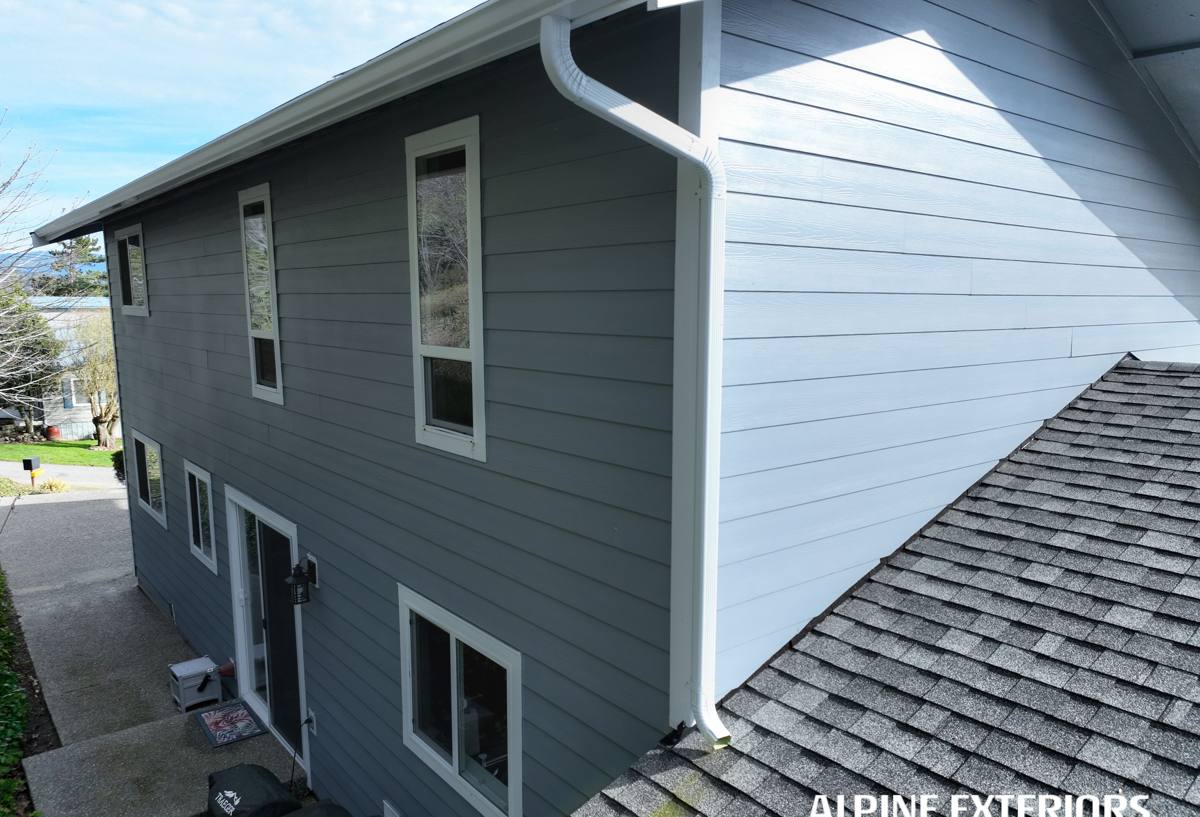
Signs a Ferndale Home Actually Needs a New Roof
Not every roof problem calls for full replacement. Before we recommend tearing a roof off, we look for the difference between isolated damage that can be repaired and system-wide failure that repair only delays.
When Repair Usually Makes Sense
- A localized leak traced to one flashing point, boot, or valley
- A section of shingles damaged by a fallen branch or isolated wind event
- Moss growth that hasn't yet lifted shingle edges or caused granule loss
When Replacement Is the Honest Answer
- Widespread granule loss showing bare, shiny asphalt on multiple slopes
- Shingles that are cupping, cracking, or curling across large areas, not just one spot
- Soft or spongy decking felt underfoot from the attic or during inspection
- Repeated leaks in different locations after the roof has already passed 20+ years
- Moss or algae that's worked under shingle tabs and is holding moisture against the deck
We'll tell you straight if a repair will genuinely hold. Recommending a full replacement when a repair would do the job isn't how we build a reputation in a county where word travels between neighbors.
What a Correct New Roof Installation Involves
Tear-Off and Deck Inspection
A new roof starts with full tear-off down to the deck, not an overlay. Overlaying a new layer on top of failing shingles traps moisture and hides deck problems that will keep growing underneath. Once the old roofing is off, we inspect the sheathing for soft spots, delamination, or rot — common wherever a roof has been holding moisture from moss or a slow leak — and replace any bad sections before anything new goes down.
Underlayment and Water Protection
This is where a lot of the region's driving-rain problem actually gets solved. A synthetic underlayment rated for high wind-driven rain exposure, installed with proper overlap and sealed laps, is the layer doing the real work when wind pushes water sideways under the shingle course above. In vulnerable areas — eaves, valleys, and around every roof penetration — we add self-adhering ice-and-water membrane as a second line of defense, even though Ferndale doesn't see the ice-dam risk of colder climates. The membrane's real job here is sealing around nail penetrations and laps against sustained wind-driven rain.
Flashing and Penetrations
Every place metal meets shingle — chimneys, skylights, vent stacks, wall-to-roof transitions — is a spot where salt air will find weak fasteners or thin metal over time. We use corrosion-resistant flashing and fasteners rated for coastal exposure rather than the cheapest stock option, because replacing failed flashing under a roof that's only a few years old is a bad outcome for everyone.
Ventilation
A roof that can't breathe traps moisture in the attic, which shortens shingle life from underneath and feeds the exact conditions moss needs to spread. Balanced intake at the eaves and exhaust at the ridge keeps air moving and the deck dry, which matters more here given how many wet months Whatcom County gets in a typical year.
Comparing Roofing Materials for a Ferndale Climate
There's no single "best" material — the right choice depends on the home's exposure, roof pitch, budget, and how much upkeep you want to take on. Here's how the common options actually perform under Ferndale's conditions.
| Material | Moss/Algae Resistance | Wind-Driven Rain Performance | Salt Air Durability | Typical Lifespan |
|---|---|---|---|---|
| Architectural asphalt shingle | Moderate — better with algae-resistant granules | Good with correct underlayment and fastening | Good; fasteners matter most | 25–30 years |
| Standing seam metal | Excellent — sheds moisture, little for moss to hold onto | Excellent when seams and flashing are correctly detailed | Requires coastal-rated coating and fasteners | 40–50+ years |
| Composite/synthetic shake | Good, varies by product | Good with proper underlayment | Good; check manufacturer coastal rating | 30–40 years |
| Cedar shake | Poor without regular treatment | Fair; more installation-sensitive | Moderate; needs more upkeep near salt air | 20–30 years with maintenance |
We'll walk through which of these actually fits your roof's pitch, sun exposure, and the look you want — not push whichever product has the best margin. Some products carry a heavier maintenance burden than homeowners expect once they're a few winters in, and we'd rather explain that trade-off up front than have you discover it later.
Our Installation Process, Start to Finish
- On-site inspection and estimate — we look at the current roof, attic ventilation, and any problem areas before quoting anything
- Material selection — we go over the honest trade-offs between options for your specific roof
- Scheduling around weather — tear-off is timed to avoid leaving a deck exposed during a rain system, which takes real planning in this region
- Tear-off and deck repair — full removal, sheathing inspection, and replacement of any compromised decking
- Underlayment, flashing, and ventilation installation — the layers that determine how the roof actually performs in wind-driven rain
- Final installation of roofing material — installed to manufacturer specification, which is what keeps the warranty valid
- Cleanup and walkthrough — magnetic sweep for debris, and a walkthrough so you know what maintenance to expect going forward
Why a Crew That Already Works Ferndale Matters
A roofing crew that works Bellingham and Whatcom County regularly isn't guessing at how a product will hold up here — they've already seen which underlayment details actually stop wind-driven rain intrusion on this side of the state, which fastener grades hold up against salt air over a decade rather than a season, and which slopes in a given neighborhood tend to hold moss longest based on tree cover and sun exposure. That local pattern recognition is the difference between an installation that looks right on day one and one that's still performing correctly ten winters later.
It also means faster response if something needs a look after a storm — a local crew isn't driving in from another region to check a flashing detail.
What Affects the Cost of a New Roof in Ferndale
Every roof is different, so we won't quote a number without seeing yours, but the main cost drivers are consistent:
- Roof size and pitch — steeper roofs take longer and require more safety setup
- Material choice — asphalt, metal, and composite options sit at different price points, reflected in the comparison above
- Deck condition — hidden rot or soft sheathing found during tear-off adds material and labor
- Number of penetrations — chimneys, skylights, and vents each need individual flashing work
- Layers being removed — a roof with an existing overlay takes longer to strip than a single layer
- Access and site conditions — steep lots, tree cover, or limited driveway access affect setup time
We'll break the estimate down by these factors so you can see exactly what you're paying for, rather than a single lump number.
Keeping a New Roof Performing Through Whatcom County Winters
A correctly installed roof still benefits from a bit of ongoing attention, especially through the moss season:
- Keep gutters clear so water isn't backing up under the roof edge during heavy rain
- Trim back overhanging branches to cut down on shade and debris that feed moss growth
- Have moss treated or gently removed before it works under shingle tabs, not after
- Check attic ventilation isn't blocked by insulation, especially after any attic work
- Have flashing points looked at every couple of years given the corrosive effect of salt air
If you're weighing a new roof for your Ferndale home, we're happy to come take a look and give you a straight, no-pressure estimate — no obligation, just an honest read on what your roof actually needs. Use the form below to get started.