 Bellingham
 Siding Repair in Sehome: What Makes This Neighborhood Different
Sehome sits close enough to the water and Bellingham's marine weather patterns that its homes take on a specific kind of wear. Salt-tinged air moves through the neighborhood off Bellingham Bay, driving rain arrives sideways during fall and winter storms, and the tree cover that makes Sehome's streets pleasant to walk also means long stretches of shade where moss and algae get a foothold on siding and never fully dry out. None of that is unique to any one house here — it's the baseline condition every exterior surface in the neighborhood has to survive, year after year.
Older homes in Sehome were often sided with materials that were standard decades ago but were never built for this level of sustained moisture exposure. Newer homes aren't immune either — even correctly installed siding degrades faster when moss mats sit against a wall for months at a time, trapping dampness against the surface. Repair work in this neighborhood has to account for that reality, not just patch the visible damage and move on.
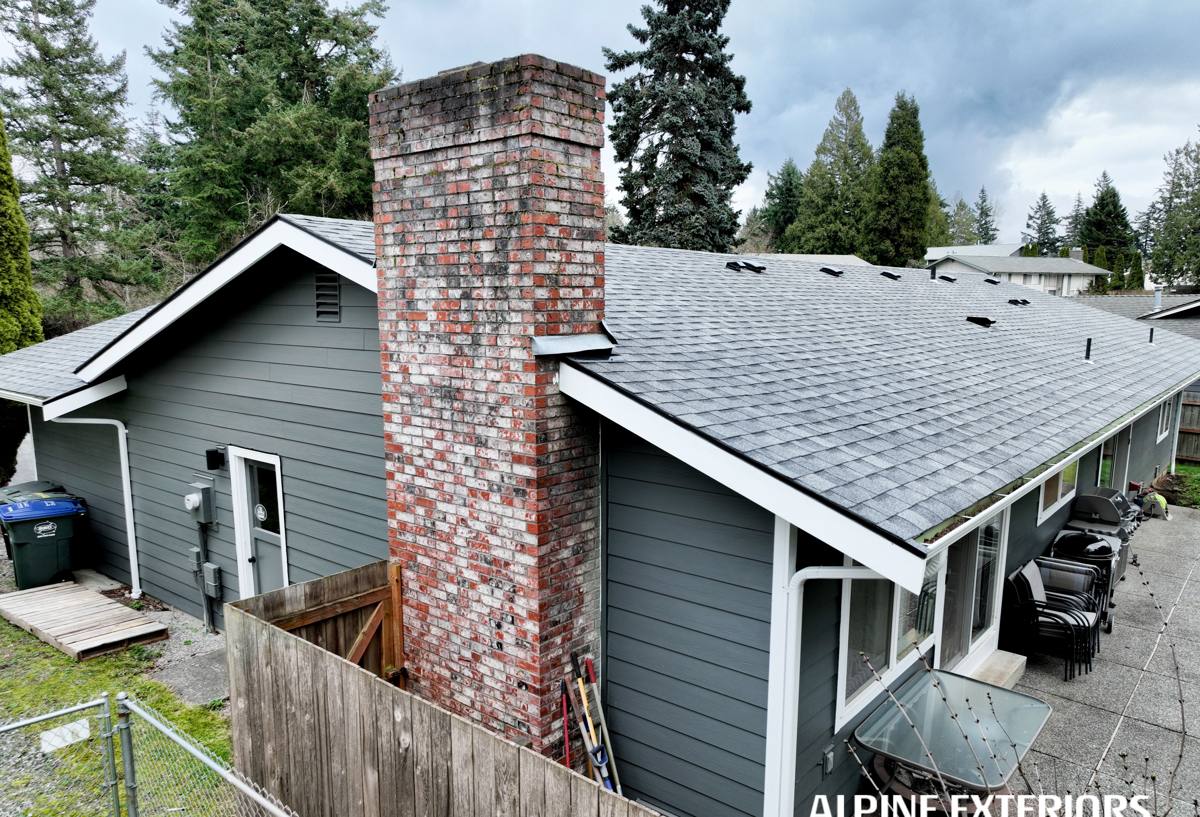
What Whatcom County's Climate Does to Siding Over Time
Whatcom County gets a long wet season, and Bellingham's proximity to the water adds a salt-air component that inland Washington towns don't deal with in the same way. Together, these conditions create three recurring problems for siding:
- Moss and algae growth — shaded, north-facing walls and areas under tree canopy stay damp for extended periods, giving organic growth time to establish and hold moisture against the siding surface.
- Driving rain intrusion — wind-driven rain doesn't just hit siding straight-on, it gets pushed up under laps, around trim, and into any gap where flashing or caulking has failed.
- Salt-air corrosion and finish breakdown — airborne salt accelerates the failure of fasteners, caulk, and paint finishes, especially on the sides of homes that face open exposure toward the bay.
Any one of these on its own is manageable. In combination, over years, they're what turns a small maintenance issue into a repair job — and if ignored long enough, into a full re-side.
Why Moss Season Matters More Than People Think
Homeowners tend to treat moss as a cosmetic nuisance — something to pressure-wash off before it looks bad. The real damage happens underneath. Moss holds water against the siding surface far longer than open air ever would, and on materials that aren't dimensionally stable or properly sealed at the edges, that sustained dampness works its way into seams, fastener holes, and cut edges. By the time discoloration is visible from the street, moisture may have already been sitting against the substrate for one or more full seasons.
Signs Your Sehome Home Needs Siding Repair, Not Just Cleaning
Not every mossy or stained wall needs repair — some just need a proper cleaning. Here's how to tell the difference:
- Soft spots or slight give when you press on the siding, especially near the bottom courses or below windows
- Visible gaps, cracks, or separation at butt joints and corners
- Staining that follows a pattern down from a specific point (often a failed flashing or caulk joint above it)
- Paint or finish that's bubbling, peeling, or chalking excessively in one localized area rather than uniformly
- Persistent moss regrowth in the exact same spot within weeks of cleaning — a sign the underlying moisture source hasn't been fixed
- Interior signs: musty smell, visible staining on interior drywall near an exterior wall, or a soft feel to interior trim in the same area
If you're seeing surface-level moss and light discoloration with no softness or gapping, a cleaning and recaulk may be all that's needed. If you're seeing any of the structural signs above, that's a repair conversation.
What a Correct Siding Repair Actually Involves
A repair that just replaces the damaged board and calls it done often fails again within a couple of seasons, because it doesn't address why that board failed in the first place. Our process on a repair call in Sehome typically works through these steps:
- Diagnose the moisture path. Before removing anything, we trace where water is actually getting in — a failed kick-out flashing, a caulk joint that's dried out and cracked, a penetration (vent, light fixture, hose bib) that was never properly flashed, or siding installed too close to grade or a deck surface.
- Open up the area. We remove enough siding around the damaged section to see the sheathing and framing underneath, not just the board that's visibly failing. Hidden rot doesn't stop at the edge of the damaged plank.
- Assess the substrate. If sheathing or framing has soft or rotted wood, that gets addressed before any new siding goes back on. Covering rot with new siding is one of the most common shortcuts that leads to repeat calls.
- Correct the water management detail. This is the step that actually stops the problem from recurring — proper flashing at penetrations and transitions, correct lap and clearance at the bottom edge, and house wrap or weather barrier repaired or replaced where it was compromised.
- Match and install new siding. New material is cut, fitted, and fastened to manufacturer spec, with attention to the same details (gapping, fastener placement, caulking) that should have been correct the first time.
Why Matching Old Siding Is Sometimes the Wrong Call
On homes with older siding — wood, vinyl, or an aged fiber cement product — finding an exact match for color and profile is often impossible, and even if a close match exists, patched sections can weather differently than the surrounding material over time. For a small, isolated repair, matching as closely as possible is usually the right call. But when a home has multiple problem areas, or the existing siding is clearly at the end of its service life, we'll tell you honestly when repair-and-match stops making financial sense compared to replacing the affected elevation.
Repair vs. Replacement: How We Help You Decide
| Factor | Favors Repair | Favors Replacement |
|---|---|---|
| Extent of damage | Isolated to one or two areas | Multiple elevations affected |
| Age of existing siding | Under 10-15 years, generally sound | Original siding is decades old or already failing broadly |
| Underlying sheathing condition | Solid, no widespread rot | Rot found in multiple locations during inspection |
| Material match | Close match available or repair location is inconspicuous | No reasonable match; patchwork would be visually obvious |
| Recurring problem history | First occurrence, clear isolated cause | Same issue keeps returning in different spots |
We'll walk this table's logic with you in person, on your actual siding, rather than push toward whichever job is larger. Plenty of repair calls really are just repairs.
Why We Only Install James Hardie Fiber Cement
When a repair does turn into a full replacement — or when a homeowner asks us to redo a problem elevation rather than keep patching it — we install James Hardie fiber cement siding exclusively. We don't install vinyl, LP SmartSide, cedar, primed spruce, or other fiber cement brands like Cemplank or Allura. That's a deliberate standard, not a default.
Vinyl is affordable and low-maintenance in mild climates, but it expands and contracts significantly with temperature swings, can become brittle over time, and doesn't hold up well to the kind of sustained moisture and impact conditions we see here. Wood-based products like cedar or primed spruce look excellent when new, but they require ongoing maintenance — repainting, re-caulking, moisture monitoring — that most homeowners underestimate, and in a climate with Bellingham's rainfall, that maintenance gap is where rot gets started. LP SmartSide and other engineered wood products have improved over the years, but they're still wood-based composites, and their long-term performance in consistently wet, shaded conditions like Sehome's tree-covered lots is a real consideration we take seriously.
James Hardie fiber cement is non-combustible, dimensionally stable across our temperature range, and factory-finished with the ColorPlus finish system, which resists fading and chipping far better than field-applied paint. Hardie's HZ5 product line is engineered specifically for climates with significant moisture exposure, and the warranty structure is transferable and backed by a company with decades of manufacturing history in fiber cement. When we tell a homeowner replacement is the right call, this is the one product line we stand behind putting on the house.
What Correct Hardie Installation Requires
Hardie siding performs exactly as well as its installation. Manufacturer-specified fastener patterns, proper gapping at joints and trim, correct flashing integration, and adherence to minimum clearance from grade, roofing, and decks all matter as much as the material itself. A significant share of the "failed fiber cement" problems we see on other homes trace back to installation shortcuts, not the product.
Our Process for Sehome Siding Repair Calls
- Free on-site inspection — we look at the specific area of concern plus a general check of the rest of the exterior
- Honest repair-vs-replace assessment, explained in plain terms with the reasoning behind it
- Written estimate before any work begins, with the scope clearly laid out
- Investigation of the actual moisture source, not just the visible symptom
- Repair or replacement work scheduled around Bellingham's weather windows, since siding work needs a reasonably dry stretch to do correctly
- Cleanup and a final walkthrough so you can see exactly what was done and why
Why a Local Crew Matters for a Neighborhood Like Sehome
Siding repair isn't a one-size-fits-all trade. A crew that works regularly in Bellingham and across Whatcom County has already seen how moss establishes on shaded Sehome lots, how driving rain finds its way into specific trim details on the housing stock common to this area, and how salt air affects fasteners and finishes differently than it would on a drier, inland job site. That local pattern recognition shortens the diagnostic part of a repair call — we're not guessing at what's causing a problem, we're checking against conditions we've already dealt with on other homes nearby.
It also means accountability. A crew based in and around Bellingham has a reason to make sure a repair holds up, because we're not driving in from out of the area for a one-time job — we're the ones you'd call back if something wasn't right, and our reputation in this community depends on getting it right the first time.
Maintaining Siding Between Repairs in a Wet Climate
Whatever siding is currently on your home, a few habits go a long way toward avoiding repeat repair calls in a climate like ours:
- Keep tree branches and shrubs trimmed back from siding to reduce shade and improve airflow, especially on north-facing walls
- Clean moss and algae growth before it spreads, using methods appropriate to your siding material (aggressive pressure washing can damage some materials, including older fiber cement)
- Inspect and refresh caulking at trim, window, and door joints every few years — this is often the first thing to fail and the easiest to catch early
- Check that gutters and downspouts are directing water away from siding, not dumping it against a wall
- Walk the exterior after major storms and note any new staining, gaps, or soft spots while they're still small
If you're seeing moss, staining, softness, or gaps on your Sehome home's siding, we're happy to take a look and give you a straight answer on what it needs — whether that's a targeted repair or something bigger. Reach out for a free, no-pressure estimate, and we'll walk the property with you and explain exactly what we find.