 Bellingham
 Siding Repair Built for Lynden's Weather
Lynden sits inland from Bellingham Bay, but it doesn't escape the marine climate that defines this part of Whatcom County. The same weather systems that bring driving, wind-blown rain to the coast push moisture-laden air across the open farmland surrounding Lynden too, and that air carries enough salt and dampness to matter for anything nailed to the outside of a house. Add a moss season that can stretch from fall through spring in a typical Pacific Northwest year, and you have a climate that is genuinely hard on siding — not because any one storm is dramatic, but because the exposure is constant and the drying time between rain events is short.
Homes in and around Lynden also tend to sit more exposed than homes tucked into wooded Bellingham neighborhoods. Open fields mean more wind, and wind-driven rain finds every gap, seam, and fastener hole that a calm rain would never reach. Siding repair here isn't about patching a cosmetic problem — it's about stopping water intrusion before it reaches the sheathing and framing behind the siding.
Signs Your Lynden Home Needs Siding Repair
Most siding problems don't announce themselves. They show up as small, easy-to-dismiss details long before they become a hole in the wall. If you own a home in the Lynden area, it's worth walking the exterior a couple of times a year and looking for the following:
- Soft or spongy spots when you press on a board, especially near the bottom courses or below windows
- Persistent moss or dark green-black staining that keeps coming back within weeks of cleaning
- Paint that's bubbling, peeling, or alligatoring in patches rather than evenly across a wall
- Visible gaps, warping, or boards pulling away from the wall at the seams
- Cracked or split boards, particularly on south- and west-facing walls that take the brunt of storms
- Interior clues — a musty smell, a damp spot on drywall, or peeling interior paint on an exterior wall
- Insects (carpenter ants, in particular) showing up near exterior walls, which often means damp wood underneath
Any one of these on its own might be minor. Two or three together, especially on the same wall, usually mean water has been getting behind the siding for a while.
What's Really Damaging Siding in Lynden
It helps to understand the specific mechanisms at work, because they point to what an honest repair actually needs to fix:
Moss and organic growth
Moss doesn't just look bad — it holds moisture directly against the siding surface for days at a time, and its root structure works into seams and coating imperfections. On wood-based products, that sustained dampness is what leads to rot underneath a perfectly paintable-looking surface.
Wind-driven rain
On open, exposed lots, rain doesn't fall straight down — it's pushed sideways into laps, corners, and butt joints. If the original installation didn't get flashing, caulking, and overlap right, this is where water finds its way in, often years before any visible damage appears.
Freeze-thaw cycling
Whatcom County gets enough cold snaps each winter that water trapped in a crack or a saturated board can freeze, expand, and widen the damage. It's a slow process, but it's cumulative — a hairline crack this year is a split board in two or three winters.
UV and coating breakdown
South- and west-facing walls take more direct sun. Once a factory or field-applied finish starts to break down, the substrate underneath is exposed to every other item on this list with nothing protecting it.
Repair or Replace? How We Make the Call
Not every damaged board means a full re-side, and not every "small" repair is actually small once you open the wall up. We make this call based on what we find, not on what's easiest to sell. Here's the general framework we use:
| Situation | Typical approach | Why |
|---|---|---|
| Isolated damage — a few boards, one wall, impact or age-related | Targeted repair: remove and replace the affected boards | Sheathing and surrounding siding are sound; no reason to disturb the rest |
| Damage clustered around one detail — a window, a corner, a roof-wall intersection | Repair the boards plus fix the underlying flashing or detail that caused it | Replacing siding without fixing the cause just buys time before it happens again |
| Rot or moisture found in multiple areas across the same wall | Broader section replacement, sometimes a full wall | Scattered damage usually means the original moisture barrier or flashing system failed broadly, not in one spot |
| Widespread rot, warping, or coating failure across most of the house | Full re-side | At that point, patching costs nearly as much as replacement and leaves mismatched, aging material next to new |
We open up suspect areas before quoting anything, because guessing at scope from the outside is how homeowners end up either overpaying for unnecessary work or underpaying for a repair that fails again in a year.
What a Correct Siding Repair Involves
A repair that actually holds up in Whatcom County's weather has to address more than the visible board. Cutting out a damaged piece and nailing up a replacement, without checking what's behind it, is how the same spot ends up rotting again a couple of winters later. A correct repair includes:
- Removing enough surrounding material to see the full extent of the damage, not just the visible section
- Checking the sheathing and framing underneath for soft spots or rot that need their own repair before new siding goes back up
- Verifying the water-resistive barrier (house wrap or building paper) is intact, lapped correctly, and not the actual source of the leak
- Correcting flashing at windows, doors, and any penetrations in the repaired area — this is the detail most often missed in a quick patch job
- Matching the replacement material's profile, exposure, and fastening pattern to the existing siding
- Sealing and finishing the repair so it holds color and performs the same as the surrounding wall, not just structurally sound but visually consistent
Our Repair Process
- Inspection. We walk the exterior, probe suspect boards, and check trouble spots — corners, penetrations, low clearance areas, and anywhere moss has been holding moisture.
- Diagnosis. If damage looks contained, we open it up on site. If it looks like it may be widespread, we say so up front rather than guessing.
- Scope and estimate. You get a clear explanation of what we found, what needs to happen, and why — including whether it's a repair or whether replacement makes more sense.
- Repair. We remove damaged material, address the sheathing and moisture barrier underneath, correct any flashing issues, and install matching or upgraded siding.
- Finish and cleanup. Caulking, paint or factory-finish matching, and a full cleanup of the work area — including debris that can otherwise sit in landscaping or gutters.
Why We Rebuild Damaged Sections With James Hardie
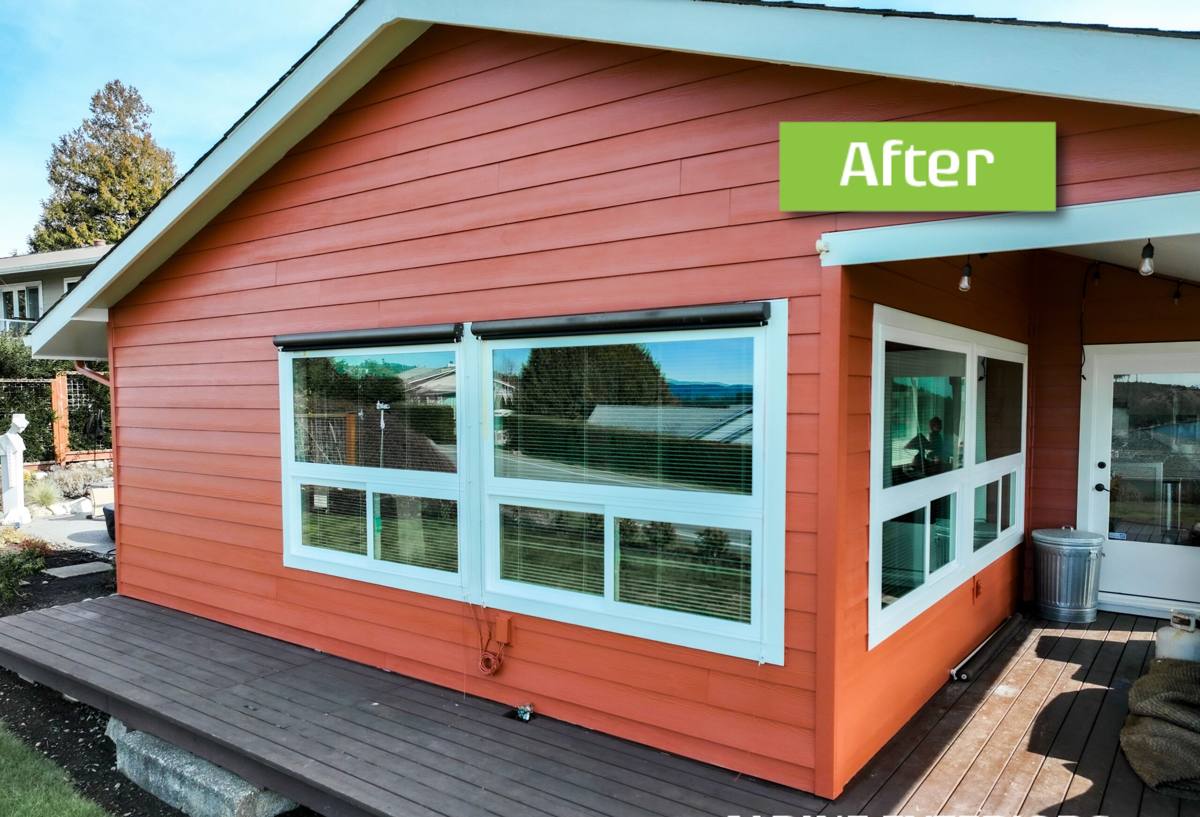
When a repair grows into a section replacement — a full wall, a gable, or more — we install James Hardie fiber cement, and only James Hardie. We don't carry LP SmartSide, vinyl, Cemplank, Allura, or unprimed wood siding, and homeowners in Lynden sometimes ask why we're that strict about it.
The honest answer is that repair work is where the weaknesses of other materials show up most clearly. Vinyl expands and contracts with temperature swings and can crack in a hard freeze, which is exactly the failure mode Whatcom County winters produce. Wood-based products like LP SmartSide perform reasonably well when installation and maintenance are perfect, but any lapse — a missed caulk line, a gap left too long — lets moisture in, and the strand-based substrate doesn't tolerate sustained dampness the way fiber cement does. We've built our repair and replacement process around a product that doesn't punish a small maintenance gap with rot.
James Hardie's fiber cement is non-combustible, holds up to repeated wetting and drying without swelling or delaminating, and — with the HZ5 product line engineered for the Pacific Northwest's damp climate — is built specifically for the conditions Lynden sees most winters. The factory-applied ColorPlus finish also means a replaced section can be color-matched with far more consistency than field-painted materials, and it carries a transferable warranty that matters if you sell the house down the road. When we patch in new siding next to old, we want that patch to actually last as long as the rest of the wall — not become next winter's callback.
Why a Crew That Already Works in Lynden Matters
Siding repair is diagnostic work as much as it's carpentry. A crew that's worked on farmhouses, newer developments, and everything in between around Lynden has already seen how this area's exposure — open fields, wind-driven rain, a long wet season — tends to fail siding, and knows where to look first instead of guessing. That local pattern recognition is the difference between a quote based on a five-minute walk-around and one based on actually knowing what's usually happening behind the wall in a house like yours.
It also matters for the practical stuff: knowing Whatcom County's permitting requirements when a repair crosses into structural territory, showing up on schedule instead of treating a repair as filler between bigger jobs, and being reachable afterward if something needs a second look. Repair work in particular tends to get treated as an afterthought by contractors chasing full re-sides — we treat it as its own job, done right the first time.
If you're seeing moss buildup, soft spots, or paint failure on your Lynden home, we're happy to take a look and tell you honestly whether it's a repair or something bigger — no pressure, no upsell. Request a free estimate below and we'll walk the exterior with you.