 Bellingham
 Decks Built for Silver Beach's Weather, Not Against It
Silver Beach sits close enough to the water that homes here deal with a different set of conditions than a deck built inland. Salt-tinged air speeds up corrosion on hardware that would last decades somewhere drier. Driving rain off Bellingham Bay finds its way into every gap and seam that isn't detailed correctly. And the moss season here runs long — often eight months or more of the year — which means any horizontal wood or composite surface is going to grow something green if it isn't designed to shed water and dry out. A deck built to a generic, one-size-fits-all spec sheet will show problems within a few seasons. One built for this specific stretch of Whatcom County holds up.
We've built and repaired decks throughout the Bellingham area long enough to know which shortcuts show up as callbacks two winters later. This page walks through what a Silver Beach deck actually needs, how we build it, and what to expect from the process.
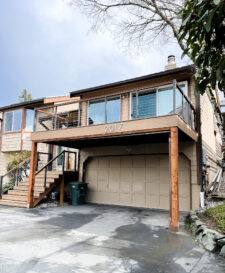
What a Deck Actually Needs to Survive Here
The Ledger Board Connection
Where a deck attaches to the house is the single most important — and most commonly botched — connection on the entire structure. If the ledger board isn't flashed correctly, water works its way behind it and into the house framing, and you don't find out until there's rot in the rim joist or subfloor. A correct ledger installation uses proper counterflashing, a drainage gap so water can escape instead of pooling against the house, and fasteners rated for the connection loads involved — not just whatever lag screws were on the truck. This is also the connection building inspectors look at most closely, for good reason.
Fasteners and Hardware
Standard zinc-coated screws and joist hangers corrode faster near the water than most homeowners expect, and the acids in modern treated lumber (ACQ-treated pine, in particular) accelerate that corrosion further. We spec stainless steel or heavy hot-dip galvanized hardware rated for contact with treated lumber, and we use hidden fastener systems on composite and PVC decking where face-screwing isn't necessary. It costs a bit more up front than hardware-store hardware. It's also the difference between hardware that's still sound in fifteen years and hardware that's staining the decking rust-orange in five.
Footings and Frost Depth
Concrete footings need to sit below frost depth and bear on undisturbed soil, not fill. On sloped or softer ground — which shows up in parts of Silver Beach closer to the water — helical piers are sometimes a better option than poured concrete, since they don't depend on excavating a clean, stable hole. Either way, footing depth and spacing are calculated from the actual load of the deck, not guessed at, and that's part of what gets reviewed at permit and inspection.
Choosing a Decking Material That Actually Holds Up
There's no universally "best" decking material — there's the right material for your budget, your maintenance appetite, and how exposed the deck is to rain and shade. Here's how the common options compare in this climate:
| Material | Upfront Cost | Maintenance | How It Handles Our Climate |
|---|---|---|---|
| Pressure-treated pine | Lowest | Needs sealing/staining every 1-2 years | Prone to moss and checking if not maintained; budget-friendly workhorse |
| Cedar | Moderate | Needs sealing or oiling regularly to hold color | Naturally rot-resistant, but still needs upkeep to fight moss and graying |
| Composite (capped) | Higher | Occasional wash-down, no staining | Resists moisture damage well; can still grow surface mildew/moss if not designed to shed water |
| PVC decking | Highest | Lowest — wash-down only | Fully moisture-resistant core; best option for shaded, damp, low-airflow areas |
We install all of the above and will walk through the honest trade-offs for your specific deck rather than pushing whatever has the best margin. A shaded, north-facing deck under trees is a different call than a sun-exposed deck facing open water, even on the same street.
Moss, Algae, and Water — Designing to Shed It, Not Hold It
Moss doesn't grow because a material is defective — it grows wherever moisture sits on a surface longer than it should. In a climate where the ground rarely fully dries out from fall through spring, deck design has to account for that instead of fighting it after the fact. That means proper board spacing for airflow and drainage, joist tape over the framing so standing water doesn't sit directly on structural lumber, a slight slope built into the frame so water runs off rather than pooling, and enough clearance underneath the deck for air to actually move. Decks built tight to the ground with no ventilation are the ones we get called back to most often for moss, mildew, and eventually soft framing.
On composite and PVC boards, moss and algae are a surface issue and usually come off with a deck-safe cleaner and a stiff brush — pressure washing composite can strip the cap layer if you're not careful with the nozzle and distance. On wood, a moss problem is often a signal that the finish has worn through and the board is holding moisture it shouldn't be.
Our Process From First Call to Finished Deck
- On-site assessment — we look at drainage, sun exposure, soil, and how the deck ties into the house before recommending anything.
- Design and material selection — layout, railing style, and decking material chosen around your budget and how the space will actually be used.
- Permitting and engineering — we handle the permit application and any structural engineering the local building department requires for the design.
- Removal of the old deck, if applicable, including a check of the framing and ledger behind it for hidden rot before we build over it.
- Framing, with footings, ledger flashing, and structural connections inspected before any decking goes down.
- Decking, railing, and stairs installed, with fastener choice and spacing matched to the material and site conditions.
- Final walkthrough — we go over care and maintenance for whatever material you chose before we call it done.
Permits and Code Requirements
Most new decks and many deck replacements in the Bellingham area require a building permit, particularly if the deck is attached to the house, elevated, or involves new footings. Requirements cover things like guardrail height on elevated decks, baluster spacing, stair rise and run, and how the ledger connects to the house. Exact thresholds and requirements are set by the local building department, and they do change, so we confirm current requirements before pulling a permit rather than relying on what applied last year. Skipping the permit on a deck that requires one isn't a shortcut worth taking — it becomes a problem at resale, and more importantly, it means no third party ever checked that the structural connections were done right.
Keeping Your Deck Sound Year After Year
A well-built deck in this climate still needs some regular attention. A short seasonal routine catches small problems before they turn into structural ones:
- Clear leaves and debris from between boards before fall rains set in — trapped organic matter holds moisture against the surface
- Check that gaps between boards haven't closed up or filled with debris, which blocks drainage and airflow underneath
- Look at the ledger flashing and the point where the deck meets the house once a year for any signs of water staining
- Inspect footings and post bases for movement, cracking, or standing water pooling around them
- Reseal or stain wood decking on schedule — don't wait until it's visibly gray and worn
- Wash composite and PVC surfaces periodically to keep mildew and pollen film from building up
- Test railings and stair connections for looseness, especially after a hard winter
Repair, Resurface, or Rebuild?
Not every aging deck needs to be torn out. If the framing and footings are sound and the problems are cosmetic — worn finish, a few damaged boards, an outdated railing — a resurface or targeted repair is the honest answer. If the ledger connection has been leaking for years, if joists are soft when probed, or if footings have shifted, patching the surface just hides a structural problem that will keep getting worse. We'll tell you which situation you're in and why, including when a repair is genuinely the right call rather than the more profitable one.
Why a Crew That Already Works in Silver Beach Makes a Difference
Building decks well near the water isn't the same skill set as building them a few miles inland. Soil conditions, wind exposure, drainage patterns, and how fast moss takes hold all shift depending on how close a property sits to Bellingham Bay and how much tree cover it has. A crew that's already worked this area isn't guessing at footing depth, fastener choice, or drainage detailing — we've seen what fails here and what doesn't, and we build accordingly from the first day on site rather than learning it on your project.
If you're planning a new deck or dealing with an aging one in Silver Beach, we're happy to take a look and give you a straightforward, no-pressure estimate — just fill out the form below.