 Bellingham
 Why Silver Beach Homes Take Extra Punishment
Silver Beach homeowners deal with a version of Bellingham's climate that's a little more aggressive than what inland Whatcom County neighborhoods see. Salt-laden air drifting in off the water works its way into seams, fasteners, and unprotected wood fiber over time. Driving rain, pushed sideways by wind off the water, finds every weak point in a siding system — not just the face of the wall, but the laps, the corners, and the trim intersections. And because this area rarely gets a hard, dry summer stretch long enough to fully bake out moisture, the moss and algae season runs long, sometimes nearly year-round on north-facing and shaded walls.
None of that is unusual for western Washington. But it does mean siding choices that perform fine in a drier climate — or even in a milder part of the Puget Sound region — can fall short here. Wood-based products absorb moisture and swell. Coatings that aren't factory-cured can chalk, fade, or lift at the seams faster than they would somewhere with less salt exposure and shorter wet seasons. This is the backdrop for every siding decision on a Silver Beach home, and it's why we standardized on one product system instead of offering a menu of options that all perform differently in this environment.
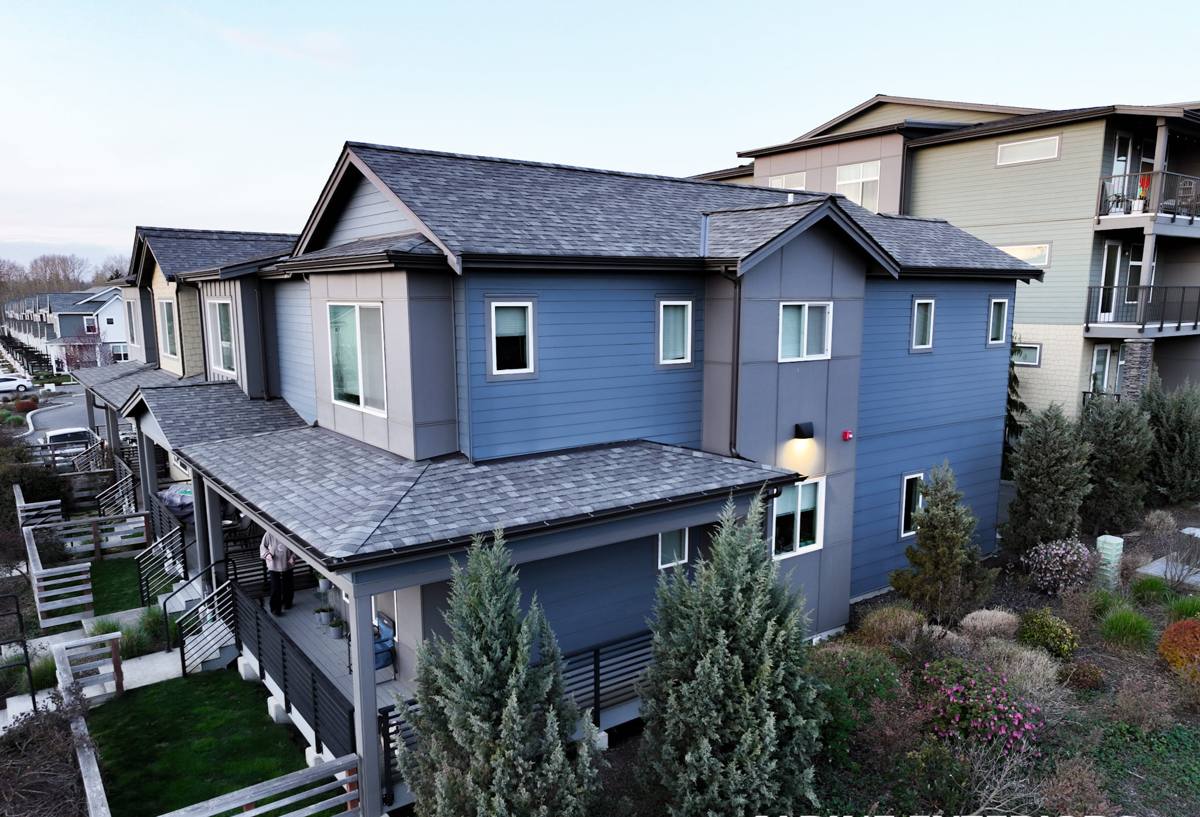
What James Hardie Fiber Cement Does Differently
James Hardie siding is a fiber cement product — a mix of cellulose fiber, sand, and Portland cement pressed and cured into planks and panels. It doesn't behave like wood, and it doesn't behave like vinyl. That's the point.
A non-combustible core
Fiber cement doesn't burn, warp in the sun, or provide a food source for insects. For a coastal-influenced climate where wind-driven wildfire smoke and ember exposure have become a bigger concern regionally, a non-combustible exterior is a real, practical advantage — not a marketing point.
A factory-applied finish, not a field-applied one
Hardie's ColorPlus finish is baked on in a controlled factory environment, not brushed or sprayed on-site in variable weather. That matters in a place like Silver Beach because field-applied paint and stain are only as good as the conditions they're applied in — humidity, temperature, and dry time all affect adhesion. A factory finish removes that variable and gives you a consistent, UV- and moisture-resistant surface with a warranty that follows the product, not the weather on install day.
The Hardie Product Lines That Make Sense Here
HardiePlank lap siding
The most common choice for Silver Beach homes. It gives you the traditional horizontal lap look, sheds water efficiently when the laps and flashing are installed correctly, and comes in a range of textures and exposures that fit both older and newer home styles in the neighborhood.
HardiePanel vertical siding
Used for modern facades, accent walls, gable ends, or mixed with lap siding for visual contrast. Vertical panels need careful joint treatment to stay watertight in a driving-rain climate, which is a detail worth asking any contractor about directly.
HZ5 climate engineering
James Hardie engineers its products by climate zone, and the Pacific Northwest falls under the HZ5 category — formulated for regions with sustained moisture exposure and freeze-thaw cycling. Installing HZ5-rated product is not optional in this climate; it's the baseline for getting the performance the warranty assumes.
How Siding Materials Actually Compare in This Climate
Every siding material has a use case somewhere. Here's how the common options stack up specifically against Silver Beach's combination of salt air, wind-driven rain, and extended moss season.
| Material | Moisture Behavior | Salt Air Resistance | Moss/Algae Resistance | Finish Longevity |
|---|---|---|---|---|
| James Hardie fiber cement | Does not swell, rot, or absorb water into its core | Non-organic, does not corrode | Dense surface resists organic growth; still needs periodic washing | Factory ColorPlus finish, long warranty |
| Vinyl siding | Sheds water but can warp/buckle with heat and impact | Fine, but seams and J-channels can trap moisture | Grows moss/algae readily in shaded, damp areas | Color is through-body but fades and chalks over time |
| LP SmartSide (engineered wood) | Wood-strand core is vulnerable if the finish is breached | Fine if finish is intact | Susceptible where finish wears thin | Field or factory finish; edges need ongoing sealing |
| Cedar / primed spruce | Absorbs moisture, prone to cupping and rot over time | Fine, but moisture is the bigger risk here | High — natural wood is an organic growth magnet | Requires recoating on a recurring schedule |
This is why we only install James Hardie. Every other option on that list can work fine in a drier or more sheltered location, but Silver Beach's combination of salt exposure, sideways rain, and long damp seasons is exactly the mix that exposes the weak points in wood-based and vinyl systems fastest.
What a Correct Installation Involves
Fiber cement performs the way it's engineered to only when it's installed to spec. In a climate like this, a handful of details separate a siding job that lasts decades from one that causes problems in a few years.
- Proper weather-resistive barrier and drainage plane behind the siding, not just a wrap stapled up as an afterthought
- Correct flashing at every window, door, and roofline intersection — this is where most water intrusion actually starts
- Minimum clearance gaps at the bottom of the siding and around trim to allow drainage and airflow
- Hardie-specified fastener spacing and type, driven flush (not overdriven, which cracks the material)
- Factory-mitered or properly caulked joints using a sealant rated for exterior, high-moisture use
- Correct lap exposure and starter strip installation so water sheds outward, not behind the panel
- Touch-up paint matched to the ColorPlus finish only where cuts expose raw material
Skipping any one of these doesn't usually show up as a failure on day one. It shows up two or three wet seasons later, as staining, soft trim, or paint failure at the seams — which is often mistaken for a siding problem when it's actually an installation problem.
Our Process for Silver Beach Projects
We approach every Silver Beach project the same structured way:
- On-site assessment. We look at existing siding condition, moisture damage, trim and window flashing, and any problem areas specific to the home's exposure and orientation.
- Product and color selection. We walk through the relevant HardiePlank or HardiePanel options and ColorPlus colors for the home's style and HOA or neighborhood expectations where applicable.
- Prep and moisture check. Before new siding goes up, we address any sheathing damage or moisture issues uncovered during removal — this is not a step to shortcut in a climate this wet.
- Installation to Hardie spec. Flashing, gapping, fastening, and joint treatment follow manufacturer requirements, not shortcuts.
- Final walkthrough. We review the finished work with the homeowner and go over basic care specific to the home's exposure.
Living With Hardie Siding: Maintenance in a Moss-Prone, Salt-Air Environment
James Hardie siding is low-maintenance, not no-maintenance. In a climate with this much moisture and organic growth pressure, a little seasonal attention goes a long way toward protecting the investment.
- Rinse the exterior periodically with a garden hose, especially on north- and shade-facing walls where moss and algae take hold first
- Avoid pressure washers on high settings directly against the siding — a gentle rinse is enough and won't force water behind laps
- Keep gutters clear so overflow doesn't run down the siding face during heavy rain events
- Trim back vegetation and tree cover that keeps a wall shaded and damp for extended periods
- Inspect caulking at trim and window joints annually and have gaps resealed before they let water in
Why Hiring a Crew That Already Works Silver Beach Matters
Siding installation looks similar on paper everywhere, but the details that actually matter shift with the local climate and building conditions. A crew that regularly works in and around Silver Beach and greater Bellingham already knows what wind-driven rain does to a poorly flashed window, what a long moss season does to siding installed with tight-to-the-ground clearance, and how salt-influenced air affects fastener and hardware choices. That's the kind of judgment that doesn't come from a spec sheet — it comes from doing the work in this exact climate, repeatedly, and seeing what holds up and what doesn't.
It also matters for the practical side of a project: knowing local permitting expectations in Whatcom County, understanding typical home styles and any neighborhood guidelines in the area, and being available for follow-up if a question comes up after the work is done.
Cost Factors to Expect
Every home is different, but a few factors consistently drive the cost of a James Hardie installation in this area:
| Factor | Why It Affects Cost |
|---|---|
| Existing siding removal and disposal | Tear-off, especially of wood or vinyl with hidden damage, adds labor |
| Sheathing or moisture repair | Rot or water damage found during removal must be fixed before new siding goes on |
| Home size and wall complexity | More corners, gables, and trim details mean more cutting, flashing, and labor |
| Product line and profile | HardiePlank, HardiePanel, and specialty trim vary in material cost |
| Color and finish selection | Standard ColorPlus colors versus custom or premium options |
| Access and site conditions | Slopes, tight lot lines, and limited staging area affect labor time |
We don't quote broad numbers over the phone because these variables genuinely change the outcome — an accurate cost picture only comes from seeing the home.
If your Silver Beach home's siding is showing its age, or you're planning ahead for a project, we're happy to take a look and walk you through what correct installation would involve for your specific home. Fill out the form below for a free, no-pressure estimate.