 Bellingham
 Custom Decks Built for South Hill's Hillside Homes
South Hill sits up on the slope above downtown Bellingham, and that elevation is both the neighborhood's biggest selling point and its biggest deck-building challenge. The view lots, mature tree cover, and older housing stock that make South Hill desirable also mean sloped yards, established root systems, and homes where the original deck (if there is one) was probably built decades ago to a very different code than what's required today. A custom deck here isn't just about picking a material and screwing down boards — it's about designing for the site you actually have, not a flat generic lot.
We've built and repaired decks throughout South Hill and the surrounding Bellingham neighborhoods long enough to know what holds up on this hillside and what doesn't. This page covers what a correctly built deck looks like for this specific area, the material trade-offs that matter here, and how our process works from first walkthrough to final sign-off.
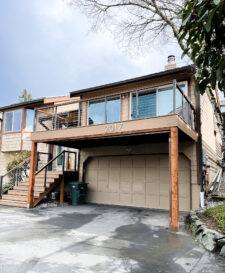
What Bellingham's Climate Does to a Deck
Whatcom County's marine climate is easy on people and hard on wood. A few things compound on a hillside lot like South Hill's:
- Salt air: Proximity to Bellingham Bay means airborne salt reaches fasteners, hardware, and metal railing components, accelerating corrosion on anything that isn't rated for coastal exposure.
- Driving rain: Wind-driven rain off the water pushes moisture sideways into ledger connections, stair stringers, and anywhere two pieces of wood meet — not just straight down onto the deck surface.
- A long moss season: Cool, wet, low-sun months stretch long here, and shaded decks under the tree canopy common on South Hill lots can stay damp for weeks at a time, which is exactly what moss and algae need to take hold.
- Freeze-thaw cycling: Winter isn't brutal in Bellingham, but repeated freeze-thaw on wet wood and concrete footings still opens up cracks and loosens fasteners over years.
None of this means a deck can't last. It means the design, material choice, and fastening details all need to account for sustained moisture exposure rather than assuming a dry-climate build will hold up fine here — because it won't.
Decking Material Options for South Hill Homes
There's no single "best" decking material — the right call depends on how much sun the deck gets, how much maintenance you want to do, and your budget. Here's how the common options stack up under Bellingham conditions:
| Material | How it handles our climate | Maintenance | Typical lifespan |
|---|---|---|---|
| Cedar | Naturally rot- and insect-resistant; needs to breathe and dry between rain events, so shaded spots need more attention | Annual cleaning, re-sealing every 1-3 years | 15-25 years with upkeep |
| Pressure-treated fir/pine | Budget-friendly, holds up structurally, but end grain and cut edges need re-sealing to stay protected | Cleaning plus sealant every 1-2 years | 15-20 years with upkeep |
| Composite | Doesn't absorb moisture like wood; resists rot, but shaded, moss-prone areas still need surface cleaning | Periodic washing, no sealing/staining | 25-30+ years |
| PVC/capped polymer | Fully moisture-resistant surface; best option for heavily shaded or low-airflow deck areas | Occasional washing | 25-30+ years |
On a shaded South Hill lot under mature trees, we often steer homeowners toward composite or capped polymer for the field of the deck, sometimes with cedar accents where sun exposure is better and the natural look matters more. On open, sunnier lots, a well-sealed cedar or treated-wood deck is a perfectly sound choice and costs less up front.
A Note on Fasteners and Hardware
The decking material gets most of the attention, but the fasteners and structural hardware matter just as much in a salt-air environment. We use stainless steel or coated fasteners rated for coastal/marine exposure rather than standard hardware — the cost difference is small relative to the whole project, and it's one of the easiest places for a deck to fail early if it's cut on price.
Site & Design Considerations Specific to South Hill
South Hill's terrain shapes almost every decision on a deck project:
Slope and Footings
Sloped lots often mean taller support posts, stepped footings, or a multi-level deck design rather than a simple single-plane platform. Footings need to be sized and set to local frost depth and soil conditions, and on a slope that usually means more engineering attention than a flat-lot deck, not less.
Drainage
Water has to go somewhere, and on a hillside it wants to run toward the house. Proper grading beneath and around the deck, along with gutters or drainage systems that direct water away from the foundation, matter more here than on flat ground.
Tree Cover and Airflow
Mature trees are part of what makes South Hill's lots appealing, but heavy canopy limits sun exposure and airflow under and around a deck — which is the main driver of moss and slow drying. Deck orientation, board spacing, and gap sizing can be adjusted at the design stage to improve airflow without asking you to remove trees you want to keep.
Permits and Local Code
Most new decks and significant deck replacements in the City of Bellingham require a building permit, and railing height, guard spacing, and stair specs are governed by current building code — which is often stricter than what's on an older existing deck. We handle the permit process as part of the job rather than leaving it to the homeowner to sort out.
What a Correctly Built Deck Involves
A deck that lasts in this climate comes down to details that aren't visible once the project is finished:
- Proper ledger board flashing where the deck attaches to the house — this is the single most common point of hidden water damage on older decks.
- Footings set below frost depth and sized for the actual load and soil conditions on your lot, not a one-size-fits-all spec.
- Joist spacing and blocking appropriate to the decking material — composite and PVC often need tighter joist spacing than solid wood.
- Corrosion-resistant fasteners and connectors throughout, not just on the visible surface boards.
- Code-compliant railings and stairs, including guard height and baluster spacing that meets current Bellingham requirements.
- Airflow underneath the deck so the structure can dry out between rain events instead of staying damp.
Skipping any of these doesn't show up on day one — it shows up as soft framing, a failing ledger connection, or a slick, moss-covered surface two or three winters in.
Our Process
- On-site assessment: We walk the lot, check slope, drainage, sun exposure, and existing structure (if replacing a deck), and talk through how you actually plan to use the space.
- Design and material selection: We put together a layout and material recommendation based on your budget, sun/shade conditions, and maintenance preferences — not a one-size template.
- Permitting: We prepare and submit the permit package required for the scope of work and coordinate inspections as needed.
- Construction: Footings, framing, ledger flashing, decking, and railings are built in sequence with attention to the moisture-management details covered above.
- Final walkthrough: We go over the finished deck with you, including care and maintenance guidance specific to the material and your lot's sun/shade conditions.
Living With Bellingham's Moss Season
Even a well-built deck needs some seasonal attention here. A simple maintenance rhythm keeps most South Hill decks looking and performing well for years:
- Sweep leaves and debris off the deck surface regularly, especially in fall — trapped organic matter under leaves is what feeds moss growth.
- Clean the deck surface at least once a year with a deck-safe cleaner; pressure washing wood decks requires a light touch to avoid damaging the grain.
- Re-seal or re-stain wood decking on the schedule appropriate to the product — waiting too long lets moisture in through worn-out finish.
- Keep gutters and downspouts near the deck clear so runoff isn't draining directly onto or under the structure.
- Check railings, stair connections, and ledger flashing yearly for early signs of loosening or water staining.
Why Hire a Crew That Already Works South Hill
A deck built to a generic spec sheet can still fail on a hillside lot with heavy tree cover and salt-laden rain coming off the bay. Crews who already work South Hill regularly know which lots need extra drainage attention, which fastener grades actually hold up here, and how the City of Bellingham's permitting process runs in practice — not just in theory. That local familiarity shows up in fewer surprises during the build and a deck that's designed for the yard you actually have, not a flat lot in a catalog photo.
We treat every South Hill deck project as a site-specific build: right footings for the slope, right material for the sun exposure, right hardware for the air quality, and a design that accounts for Whatcom County's long wet season rather than fighting it after the fact.
If you're planning a new custom deck or replacing an aging one on your South Hill property, we're happy to walk the site with you and put together a straightforward plan and estimate — no pressure, no obligation. Use the form below to get started.