 Bellingham
 Installing Siding on a Sudden Valley Home Is Its Own Job
Sudden Valley sits on the south shore of Lake Whatcom under some of the heaviest second-growth tree cover in the Bellingham area, and that setting changes what a siding installation needs to accomplish before a single panel goes up. A re-side here isn't just swapping one material for another. It's an installation that has to account for walls that stay shaded most of the day, wind-driven rain that hits different elevations of the same house with different force, salt-tinged air reaching in from the Sound on top of the lake's own humidity, and a moss season that barely lets up. Get the install right and a home shrugs that off for decades. Get it wrong — even with a good material — and the same conditions will find every shortcut within a few wet seasons.
We install James Hardie fiber cement siding exclusively, and on a property like this, the installation details matter just as much as the product choice. This page walks through what Sudden Valley's climate actually demands from a siding job, what correct installation looks like step by step, and why it's worth hiring a crew that already knows this specific stretch of Whatcom County before they ever show up with a nail gun.
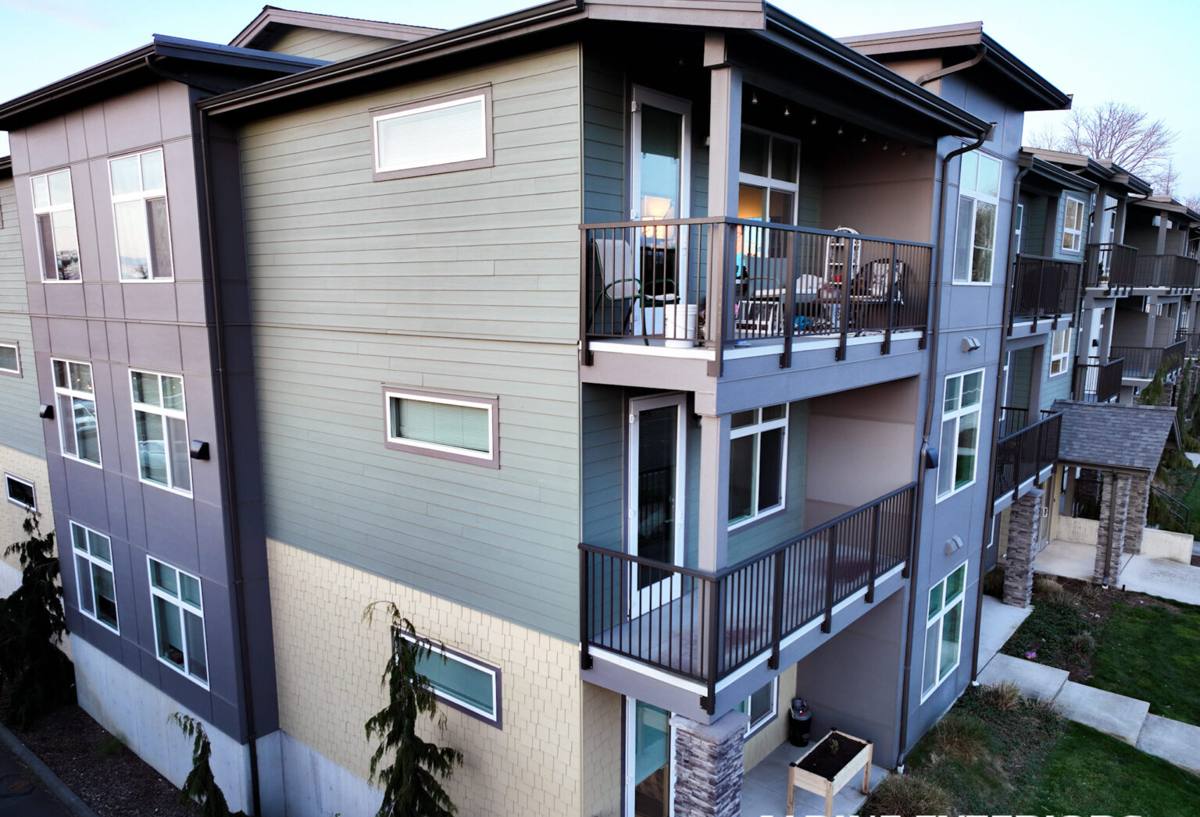
What Sudden Valley's Climate Demands From an Installation
Shade That Slows Every Dry-Out Cycle
Most lots in Sudden Valley sit under significant canopy, and it's common for a home to have one or two wall faces that see very little direct sun across the entire year. That matters during installation as much as afterward — sheathing and framing exposed during a tear-off need to be protected and, where necessary, given time to dry before new siding and weather-resistive barrier go on. A crew that treats every wall the same regardless of sun exposure is setting up the shadiest elevations to trap moisture from day one.
Wind-Driven Rain That Doesn't Hit Every Wall Equally
Sudden Valley's terrain is hilly, with homes at a range of elevations and orientations relative to the lake and the surrounding ridgelines. That means wind-driven rain can slam into one elevation while barely touching another on the same house. A correct installation reads each wall on its own terms — heavier flashing and drainage detailing where exposure is worst, not a single generic approach applied uniformly across the whole exterior.
Salt Air and a Moss Season That Doesn't Really End
Air moving in from the Sound carries a low level of salt content even this far inland, and combined with the humidity Lake Whatcom adds to the mix, it accelerates wear on fasteners, flashing, and any finish that isn't built to handle sustained moisture exposure. Add in the shade and mild temperatures that keep moss and mildew active on this property for most of the year, and every detail of the installation — from fastener grade to how joints get sealed — has to assume the house will rarely get a long, uninterrupted dry stretch.
What a Correct Siding Installation Actually Involves
A siding job is only as good as what happens before the first piece of trim goes on. On a shaded, moisture-heavy lot like the ones throughout Sudden Valley, skipping steps here is exactly what turns into a callback five years later.
Starting With What's Underneath
Once the old siding comes off, the sheathing underneath gets a real inspection, not a glance. On homes that have sat under heavy tree cover for years, it's common to find soft or water-stained sheathing sections, especially around old trim, window openings, and anywhere the previous water management wasn't doing its job. Damaged sheathing gets replaced before anything new goes on top of it — covering a rotten substrate with new siding just hides the problem for a while.
The Weather-Resistive Barrier and Flashing
A new weather-resistive barrier goes over the sheathing, lapped correctly from the bottom of the wall up so water is always shed downward and outward. Flashing gets installed at every window, door, roof-to-wall intersection, and horizontal trim transition — the specific spots where water actually finds its way into a wall assembly. On the shadier, wetter elevations common throughout Sudden Valley, we don't treat this as a place to save time.
Fastening, Clearances, and Joint Detail to Hardie Spec
James Hardie siding only performs the way it's engineered to when it's fastened with the correct nail or screw type at the spacing the manufacturer specifies, with proper clearance maintained from grade, roof lines, decks, and any adjoining surface. Joints get treated correctly rather than caulked and hoped for, and where the wall assembly calls for a drainage plane or rain-screen detail behind the panels, that gap gets built in rather than skipped to save a step. None of this is optional on a lot that stays damp longer than average — it's the difference between a wall that dries out between storms and one that never quite does.
The James Hardie Products We Install
We work almost exclusively with Hardie's HZ5 formulation, engineered specifically for regions with sustained moisture exposure and freeze-thaw cycling rather than a hot, dry climate — a good match for a lakeside, tree-shaded property. Depending on the home's style, that can mean traditional lap siding, panel siding for a more modern look with fewer horizontal joints, or board-and-batten for a vertical, craftsman-style profile. Whichever profile fits the house, every board arrives with the ColorPlus finish already baked on at the factory, which resists fading, chalking, and moisture intrusion far longer than a field-applied paint job — a real advantage on walls that rarely get a full day of direct sun to help a coating cure or dry between coats.
Our Installation Process, Start to Finish
- On-site assessment: we walk the full exterior, checking how shade, drainage, and moisture have affected each elevation differently, since that varies more here than on a typical open lot.
- Written scope and timeline: a clear scope goes together before any work begins, including what happens if hidden sheathing damage turns up once the old siding comes off.
- Tear-off and substrate repair: old siding comes off, sheathing gets inspected, and anything compromised gets replaced before moving forward.
- Weather barrier, flashing, and drainage detail: installed to spec at every penetration and transition, with extra attention on the shadiest, wettest-exposed walls.
- Siding installation to Hardie specification: correct fasteners, spacing, clearances, and joint treatment on every elevation.
- Final walkthrough: we go over the finished exterior together and address anything on the punch list before calling the job done.
Why a Crew That Already Works Sudden Valley Matters
Sudden Valley is a private community with its own internal road network and homeowners association, and a crew that regularly works here already understands the practical side of that — coordinating access, working within HOA expectations, and scheduling around a community that isn't a straight drive-in job site the way a standard city lot is. That familiarity carries into the technical decisions too: knowing which elevations on a typical Sudden Valley lot need extra drainage detailing because they rarely see sun, how to flash a steep roof-to-wall transition on a heavily wooded property, and which fastener grade actually holds up in a damp, lakeside microclimate rather than just meeting a generic code minimum. Those are judgment calls that come from having done this specific work, on this specific terrain, more than once.
What Affects the Cost of a Siding Installation Here
Every Sudden Valley home is different, but a few factors consistently move the price of a siding installation up or down. This isn't a quote — it's a starting point for the conversation.
| Cost Factor | Why It Matters |
|---|---|
| Condition of existing sheathing | Years under heavy tree cover can hide moisture damage that isn't visible until the old siding comes off |
| Home elevation and lot access | Sudden Valley's hilly terrain and private roads can affect equipment staging and material delivery |
| Number of shaded, high-exposure walls | Elevations that stay damp longer often need more thorough drainage and flashing detail |
| Trim, window, and roofline complexity | More transitions and penetrations mean more flashing work and installation time |
| Siding profile chosen | Lap, panel, and board-and-batten differ in material and labor requirements |
Before You Hire Anyone for This Job
- Ask exactly which siding product they install and why they settled on it
- Confirm current Washington contractor licensing and active liability insurance
- Ask how they handle hidden sheathing damage discovered mid-project, and how that gets priced
- Ask specifically how their installation approach changes for shaded, high-moisture walls versus sunnier ones
- Ask about experience working within HOA-governed or private-road communities like Sudden Valley
- Get a written scope of work, including fastener type and flashing details, before signing anything
If you're weighing a siding replacement on a Sudden Valley home, we're glad to walk the exterior with you and give a straight read on what it needs, wall by wall. Reach out below for a free, no-pressure estimate.