 Bellingham
 Siding Replacement, Specifically, for Sudden Valley Homes
There's a difference between patching up siding and actually replacing it, and knowing which one a home needs is the first real decision in this whole process. Sudden Valley's mix of dense second-growth tree cover, hilly terrain along Lake Whatcom, and a wet season that runs long even by Whatcom County standards means siding here tends to reach the end of its useful life differently than siding on an open, sunny lot closer to town. This page is about the replacement job itself — what leads a home to that point, what we typically find once the old material comes off, how the work should be done, and what it takes to get it right on a Sudden Valley property specifically.
A lot of Whatcom County homes closer to the water deal with salt air off the bay as their main moisture stressor. Sudden Valley doesn't get that — it's inland, on a freshwater lake — but it gets its own version of the same problem. Heavy tree canopy keeps walls shaded and damp for days after a storm, and that lakeside humidity paired with driving rain and a long moss season does to siding here roughly what salt air does to siding closer to the coast: it wears materials down faster than homeowners expect, and it does it quietly, wall by wall, over years.
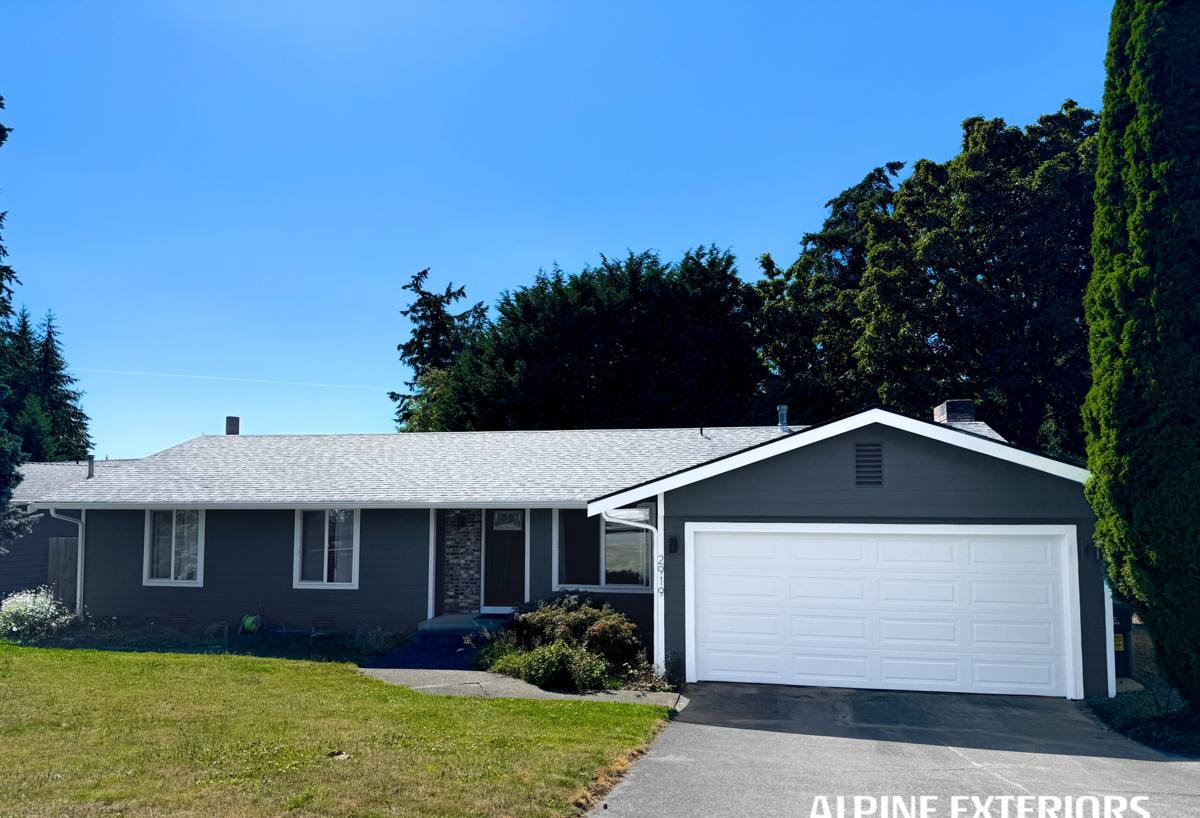
What Usually Drives a Replacement Decision Here
Most homeowners don't wake up one day and decide to replace their siding. It's usually a slow accumulation of small warning signs, or one specific problem — a soft spot near a window, a section that's visibly cupping — that prompts a closer look and reveals the issue is bigger than it first appeared. In Sudden Valley specifically, the properties we see needing full replacement rather than a repair tend to share a few things: heavy shade on at least one elevation, wood-based or engineered-wood siding that was never fully sealed at cut edges, and years of moisture that never had a good chance to dry out between storms because of the surrounding canopy.
Repair makes sense when the damage is isolated and the rest of the wall assembly underneath is sound. Replacement becomes the right call when the damage is spread across multiple sections, when moisture has clearly gotten behind the siding rather than just affecting its face, or when the material itself — regardless of how well it's held up so far — is a type we know doesn't perform well long-term in this kind of shaded, damp environment.
Signs a Sudden Valley Home Is Past the Point of Repair
- Soft or spongy siding when pressed near windows, doors, or corner trim
- Visible cupping, warping, or separation at multiple seams, not just one spot
- Moss or dark staining that keeps returning within weeks of being cleaned off
- Paint that won't hold no matter how often it's redone
- Rot found at the bottom edge of boards near grade or roof-to-wall transitions
- Visible daylight, drafts, or water staining on interior walls near an exterior wall
- Siding original to a home built more than 20-25 years ago, especially on shaded elevations
Any single item on that list doesn't automatically mean a full tear-off. But two or three together, especially on a shaded wall, usually mean the underlying wall assembly has been absorbing moisture for a while — and that's worth an honest, in-person look rather than another round of caulk and paint.
What Tear-Off Usually Reveals
This is the part homeowners are rarely prepared for, and it's the whole reason a proper replacement matters more than just swapping the visible material. Once old siding comes off a shaded Sudden Valley wall, it's common to find a weather-resistive barrier that's torn, poorly lapped, or missing in sections; sheathing that's gone soft or delaminated in spots where moisture has been sitting the longest; flashing at windows and penetrations that was never properly integrated with the barrier behind it; and fastener corrosion where hardware wasn't rated for sustained damp exposure.
None of that is visible from the outside before tear-off starts, which is why a fixed, sight-unseen quote for a full replacement is rarely realistic. We build a substrate-repair allowance into every replacement estimate for exactly this reason, and we walk homeowners through what we actually find once the wall is open, before we close it back up with anything new.
What a Legitimate Replacement Addresses, Beyond the Visible Siding
- Sheathing condition — replacing any soft, delaminated, or rotted panel sections found during tear-off
- Weather-resistive barrier — installing a continuous, properly lapped barrier rather than patching over gaps in the old one
- Flashing at every window, door, and penetration, integrated correctly with the new barrier so water sheds out and away
- Fastener selection rated for sustained damp, shaded exposure rather than a generic hardware grade
- Clearance above grade, roofline, and hardscape so the bottom courses aren't sitting in standing moisture
How the Job Should Be Done, Step by Step
- On-site assessment. We walk the property, look at every elevation individually — shade, orientation, and exposure vary more from wall to wall in Sudden Valley than on a typical open lot — and give an honest read on repair versus replacement before recommending either.
- Tear-off. Old siding and any compromised trim come off down to the sheathing, and we inspect the wall assembly underneath before anything new goes up.
- Substrate repair. Any soft or damaged sheathing gets replaced. This is the step that gets skipped by crews trying to keep a bid low, and it's the one that determines whether the new siding actually lasts.
- Weather-resistive barrier and flashing. A continuous barrier goes on, properly lapped, with flashing detailed at every window, door, and penetration so water is directed out rather than trapped behind the new cladding.
- Siding installation. New James Hardie fiber cement goes up to manufacturer specification — correct fastener type and spacing, correct clearance, and attention to which elevations need extra drainage detailing because they stay damp longer under tree cover.
- Trim, caulking, and touch-up. Finish details are sealed correctly rather than relying on caulk to cover gaps that should have been flashed.
- Cleanup and disposal. Old material, cutoffs, and debris are hauled off the property completely, which takes more planning on a wooded, sloped Sudden Valley lot than it does on a flat, open one.
Why We Rebuild the Wall in Hardie, Not a Like-for-Like Swap
When a homeowner is already paying for tear-off and disposal, replacing the old material with something that carries the same long-term risk rarely makes sense. We install James Hardie fiber cement exclusively — we don't install vinyl, LP SmartSide, Cemplank, Allura, primed spruce, or cedar. Fiber cement doesn't swell, cup, or absorb moisture the way wood-based products can, which matters directly on a shaded lot where a wall may not see full sun for most of the year. It's non-combustible, which is a real consideration on a heavily wooded property surrounded by forest. Its ColorPlus finish is baked on at the factory rather than field-applied, so it resists the fading and moisture-driven breakdown that a site-applied coating struggles with in constant damp. And Hardie builds climate-specific HZ formulations rather than one generic board, which is relevant in a place that stays wet as long as Sudden Valley does.
That's a professional standard, not a sales position. Other products have legitimate uses elsewhere, at different price points and in drier conditions. But on a replacement job — where we're already opening the wall and have the chance to rebuild it correctly — putting anything back up that we know struggles with sustained shade and moisture doesn't hold up to the reason the old siding failed in the first place.
What Drives Cost on a Sudden Valley Replacement
Every replacement estimate is specific to the home, but a few factors consistently move the price on Sudden Valley properties more than they would on a typical in-town job:
| Cost Factor | Why It Matters on a Sudden Valley Lot |
|---|---|
| Substrate condition behind old siding | Shaded, long-damp walls more often need sheathing repair than sunnier, drier walls do |
| Access and staging | Sloped lots and Sudden Valley's private road network can limit where a dumpster, material staging, or lift equipment can sit |
| Number and complexity of elevations | Hilly terrain means walls at different heights and angles relative to the house, which changes scaffolding and access needs wall by wall |
| Amount of trim and detail work | Homes with more windows, dormers, or architectural detail require more flashing and cut work per square foot of siding |
| Disposal logistics | Hauling old material off a wooded, sloped property takes more time than a flat, open-access lot |
We give a written scope and a substrate-repair allowance up front, and we walk homeowners through any change before it happens, rather than surprising them with a number once the wall is already open.
Why a Crew That Already Works Sudden Valley Matters for This Job
Replacement work rewards familiarity with the specific property type more than most exterior projects do, because so much of what drives the outcome — where moisture has been sitting the longest, how to stage a dumpster and materials on a sloped, tree-lined lot, how to schedule around Sudden Valley's private road access — isn't something a crew figures out well on their first visit. A contractor who works this community regularly already knows which elevations tend to need extra sheathing repair before they even open the wall, and has a working sense of how to move equipment and debris on lots where a flat, wide driveway isn't a given.
That familiarity doesn't replace a proper on-site assessment of your specific home, but it does mean fewer surprises once the old siding comes off, and a more accurate estimate from the start.
Our Process, Start to Finish
We start with a free, honest walk-through of the exterior, wall by wall, and tell you plainly whether your home needs full replacement or whether targeted repair will hold for a while longer. If replacement is the right call, we put together a clear written scope, a substrate-repair allowance, and a realistic timeline before any tear-off begins. We handle disposal and cleanup completely, and we don't consider the job finished until the new James Hardie siding is installed to specification — not just visually complete.
If you're seeing warning signs on a Sudden Valley home, or you just want an honest opinion on whether repair or full replacement makes more sense, we're glad to take a look. Reach out using the form below for a free, no-pressure estimate.