 Bellingham
 James Hardie Siding for Birch Bay Homes
Birch Bay sits directly on the water in northern Whatcom County, and that location is exactly why we treat siding differently out here than we would on a home set back a few miles inland. Salt-laden marine air, wind-driven rain that comes in sideways off the bay, and a moss season that can run most of the year on shaded walls all put steady pressure on a home's exterior. Siding that looks fine going up can still fail early in this environment if the wrong material was chosen or the installation cut corners that don't show up until a few wet seasons in.
This page is specifically about James Hardie fiber cement siding as it applies to Birch Bay properties — the product lines that fit this climate, what a correct installation actually involves here, and how we run a project on this stretch of coastline. We install James Hardie exclusively. We don't offer LP SmartSide, vinyl, Cemplank, Allura, primed spruce, or cedar, and the reasoning behind that decision matters more on a waterfront lot like this than it does almost anywhere else in the county.
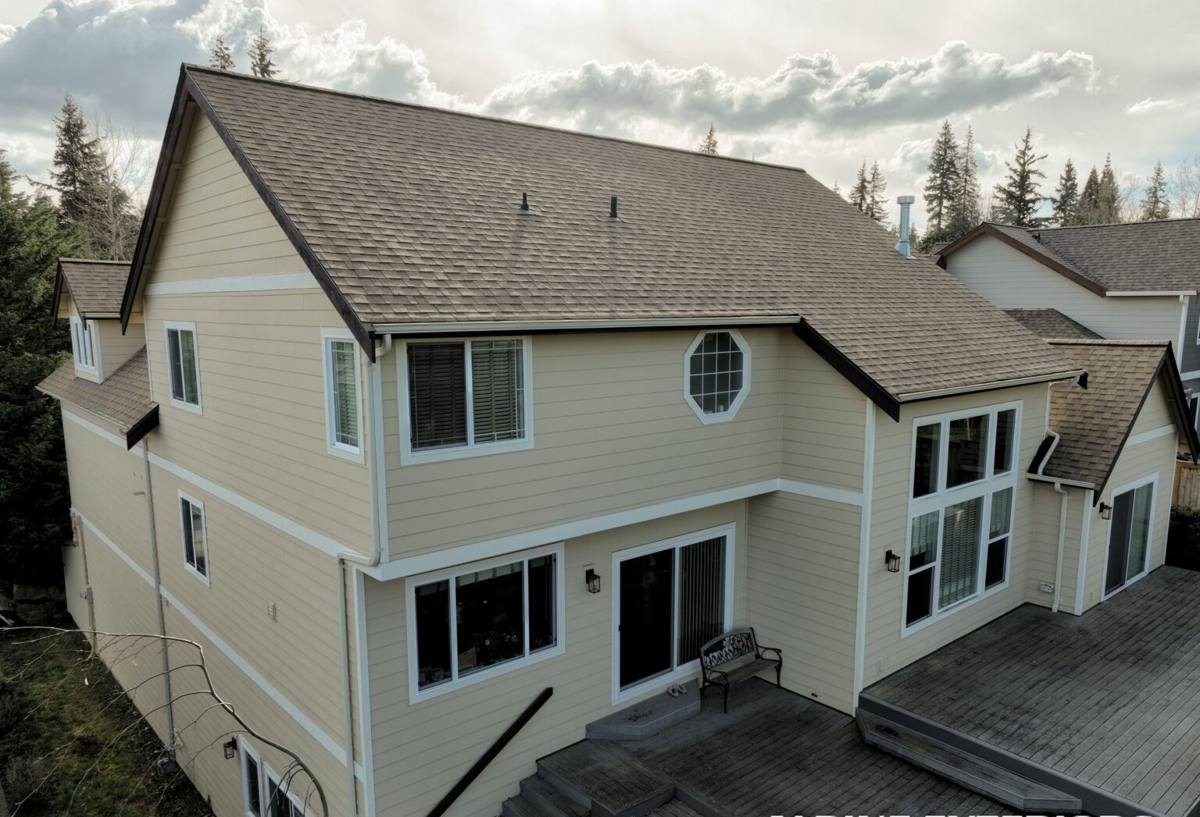
What Birch Bay's Climate Asks of Siding
Salt Air and Corrosion
Homes directly on Birch Bay take on more salt exposure than properties even a short distance inland. Salt accelerates corrosion in fasteners, flashing, and trim, and it wears down lower-quality finishes faster than a drier climate would. Siding material matters here, but so does every piece of hardware behind it — a good board with the wrong fastener spec still fails early in salt air.
Wind-Driven Rain
Waterfront exposure means more wind, and wind-driven rain doesn't behave like a simple annual rainfall total suggests. It gets pushed sideways into laps, seams, and trim transitions, which is a heavier and more sustained moisture load than a sheltered inland wall ever sees. Siding and flashing details that hold up fine a few miles away can leak here specifically because the water is coming from the side, not straight down.
A Long Moss Season
Mild temperatures, shade, and near-constant dampness add up to a moss and mildew season that runs most of the year on north-facing and tree-shaded walls around Birch Bay. Any siding surface that holds moisture against itself, or that's porous enough for organic growth to get a foothold, becomes a maintenance problem faster here than it would in a drier region.
The James Hardie Product System
HZ5 Formulation for This Region
James Hardie engineers its fiber cement differently depending on climate zone. The HZ5 formulation is built for regions that see sustained moisture exposure and freeze-thaw cycling, which describes coastal Whatcom County well. Using the region-appropriate HZ line isn't a minor spec detail — it's part of what makes the product perform the way it's designed to over decades instead of years, and it's part of what keeps the manufacturer's warranty valid.
Siding Profiles Available
Hardie's fiber cement system covers more than one look, and most Birch Bay homes end up using a combination rather than a single profile:
- HardiePlank lap siding — the most common profile, horizontal boards that overlap to shed water; available in several widths and textures
- HardieShingle siding — a shingle-style look for homes wanting a more traditional or coastal-cottage appearance, without the moisture sensitivity of real wood shingle
- HardiePanel vertical siding — full sheets used for a modern look or in combination with board and batten detailing
- HardieTrim boards — trim around windows, doors, corners, and rooflines that matches the siding's durability instead of relying on a softer wood trim that weathers faster
Mixing profiles — lap siding on the main field with trim and shingle or panel accents at gables or entries — is common on this part of the coast and doesn't compromise performance as long as every transition between profiles is flashed correctly.
ColorPlus Technology: Factory Finish vs. Field-Painted
Most James Hardie siding installed today uses the ColorPlus finishing system — color baked onto the board in a controlled factory process rather than brushed or sprayed on site after installation. That distinction matters more in a marine climate than it would somewhere drier, because field-applied paint depends entirely on weather conditions during application and tends to break down faster under sustained UV and salt exposure. A factory-cured finish goes on before the board ever sees a job site, which gives it better adhesion and color retention over time.
Hardie backs its fiber cement with a strong, transferable limited warranty, and ColorPlus finishes carry a separate finish warranty on top of that. Both depend on the product being installed to Hardie's published specifications — a warranty on paper doesn't help if the installation itself created the moisture path that caused the failure.
On the field side, the only paint work involved with ColorPlus siding is priming cut edges before installation, since factory color doesn't extend to a freshly cut board end. That's a small detail, but skipping it is one of the more common shortcuts on a rushed install, and it's exactly the kind of edge that salt air and driving rain will find first.
What a Correct Installation Involves Here
The material itself is only half of what determines how Hardie siding performs on a Birch Bay home. Installation detail carries at least as much weight in this climate:
- House wrap or weather-resistive barrier installed and correctly lapped, shingle-style, before any siding goes up
- A drainage gap or rainscreen behind the siding on walls with heavy wind-driven rain or shade exposure, so any moisture that gets past the surface can dry out rather than sit against the sheathing
- Corrosion-resistant fasteners, sized and spaced to Hardie's specification rather than a generic national standard
- Correct clearance from grade, roof lines, and decks — Hardie specifies minimum gaps that keep the bottom edge of the siding from sitting in standing water or snow
- Properly lapped and sealed flashing at every window, door, and roof-to-wall transition, since these are the most common places water gets behind siding on waterfront homes
- Field-cut edges primed before installation to protect the exposed core where factory ColorPlus finish doesn't reach
Skip any one of these and the siding can still look correct for a year or two. The consequences — staining at seams, soft trim, paint or caulk failure at joints — take a few wet seasons to surface, which is exactly why a corner-cutting install can get away with it right up until the homeowner is the one dealing with the repair.
Correct Installation vs. a Corner-Cut Install
| Detail | Correct Installation | Corner-Cut Installation |
|---|---|---|
| Drainage behind siding | Rainscreen or drainage gap on exposed and shaded walls | Siding fastened tight to the wall with no gap |
| Fasteners | Corrosion-resistant, spec-correct spacing | Standard fasteners, spaced by eye |
| Flashing at openings | Lapped and sealed to shed water at every transition | Caulk relied on in place of proper flashing |
| Cut edges | Primed before installation | Left unprimed or primed after the fact |
| Clearance from grade/roof | Meets Hardie's minimum gap specification | Siding run close to grade or roof deck |
| Warranty status | Installation supports the manufacturer warranty | Warranty risk if a claim is ever filed |
Both installs can look identical from the curb on day one. The difference shows up years later, and by then it's a repair rather than a five-minute fix.
Our Process for a Birch Bay Project
Walkthrough and Assessment
We start on site, looking at which walls take the most direct weather, which are shaded and slower to dry, and whether the existing wall assembly already has moisture issues that need addressing before new siding goes up. Hardie siding installed over a wall with hidden rot just buries the same problem under new material.
Product and Color Selection
We walk through profile options — lap, shingle, panel, and trim combinations — along with ColorPlus color choices, so the final look matches the home and the HOA or neighborhood context if one applies.
Installation to Manufacturer Spec
Every fastener, gap, and flashing lap follows James Hardie's published requirements for this climate zone. That's what keeps the manufacturer's warranty intact and what determines whether the siding performs for decades instead of years.
Final Walkthrough
We walk the finished job with you, cover what little maintenance ColorPlus fiber cement actually needs, and make sure you know what to look for if you ever want to check the siding yourself down the road.
Why Hire a Crew That Already Works Birch Bay
Siding installed on a Birch Bay waterfront lot needs to account for exposure most inland Whatcom County homes never deal with. A crew that's worked this stretch of coastline through multiple wet seasons already knows which walls need extra drainage detailing because of shade or tree cover, how much fastener corrosion resistance actually matters this close to the water versus what a generic spec sheet assumes, and where flashing tends to fail first on homes with this kind of direct salt and wind exposure. That judgment doesn't show up on a product brochure — it shows up in whether the siding still looks and performs the same in twenty years or is showing seam staining and soft trim in five.
Cost Factors for James Hardie Siding in Birch Bay
James Hardie siding is a mid-to-upper range material choice, and the final cost on any given home depends on more than square footage alone:
| Factor | Why It Matters |
|---|---|
| Profile mix | Combining lap, shingle, panel, and trim adds material and labor complexity versus a single profile |
| Wall height and complexity | More corners, dormers, and transitions mean more cuts and flashing details |
| Existing wall condition | Rot or moisture damage found during tear-off needs repair before new siding goes up |
| Drainage detailing | Rainscreen or drainage gap installation adds labor but pays off in this climate |
| Access and site conditions | Waterfront lots with steep grades or limited access can add labor time |
We'll walk your specific home and give real numbers rather than a rough estimate based on square footage alone — two Birch Bay homes with similar footprints can land at very different costs depending on exposure, existing wall condition, and how much trim and flashing detail the layout calls for.
Getting It Right the First Time
Siding on a waterfront property in this climate isn't a good place to find out an installer skipped drainage detailing or used the wrong fastener spec. The material itself, James Hardie's HZ5 fiber cement with a factory ColorPlus finish, is built to handle salt air, driving rain, and a long moss season. Whether it actually does comes down to installation, which is why we treat the planning and detailing on every Birch Bay project as carefully as the install itself.
If you're weighing James Hardie siding for a home in Birch Bay, we're happy to walk the property, talk through what your specific walls and exposure need, and give you a straightforward, no-pressure estimate. There's a form below — reach out and we'll set up a time to take a look.