 Bellingham
 Birchwood's Climate Is Harder on Siding Than It Looks
Birchwood doesn't get hurricanes or hailstorms, and that's part of the problem — it's easy to assume the siding on a Bellingham home just needs to look decent and keep the rain out. What actually happens is slower and less obvious. Marine air off the Salish Sea carries salt that settles on exterior surfaces and accelerates corrosion on anything metal — fasteners, flashing, trim screws. Wind-driven rain, especially during fall and winter storms, doesn't just fall straight down; it gets pushed sideways into laps, seams, and butt joints where a lot of siding failures actually start. And Whatcom County's long stretch of damp, mild months means moss and algae have months at a time to take hold on north-facing walls and shaded siding before a dry spell ever shows up to slow them down.
None of these forces are dramatic on their own. Together, over years, they're exactly what separates a siding job that still looks good at year fifteen from one that's chalking, staining, and letting water behind the wall by year eight. Any siding product installed in Birchwood has to be chosen and installed with that reality in mind, not the sunbelt conditions most siding marketing is written for.
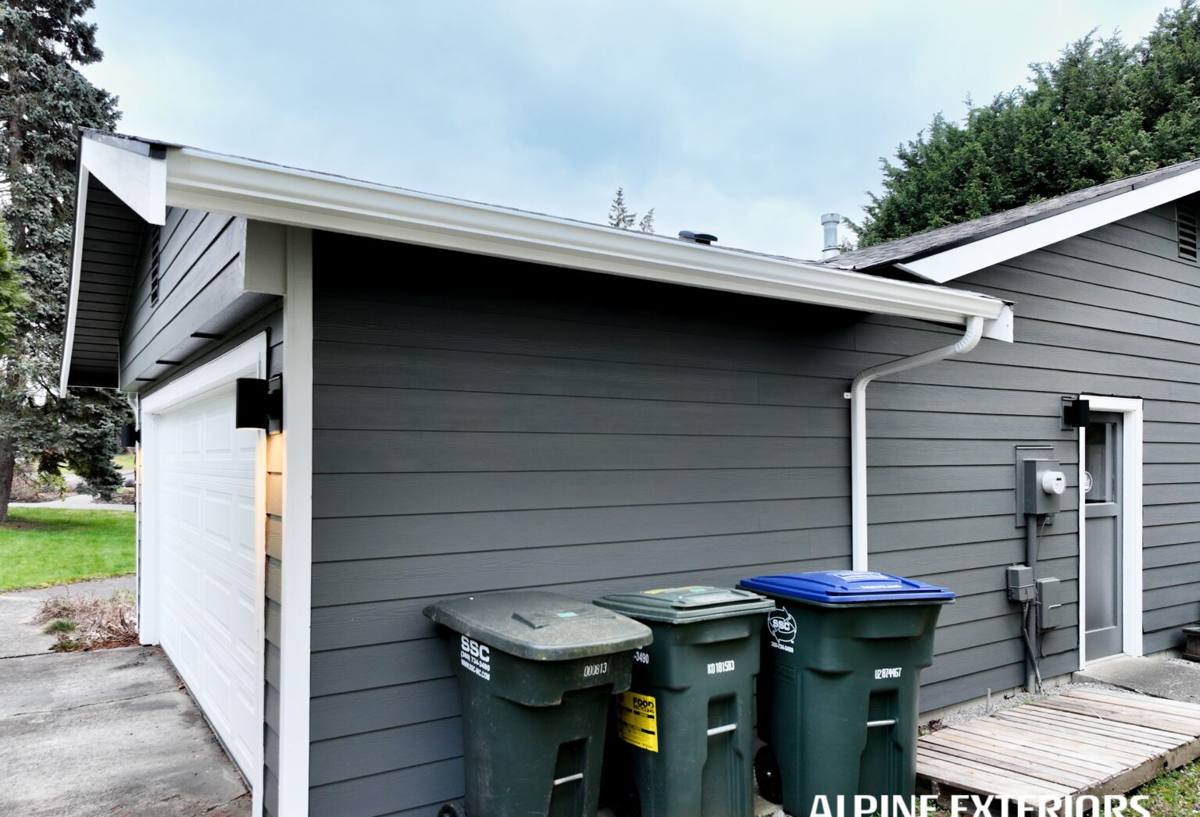
Why We Standardized on Fiber Cement for Homes Like These
We only install James Hardie fiber cement siding — no LP SmartSide, no vinyl, no Cemplank or Allura, no primed spruce or cedar. That's not a marketing position, it's a decision we made after weighing how each of those products actually holds up in a wet, salt-influenced, moss-prone climate over the long haul.
Wood siding can look great, but it needs a maintenance commitment — repainting, re-caulking, and vigilance about moisture — that most homeowners underestimate until they're a decade in. Vinyl is low-maintenance in the sense that you don't paint it, but it expands and contracts with temperature swings, and in a region with driving rain it depends heavily on what's behind it, since vinyl itself isn't a weather barrier so much as a cladding. Engineered wood products bring their own moisture-management requirements at cut edges and seams. Fiber cement, done right, sidesteps most of these specific weak points: it doesn't rot, it's non-combustible, it holds paint (or in Hardie's case, a factory-baked finish) far longer than field-applied coatings, and it's dimensionally stable enough that it doesn't buckle or gap the way some alternatives do in freeze-thaw cycles. That combination is why it's the only product we put on Birchwood homes.
What "ColorPlus" Actually Buys You Here
James Hardie's ColorPlus finish is baked on and cured at the factory under controlled conditions, rather than sprayed or brushed on-site. In a climate where salt air and UV both work to break down field-applied paint, that matters — the finish resists fading and chalking longer, and touch-up product is formulated to match rather than requiring a full repaint when a scuff needs attention.
The Right Product Line for This Zone
James Hardie engineers its siding by climate zone under what it calls HardieZone, and Bellingham falls into the zone formulated for wetter, more humid conditions. That's not a marketing detail — it affects the substrate formulation itself, aimed at performing in exactly the kind of damp, marine-influenced weather Whatcom County gets most of the year.
| Product | Typical Use on Birchwood Homes |
|---|---|
| HardiePlank lap siding | Primary field siding on most single-family homes; the workhorse product for full re-sides |
| HardiePanel vertical siding | Accent walls, gables, or a modern look on additions and porches |
| HardieShingle | Accent siding on gables or dormers where a shingled look fits the home's style |
| HardieTrim boards | Corner boards, window and door trim, fascia — detail work that takes the brunt of driving rain |
Color and texture choices (smooth, cedar-shake texture, various ColorPlus tones) are largely aesthetic, but the product selection above is where climate performance actually gets decided.
What a Correct Installation Involves
Fiber cement siding is only as good as the wall assembly behind it. This is where a lot of the real protection against Bellingham's driving rain and moisture actually happens — and where a rushed or unfamiliar install shows up as a callback two or three winters later.
Drainage Plane and Flashing
Hardie siding should be installed over a code-compliant water-resistive barrier, with flashing integrated at every window, door, and roof-to-wall intersection so water is directed out and down rather than trapped. In a climate that gets sustained wind-driven rain, gaps in this layer are where moisture gets in — not through the siding face itself.
Fasteners and Clearances
Given the salt content in the air here, fastener selection matters more than it would inland. Corrosion-resistant fasteners, correct nailing patterns per Hardie's installation specs, and proper clearance between the bottom of the siding and grade, decks, or roof lines all help keep moisture from wicking into the bottom courses — one of the most common failure points on older Bellingham-area homes we've assessed.
Caulking and Cut Edges
Factory-cut edges and any field cuts need to be sealed per manufacturer spec, and caulk should only be used where Hardie's details actually call for it — over-caulking joints that are supposed to be able to move or drain can trap water just as easily as leaving a real gap unsealed.
- Water-resistive barrier installed and lapped correctly, with no gaps at penetrations
- Flashing integrated at every window, door, and roofline intersection
- Corrosion-resistant fasteners driven per Hardie's nailing pattern, not overdriven
- Minimum clearance maintained between siding and grade, roofing, and decking
- Cut edges primed or sealed before installation
- Caulk used only at manufacturer-specified joints, not as a substitute for flashing
- Rainscreen or drainage gap included where wall assembly calls for it
Moss, Algae, and What Homeowners Should Actually Watch For
Moss and algae staining on siding is mostly a cosmetic and maintenance issue rather than a structural one when the siding itself is fiber cement — but it's not something to ignore. Moss holds moisture against the wall surface for extended periods, which can degrade caulk joints and trim faster than it would otherwise, and heavy growth in gutters or against the bottom courses of siding can create standing moisture right where clearance matters most.
A simple annual rinse (not pressure-washed directly into seams), keeping gutters clear, and trimming back vegetation that shades a wall and keeps it damp will do more for long-term appearance and performance than any product choice alone. This is true regardless of what siding is on the house, but it's especially relevant on shaded, north-facing walls that are common in this part of Whatcom County.
Cost Factors on a Birchwood Project
| Factor | Why It Affects the Job |
|---|---|
| Home size and wall complexity | More corners, gables, and dormers mean more trim work and cut waste |
| Condition of existing sheathing | Moisture damage found during tear-off needs repair before new siding goes up |
| Trim and accessory scope | Full trim replacement vs. reusing sound existing trim changes both cost and long-term performance |
| Product mix | Plank-only jobs are simpler than jobs mixing plank, panel, and shingle accents |
| Site access | Sloped lots, tight setbacks, or limited staging area affect labor time |
| Old siding removal and disposal | Tear-off and haul-away of old material adds to scope on most re-sides |
We won't quote a number without seeing the house — anyone who does hasn't accounted for what's actually behind the existing siding.
Our Process on Birchwood Homes
- Assessment — we check the condition of existing siding and, where accessible, moisture levels in the wall assembly before recommending anything
- Tear-off and sheathing check — old siding comes off and sheathing gets inspected for rot or moisture damage before we cover it back up
- Water-resistive barrier and flashing — installed and integrated at every penetration per code and manufacturer spec
- Hardie installation — panels, planks, or shingles installed to manufacturer fastening and clearance specs
- Trim, caulk, and finish detail — the work that determines how the job actually performs in driving rain, not just how it looks on install day
- Final walkthrough — we go over the finished work and warranty registration with the homeowner directly
Why Hiring a Crew That Already Works in Birchwood Matters
A siding crew that already knows Bellingham's weather patterns isn't guessing at how much clearance to leave at grade, which walls take the worst of the driving rain, or why fastener corrosion resistance isn't optional here. That familiarity shows up in details — flashing choices, fastener selection, where extra attention to sealing gets paid — that a crew installing mostly in drier climates might not think twice about. It also means we're not learning Whatcom County's permitting and inspection process on your project; we already know what local building departments expect to see.
If you're planning a re-side in Birchwood, or you're not sure whether your current siding still has years left in it, we're happy to take a look. Reach out for a free, no-pressure estimate using the form below.