 Bellingham
 Why Cordata Roofs Wear Differently Than You'd Expect
Homeowners in Cordata are often surprised at how much faster a roof shows its age here compared to what the shingle manufacturer's warranty paperwork implies. It isn't bad luck or a bad install ten years ago — it's the environment. North Bellingham sits close enough to the water that salt-laden air reaches roof surfaces, the Pacific storm track sends driving, wind-blown rain at the house instead of straight down, and the shaded, damp winters give moss months at a time to get established on north-facing slopes and valleys. A roof built for a drier, calmer climate simply doesn't hold up the same way out here.
This page is about one job: putting a correctly built new roof on a Cordata home, not a generic overview of roofing everywhere. If you're comparing bids or trying to understand why one quote looks different from another, the details below should help.
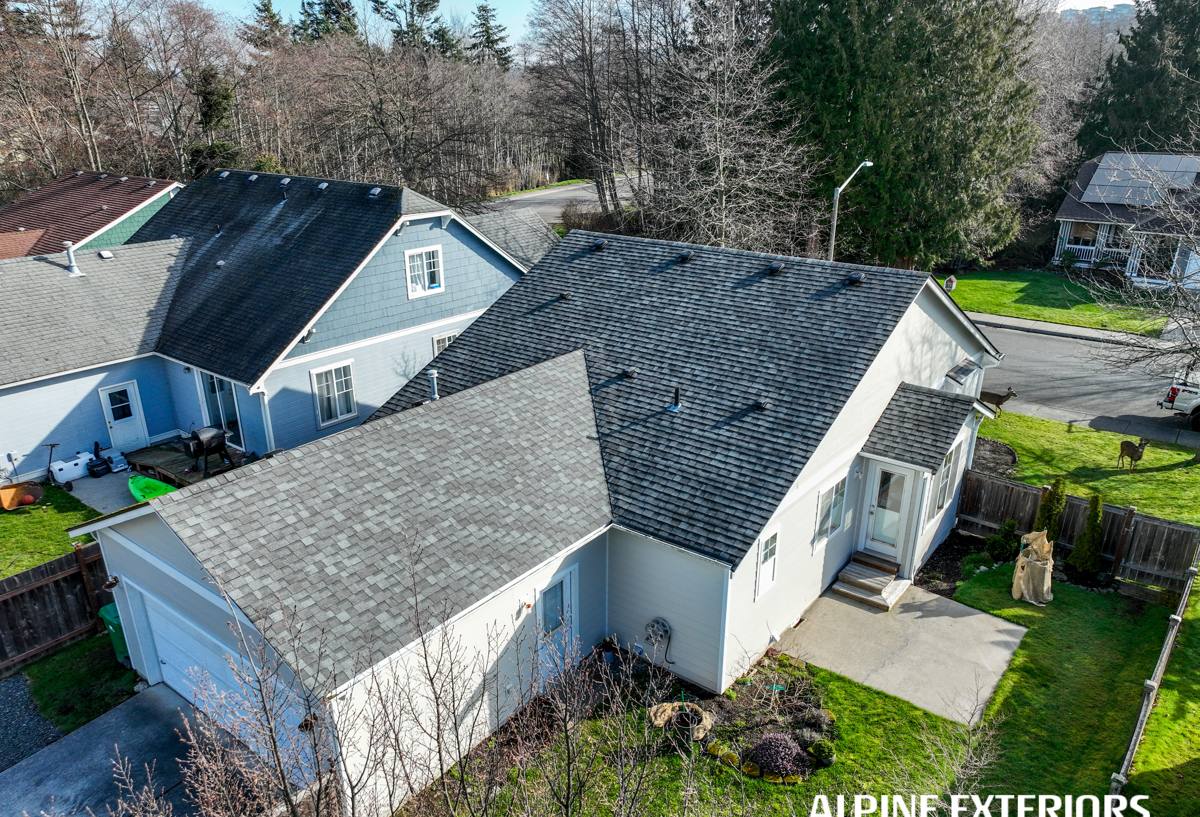
What Cordata's Climate Actually Demands From a New Roof
Salt Air
You don't have to live directly on the waterfront for salt air to matter. Airborne salt travels with the marine wind and settles on roofing metal, fasteners, and flashing across the wider Bellingham area, including neighborhoods set back from the shoreline. Over years, that accelerates corrosion on lower-grade metal components — exposed nails, cheap flashing, uncoated valley metal — long before the shingles themselves fail.
Driving Rain
Whatcom County rain rarely falls straight down. Wind pushes it sideways and up under laps, edges, and penetrations that would stay dry in a calmer climate. That's a detailing problem more than a materials problem — it's solved with correct underlayment coverage, properly lapped flashing, and sealed penetrations, not just a heavier shingle.
The Moss Season
Shade, moisture, and mild temperatures give moss and algae a long runway to establish on Cordata roofs, especially north- and east-facing slopes near trees. Left alone, moss lifts shingle edges, holds moisture against the roof deck, and shortens the life of the whole system — regardless of how good the shingle itself is.
Signs a Cordata Home Needs a New Roof, Not Another Repair
Not every roof problem calls for full replacement, and we won't sell you one if a repair genuinely solves it. But there's a point where patching stops being the honest answer. Common signs we see on Cordata homes include:
- Granule loss heavy enough that you can see bare asphalt on multiple slopes, not just one worn spot
- Shingles that are cupping, curling, or cracking across large sections rather than isolated storm damage
- Moss or moss staining that keeps returning within a season or two of cleaning, even after treatment
- Soft spots, sagging, or visible daylight in the attic near eaves and valleys
- Recurring leaks around chimneys, skylights, or valleys despite prior flashing repairs
- A roof already past, or close to, its material's realistic service life for this climate
If you're only seeing one or two of these in a limited area, a repair may still be the right call — and we'll tell you that during the estimate.
What a Correct New Roof Installation Involves
A new roof is more than laying new shingles over what's there. Done right for this climate, the job includes several steps that matter more here than in drier regions:
Full Tear-Off and Deck Inspection
We remove existing roofing down to the deck so we can actually see what's underneath. Years of moisture intrusion in this climate can soften or rot sheathing in spots that look fine from above. Any damaged decking gets replaced before anything new goes down — building over a compromised deck just hides the problem.
Underlayment Built for Wind-Driven Rain
Given how often rain gets pushed sideways here, underlayment coverage and lap direction matter as much as the underlayment product itself. We pay particular attention to eaves, valleys, and low-slope transitions, where wind-driven water is most likely to find a way in.
Flashing and Metal Details
Flashing around chimneys, skylights, sidewalls, and valleys is where most roof leaks actually start — not in the field of the shingles. We use corrosion-resistant metal appropriate for a marine-influenced climate and make sure every lap, seal, and termination is done to shed water, not just look finished.
Ventilation
Balanced intake and exhaust ventilation keeps the attic temperature and moisture level in check, which matters for both energy efficiency and moss/moisture control from the underside of the deck. A roof can be installed perfectly on the surface and still fail early if ventilation is wrong.
Moss-Resistant Details Where They Make Sense
On shaded slopes, we'll talk through options like zinc or copper strips near the ridge, which discourage moss regrowth over time as rainwater carries trace metal down the roof face. It's not a substitute for periodic cleaning, but it reduces how often that cleaning is needed.
Roofing Material Options for Cordata Homes
There's no single "best" roofing material — it depends on your budget, your roof's exposure to shade and moisture, and how long you plan to stay in the home. Here's how the common options actually perform in this climate, honestly:
| Material | Typical Lifespan Here | Moss & Moisture Behavior | Relative Cost |
|---|---|---|---|
| Architectural asphalt shingle | 20–30 years | Good with proper ventilation and periodic moss removal | Moderate |
| 3-tab asphalt shingle | 15–20 years | More prone to curling and moss lift over time | Lowest |
| Standing seam metal | 40+ years | Sheds moisture well; moss struggles to hold on smooth metal | Higher |
| Synthetic/composite shingle | 30–50 years | Resists moisture absorption better than wood; performance varies by product | Higher |
| Cedar shake | 20–30 years with diligent upkeep | Attractive but demanding — traps moisture and needs frequent moss/algae maintenance in this climate | Highest |
On cedar specifically: it's a traditional Pacific Northwest look, and we're happy to install it if that's what a homeowner wants. But our professional standard is to be upfront that wood roofing carries a heavier maintenance burden in a climate this wet and shaded — it needs more frequent moss treatment and inspection than composite or metal to reach a comparable service life. That's a maintenance trade-off, not a knock on the material.
Our Process, Start to Finish
- Free on-site estimate. We walk the roof (or inspect from ground/ladder if pitch or access requires it), check the attic if accessible, and give you an honest read on repair vs. replacement.
- Written scope and quote. You get a clear breakdown of materials, tear-off, deck repair allowance, flashing, and ventilation work — no vague line items.
- Scheduling around Whatcom County weather. We plan install windows with realistic rain forecasts in mind and stage materials to keep the deck covered and dry between steps.
- Tear-off and deck inspection. Old roofing comes off, decking is inspected and repaired as needed, and we document anything that changes the original scope before proceeding.
- Underlayment, flashing, and field installation. Installed in the sequence and lap direction that actually sheds wind-driven rain, not just rain falling straight down.
- Ventilation check and correction. We confirm intake and exhaust venting is balanced for your attic size and roof design.
- Final walkthrough and cleanup. Magnetic sweep for nails, debris hauled off, and a final walk-through so you know exactly what was done.
What Actually Drives the Cost of a New Roof in Cordata
| Cost Factor | Why It Matters |
|---|---|
| Roof size and pitch | More square footage and steeper pitches mean more material, labor time, and safety setup |
| Number of tear-off layers | Removing multiple old layers costs more in labor and disposal than a single-layer tear-off |
| Deck repair needed | Rotted or soft sheathing found during tear-off has to be replaced before new roofing goes down |
| Flashing and penetration complexity | Chimneys, skylights, multiple valleys, and dormers all add detailing time |
| Ventilation upgrades | Adding or correcting intake/exhaust venting is worth doing right the first time |
| Material choice | Asphalt, metal, synthetic, and cedar carry very different material and labor costs |
Because of these variables, we don't give ballpark numbers over the phone without seeing the roof — a flat roof with simple penetrations and a steep roof with three valleys and a chimney are not the same project, even if the square footage looks similar on paper.
Why a Crew That Already Works Cordata Matters
Roofing crews that work across a lot of different climates tend to build to a generic standard. A crew that regularly works Cordata and the surrounding Bellingham neighborhoods already knows which slopes hold moss longest based on tree cover and sun exposure, which flashing details tend to fail first in this rain pattern, and how local permitting and inspection typically go in Whatcom County. That local repetition shows up in fewer callbacks and a roof that's actually built for what it's going to face here — not for an average national climate.
Questions Worth Asking Before You Hire
- Are you licensed and insured to work in Washington, and can you provide proof?
- Will you do a full tear-off and deck inspection, or install over existing layers?
- What underlayment and flashing materials do you use, and why for this climate?
- How will you handle attic ventilation as part of the install?
- What's your plan for keeping the deck dry if weather changes mid-project?
- Is the workmanship warranty separate from the manufacturer's material warranty, and what does each actually cover?
A contractor who answers these clearly and specifically, without dodging into brand names alone, is usually one who understands the job rather than just selling a product.
Get a Straightforward Estimate
If your Cordata roof is showing its age, or you just want an honest opinion on whether repair or replacement makes more sense, we're glad to take a look. Fill out the form below for a free, no-pressure estimate — we'll tell you what we actually see, not what's easiest to sell.