 Bellingham
 Blaine's Waterfront Climate and What It Does to a Deck
Blaine sits at the northern edge of Whatcom County, right where Puget Sound meets the Canadian border, and that location comes with a specific set of conditions most inland decks never have to deal with. Salt-laden air moves in off the water on a regular basis, driving rain comes in sideways during fall and winter storms, and a long stretch of damp, overcast months each year keeps every horizontal surface wet enough, long enough, for moss and algae to take hold. None of that is unusual for anyone who has lived in this part of Whatcom County for a while — but it adds up fast on an outdoor deck.
Salt air is corrosive to unprotected metal fasteners and hardware over time. Driving rain finds its way into any gap in the decking boards, railing joints, or the ledger board connection to the house. And moss season — which around Blaine can realistically run from early fall through late spring — holds moisture against wood and composite surfaces alike, feeding rot in the framing underneath and turning the decking surface slick and stained. A deck that was built or repaired without those specifics in mind will show its age years before it should.
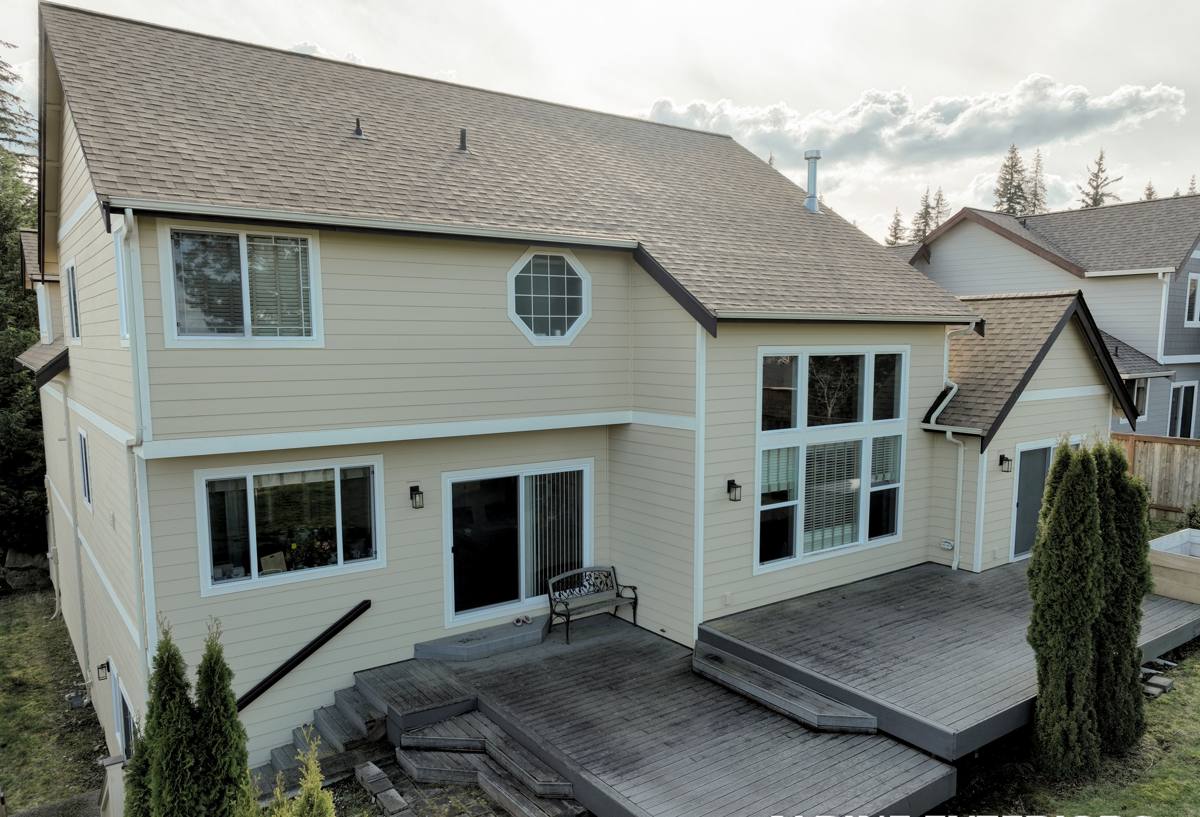
Repair or Replace? Reading the Signs
Not every tired-looking deck needs to come out. Sometimes a few boards, a section of railing, or a coat of finish is genuinely all it needs. The signs below are what separate a maintenance job from a full replacement:
- Soft, spongy, or springy boards when you walk across the deck
- Fasteners that have rusted, backed out, or left dark staining in the wood around them
- A ledger board pulling away from the house, or gaps opening up at the flashing
- Support posts or footings that have shifted, cracked, or show rot at the base
- Railings or stair stringers that flex or wobble under hand pressure
- Persistent green or black staining that pressure washing no longer removes
If you're only seeing one or two of these and the framing underneath is sound, repair can still make sense. Once the substructure itself is compromised — the ledger, the joists, or the footings — patching the visible decking only hides the real problem for another season or two before it resurfaces, usually as a bigger repair bill.
What a Correct Deck Replacement Actually Involves
A deck replacement isn't just pulling up old boards and laying down new ones. Done right, it's a rebuild of the structure the decking rides on, with specific attention to the parts of the system that fail first in a wet, salty coastal climate.
Substructure and Footings
Everything starts underneath the surface. Footings need to be sized and set to current code, posts need to bear on solid, undisturbed soil, and the ledger board — where the deck attaches to the house — needs proper flashing and fastening so water is directed away from the house framing rather than into it. This is the single most common place we find hidden rot on older Blaine decks: a ledger that was face-nailed without flashing decades ago, quietly letting water into the rim joist ever since.
Decking Material Options
The right decking material depends on budget, how much upkeep you want to do, and how exposed the deck is to wind-driven rain and salt air. Here's how the common options stack up:
| Material | Upfront Cost | Ongoing Maintenance | How It Handles Salt Air & Moisture |
|---|---|---|---|
| Pressure-treated wood | Lowest | Annual cleaning, periodic staining or sealing | Needs consistent upkeep or moisture works into end grain and fastener holes over time |
| Cedar | Moderate | Regular sealing to hold color and resist moisture | Naturally rot-resistant but still needs protection from prolonged wet exposure |
| Composite decking | Higher | Occasional washing, no staining or sealing | Resists rot and doesn't absorb moisture, though moss can still build up between boards and needs periodic cleaning |
| PVC / cellular decking | Highest | Lowest maintenance of the group | Fully moisture-resistant with no wood content to rot, generally the best fit for a high-moss, salt-air location |
We'll walk through this trade-off with you honestly rather than push one product line. A lower-maintenance material costs more today and less over the life of the deck; a wood deck costs less today but only holds up if someone keeps up with the sealing schedule. Neither answer is wrong — it depends on what you'd rather spend, time or money.
Fasteners, Flashing, and Hardware
This is where a lot of otherwise decent deck work falls short in a coastal environment. Standard zinc-coated screws and connectors corrode faster here than they would inland, and once a fastener starts rusting, it weakens and stains the wood or composite around it. Our standard is stainless steel or coated fasteners rated for coastal and treated-lumber exposure, along with self-adhering flashing tape at the ledger and any other point where the deck framing meets the house. It costs more than the hardware-store minimum, but it's the difference between hardware that lasts the life of the deck and hardware you're replacing again in five years.
Railings, Stairs, and Guardrail Code
Railings and stairs get replaced along with the decking on most full jobs, and for good reason — they take direct weather exposure and daily hand contact, and they're a safety item, not just a finish item. Current guardrail height, baluster spacing, and stair rail requirements are set by code, and older decks around Blaine were often built to whatever standard was current decades ago. When we replace a deck, we bring the railing and stair system up to current code as part of the job, not as an upsell afterward. That matters both for safety and for resale, since an out-of-code railing is a common item that shows up on a home inspection.
Our Deck Replacement Process, Start to Finish
- On-site evaluation. We look at the existing structure, note what's salvageable versus what isn't, and check the ledger, footings, and framing for hidden damage before quoting anything.
- Written scope and material selection. You get a clear breakdown of what's being replaced, what materials are being used, and why — no vague line items.
- Permitting. Deck replacements involving structural changes typically require a permit through the local jurisdiction; we handle that paperwork so you don't have to chase it down.
- Demolition and disposal. Old decking, railing, and any compromised framing come out and are hauled off the site.
- Framing rebuild. Footings, posts, beams, joists, and ledger flashing are installed or corrected to current code before a single decking board goes down.
- Decking, railing, and stairs installed. Using the material you selected, with coastal-rated fasteners and hardware throughout.
- Final walkthrough. We go over the finished deck with you, including basic care and what to watch for in the first year.
What Drives the Cost
Every deck is different, so we don't quote off a generic per-square-foot number until we've actually seen the site. These are the factors that move the price up or down:
| Factor | Why It Matters |
|---|---|
| Deck size and shape | More square footage and complex angles or multiple levels mean more material and labor |
| Condition of the existing framing | Hidden rot at the ledger or footings adds structural repair work beyond the decking itself |
| Decking material chosen | Pressure-treated wood, cedar, composite, and PVC span a wide price range |
| Height and access | A raised or hard-to-access deck takes more time and sometimes different equipment |
| Railing and stair scope | Bringing an out-of-code railing or stair system up to standard adds material and labor |
| Permit requirements | Structural changes typically require permitting and inspection, which adds time to the schedule |
Rather than throw out a broad range that doesn't mean much until we've seen your deck, we'll give you real numbers after the on-site evaluation, tied to the actual scope of work.
Living With Your New Deck: Salt Air and Moss Season Maintenance
Even the right materials and hardware do better with a little seasonal attention. A short annual routine keeps a new deck looking and performing the way it should for years:
- Sweep debris off the deck regularly, especially in fall when leaves and needles trap moisture against the boards
- Rinse or lightly wash the surface a couple of times a year to knock back early moss and algae growth before it sets in
- Keep gutters and downspouts near the deck clear so runoff isn't dumping directly onto it
- Check railing connections and stair treads once a year for any looseness
- For wood decking, re-stain or reseal on the schedule the product calls for — don't wait until it's visibly gray and dry
- Walk the deck's edges and steps after major storms to catch any shifting early
None of this is a big time commitment, but skipping it is exactly how a well-built deck ends up with the same moss and moisture problems as the one it replaced.
Why a Blaine-Experienced Crew Matters
A lot of deck problems we get called out to fix started with a design or a materials choice that would have been fine somewhere drier and inland, but wasn't a good match for a Whatcom County waterfront property. Fastener choice, flashing details, and even which decking material makes sense are all decisions that should account for salt air, driving rain, and a long moss season from the start, not get discovered as a problem five years later. A crew that already works in and around Blaine has seen how these decks actually hold up over time here, not just on a spec sheet.
If your deck is showing its age, or you're just not sure whether it needs repair or full replacement, we're happy to take a look and talk through it honestly. Reach out for a free, no-pressure estimate using the form below.