 Bellingham
 Why Puget-Area Siding Takes More Than a Standard Install
Homes in the Puget area of Whatcom County sit in one of the more demanding siding climates in the Lower 48 — not because of extreme heat or cold, but because of relentless moisture. Bellingham Bay and the greater Puget Sound push salt-laden air inland, driving rain comes in sideways off the water for months at a stretch, and the shaded, damp conditions common on north- and west-facing walls keep moss and algae growing nearly year-round. Siding here doesn't fail from one big storm. It fails slowly, from water finding a seam that wasn't sealed right, or from a product that can't shed moisture as fast as the climate delivers it.
That's the lens we use on every Puget-area job: this siding has to perform in wind-driven rain, resist salt-air corrosion at fasteners and trim, and hold its finish through a moss season that can run from fall through spring. A siding job that looks fine going up but wasn't built for this climate usually shows problems within a few winters — swelling at butt joints, staining, soft spots at the bottom courses, or moss establishing itself in surface texture that never fully dries out.
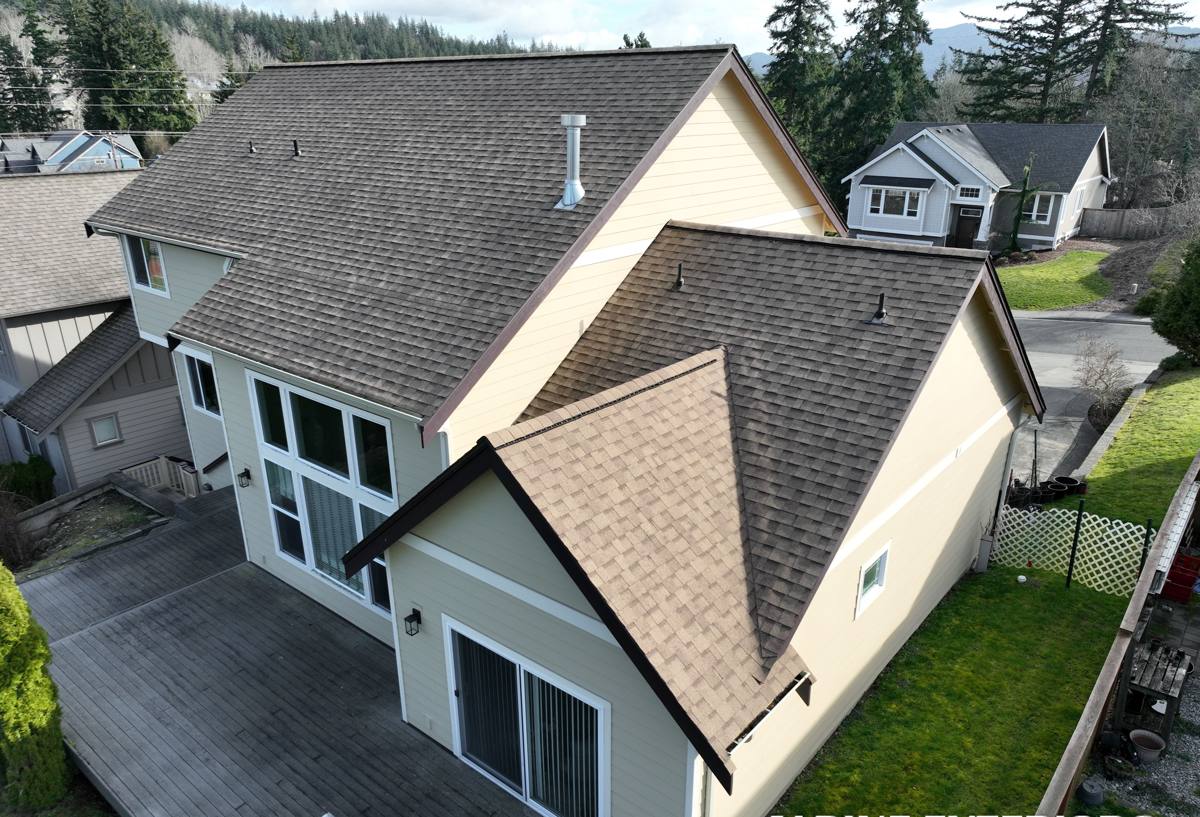
What a Correct Fiber Cement Job Involves Here
The Water Management Layer
Fiber cement siding is only as good as what's behind it. In a climate this wet, we don't treat the weather-resistive barrier and drainage plane as optional extras — they're the actual defense against moisture intrusion, and the siding is the finish layer on top of that system. A proper install includes a continuous weather-resistive barrier, correctly lapped and taped seams, and a drainage gap that lets any water that gets behind the siding find its way back out instead of sitting against the wall sheathing.
Flashing and Trim Details
Most siding failures we get called out to inspect in this region trace back to flashing, not the siding panel itself — missing kick-out flashing at roof-to-wall intersections, window and door heads without proper drip caps, or trim boards butted directly against a wall with no room for water to escape. Puget's driving rain finds every one of these gaps eventually.
Fastening for Salt Air
Corrosion-resistant fasteners matter more here than in drier inland climates. Salt air accelerates rust at exposed nail heads and trim fasteners, so we follow James Hardie's fastening specifications with corrosion-resistant nails or screws sized and spaced to the manufacturer's requirements — not generic construction fasteners.
Why We Only Install James Hardie
We install James Hardie fiber cement exclusively. We don't offer vinyl, LP SmartSide, primed wood, cedar, or other fiber cement brands, and that's a deliberate standard, not a lack of options. In a climate that punishes moisture mistakes and cycles through wet and dry conditions all year, we want a product with an engineered track record in this exact climate zone, a factory-applied finish that doesn't depend on field painting to perform, and a warranty structure backed by one manufacturer we can stand behind. James Hardie is non-combustible, holds up to the freeze-thaw and moisture cycling common in Whatcom County, and its ColorPlus finish is baked on at the factory rather than applied with a brush on site — which matters when the difference between a coating that lasts and one that doesn't is measured in Puget Sound winters, not Puget Sound summers.
The HardieZone System: What Fits a Puget-Area Home
James Hardie engineers its siding formulations by climate zone, and the Pacific Northwest falls into HZ5, the zone built for high-moisture, freeze-thaw conditions. That's not a marketing detail — it's the actual product engineering that determines how well the board resists moisture absorption and holds its dimensional stability through our wet season. On Puget-area homes we most commonly use:
- HardiePlank lap siding — the standard horizontal siding for most home styles, available in several textures and exposures
- HardiePanel vertical siding — used for board-and-batten looks or as an accent on gables and dormers
- HardieTrim boards — for corners, window and door casing, and fascia, matched to resist the same moisture exposure as the field siding
- HardieSoffit panels — for eaves and overhangs, where trapped moisture and moss growth are common in this climate
Color choice matters too. Darker ColorPlus finishes can show moss and algae growth faster on shaded elevations, so on north-facing walls or heavily treed lots we'll talk through finish options that hold up better to the specific microclimate of your lot, not just the house as a whole.
Our Process on a Puget-Area Job
1. On-Site Assessment
We walk the exterior and look specifically at moisture history — staining, soft trim, moss buildup patterns, and any existing flashing or drainage problems — before we talk product or price.
2. Tear-Off and Substrate Check
Removing the old siding lets us actually see the sheathing underneath. If there's rot or water damage from a prior installation's shortcuts, we address it before anything new goes up — covering a wet substrate with new siding just hides the problem for a few more years.
3. Water Management Install
Weather-resistive barrier, flashing at every penetration and transition, and a drainage gap where the assembly calls for it. This is the step that determines whether the siding lasts twenty years or forty.
4. Siding Installation to Spec
James Hardie panels and trim installed to manufacturer fastening, clearance, and caulking specifications — including the ground clearance and roof clearance details that keep splash-back moisture off the bottom courses, which is one of the first places we see problems on older Puget-area homes.
5. Final Walkthrough
We check seams, caulking, trim reveals, and flashing details before calling the job done, and we're straightforward about what maintenance the homeowner should expect going forward.
What It Costs: Factors That Actually Move the Number
Every home is different, so we won't put a fake number on this page — but these are the factors that genuinely drive cost on a Puget-area fiber cement project:
| Factor | Why It Matters Here |
|---|---|
| Tear-off condition | Rot or water damage found under old siding adds repair scope before new siding goes up |
| Wall complexity | Dormers, multiple gables, and cut-up elevations mean more trim and flashing labor |
| Siding profile and texture | Lap exposure, panel style, and texture (smooth vs. cedar-textured) affect material cost |
| Trim and accent scope | Vertical accents, soffit replacement, and trim board upgrades add to the total |
| Site access | Steep lots, tight setbacks, or limited staging space common in some Whatcom County neighborhoods affect labor time |
What to Expect From an Honest Bid
- A written scope that separates tear-off, repair, and new install — not one lump number
- Specific James Hardie product lines and colors named, not just "fiber cement siding"
- Flashing and drainage plane work called out explicitly, not assumed
- A clear fastening and warranty statement tied to James Hardie's requirements
- No pressure to sign same-day — a legitimate contractor expects you to compare bids
Living With Fiber Cement in a Wet, Mossy Climate
James Hardie siding installed correctly needs very little upkeep, but "very little" isn't "none," especially with Puget's moss season. A short annual routine keeps it looking right and catches small issues before they become expensive ones:
- Rinse siding annually with a garden hose and soft brush — avoid pressure washers, which can force water behind panels or damage the finish
- Check and clear gutters before the fall rains so overflow doesn't run down the siding face
- Trim back vegetation and tree canopy that keeps shaded walls damp longer than they need to be
- Re-caulk any joints where sealant has cracked or pulled away, particularly around windows and trim
- Watch north- and west-facing walls for early moss growth and address it before it spreads
Why Hiring a Crew That Already Works Puget Matters
Fiber cement installed to spec in Arizona and fiber cement installed to spec in a Puget Sound microclimate aren't the same job, even though the product is identical. The difference is in the water management details — the flashing, the drainage gap, the fastener spacing, the caulking judgment calls — that a crew only gets right consistently after doing it in this exact climate, on homes exposed to this exact combination of salt air, wind-driven rain, and moss pressure. A crew that's worked Whatcom County homes has already seen where the old installs failed and builds around those failure points as a matter of habit, not as a special add-on.
If you're planning a siding project in the Puget area and want to talk through what your home actually needs, we're glad to walk the exterior with you and give you a straightforward, no-pressure estimate — no invented urgency, just an honest look at the job.