 Bellingham
 Board & Batten Built for Sudden Valley's Particular Climate
Sudden Valley sits back in the trees along Lake Whatcom, and that setting is exactly what makes it different from a lot of the siding jobs we do closer to town. Homes here tend to sit under heavy fir and cedar canopy, with lots facing the lake and getting long shaded exposures that stay damp well after a storm has passed through the rest of Whatcom County. Add in the driving rain that comes off the Salish Sea through the winter and the long moss season that hits every shaded surface in this part of Washington, and you've got a set of conditions that board & batten siding either handles well for decades or fails at within a few years — depending entirely on the material and the installation.
Board & batten is a popular choice out here because it fits the mountain-cabin, lake-community look a lot of Sudden Valley homeowners want. But the vertical board-and-strip pattern has more seams, more fastening points, and more places for water to find a way in than a standard lap siding job. On a shaded, moisture-heavy lot, those details matter more than they would on an open, sun-exposed site closer to the water in town.
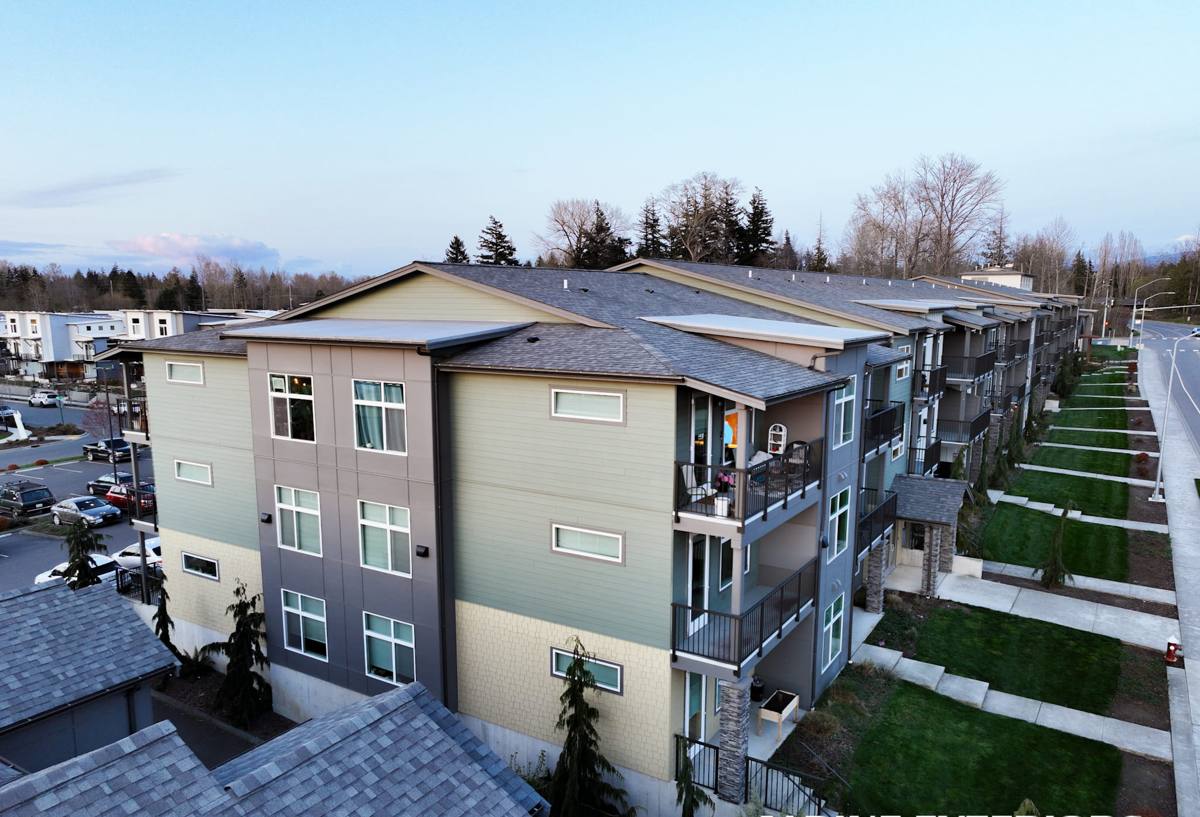
What Board & Batten Siding Actually Is
Board & batten is a vertical siding system built from wide flat panels or boards with narrower strips (battens) covering the seams between them. It's not a single product — it's a pattern that can be built out of several different materials, each with very different long-term behavior in a wet, shaded climate like Sudden Valley's:
- Fiber cement (James Hardie) — engineered panels and battens, factory-primed or factory-finished, dimensionally stable in wet climates
- Cedar or primed spruce — traditional look, but wood that needs consistent maintenance to resist rot and moss in shade
- Vinyl — low upfront cost, but flexes and gaps over time and is not what most board & batten buyers are actually picturing
- Engineered wood (LP SmartSide and similar) — wood-based composite that depends heavily on caulking and edge sealing staying intact
We install board & batten in James Hardie fiber cement exclusively. That's a deliberate standard, not a default — we'll explain why below, but the short version is that the moisture behavior of the material matters more on a shaded Sudden Valley lot than it does almost anywhere else we work in Whatcom County.
Why Shade and Moss Season Are the Real Test for This Siding
A lot of siding failures we get called out to inspect aren't dramatic — they're slow. Moisture gets behind a seam, doesn't fully dry because the wall never gets direct sun, and over a few seasons that turns into soft wood, lifted paint, or a moss mat that's actually holding water against the siding face instead of running off it. On an open, sun-exposed elevation, a marginal installation might get away with it longer because afternoon sun dries things out. On a shaded Sudden Valley lot backing up to trees, there's no margin for error — whatever gets wet stays wet.
This is why board & batten specifically needs correct detailing here: every vertical seam under a batten is a place water can travel if it's not flashed and fastened right, and every horizontal joint needs to shed water outward instead of trapping it. Moss doesn't cause rot by itself, but a moss-covered wall holds moisture against the surface for weeks longer than a clean one — which is exactly the kind of slow, invisible exposure that rots wood-based products and does nothing to a properly installed fiber cement system.
What we look for on a Sudden Valley inspection
- Butted or poorly caulked vertical seams behind the battens
- Battens nailed directly through both layers without room to move with temperature and moisture changes
- No gap or drainage path at the bottom of the wall where water needs to exit
- Heavy moss and moisture staining concentrated on north- and lake-facing walls under tree cover
- Missing or undersized flashing above windows, doors, and horizontal trim breaks
Why We Install James Hardie, Not Wood or Vinyl, for This Look
Cedar and primed spruce board & batten can look beautiful, and we understand the appeal — it's the traditional material for this style. But wood in a shaded, high-moisture setting like Sudden Valley needs consistent recoating, caulk maintenance, and moss removal to keep performing, and if that maintenance schedule slips even one season, moisture gets a foothold that's hard to reverse. Vinyl board & batten is lower-maintenance in the sense that it doesn't rot, but it's a thin, flexible product that was never engineered to be non-combustible or to hold a crisp, flat panel look over time — and it's not the aesthetic most homeowners choosing this style are actually after.
James Hardie's fiber cement panels and battens are engineered specifically for wet Pacific Northwest conditions through their HZ5 product line, which is formulated for high-moisture, freeze-and-thaw climates like ours. The material doesn't absorb and swell the way wood does, it's non-combustible, and the ColorPlus factory finish is baked on and warrantied against peeling and cracking — which matters on a shaded wall where a field-applied paint job would otherwise need recoating far more often. We standardized on Hardie because it's the one board & batten material we can install once, detail correctly, and trust to hold up under Sudden Valley's specific combination of shade, moisture, and moss without a maintenance clock ticking against it.
| Material | Moisture Behavior in Shade | Maintenance Needed | Typical Lifespan Here |
|---|---|---|---|
| James Hardie fiber cement | Dimensionally stable, does not swell or rot | Occasional wash, no recoating needed | Decades, factory finish warrantied |
| Cedar / primed spruce | Absorbs moisture, prone to rot under moss and shade | Regular recoating, caulk inspection, moss removal | Highly dependent on upkeep |
| Engineered wood (LP-style) | Vulnerable at cut edges and seams if sealing fails | Edge sealing and caulk maintenance | Shorter if maintenance lapses |
| Vinyl | Doesn't rot, but flexes, gaps, and traps moisture behind panels | Low, but limited repairability | Variable, thinner appearance over time |
What a Correct Board & Batten Install Involves
The look of board & batten is simple, but the assembly behind it is not. A correct install on a shaded Sudden Valley wall includes:
Rainscreen drainage
A furring or drainage gap behind the siding lets any moisture that does get past the surface drain and dry instead of sitting against the sheathing. On a shaded wall that never fully dries in open air, this gap is doing real work every wet season, not just meeting code on paper.
Proper fastening
Battens need to be fastened to allow the panel underneath room to move slightly with temperature and moisture changes, not pinned rigidly through both layers. Fastener spacing and placement follow Hardie's engineering specs, not a generic "close enough" pattern.
Flashing at every transition
Windows, doors, roof-to-wall intersections, and any horizontal trim break need flashing that directs water outward and away from the wall assembly — this is where we see the most costly failures on older installs in tree-covered lots.
Correct joint sealing
Seams get sealed per manufacturer spec with sealants rated for the exposure, not just caulked once and left. Where panels butt together, the joint has to be backed and sealed correctly the first time, because it's not something you can inspect again once the battens go on.
Our Process on a Sudden Valley Project
- On-site inspection of the existing wall assembly, drainage, and any current moss or moisture damage
- Assessment of shade exposure and tree cover on each elevation, since north and lake-facing walls often need extra attention to drainage detailing
- Written estimate covering material, labor, flashing, and any sheathing repair the inspection turns up
- Installation following James Hardie's fastening and rainscreen specifications, elevation by elevation
- Final walkthrough covering the finished work and what to expect from the ColorPlus finish over time
Because we already work regularly in the Sudden Valley area, we know what a lake-community lot under tree cover typically needs before we even get up on the ladder — and we're not learning the site's quirks on the homeowner's dime.
Living With Board & Batten in This Climate: A Maintenance Checklist
Even the right material benefits from basic upkeep. On a shaded Sudden Valley property, we recommend:
- Rinse siding annually, focusing on shaded and north-facing walls where moss and grime build up fastest
- Keep overhanging branches trimmed back to let air and light reach the wall surface
- Clear debris and needles from the base of walls and any drainage gaps at grade
- Check caulking at trim and window edges every couple of years; re-caulk joints that have opened up
- Have any moss buildup addressed promptly rather than letting it sit against the siding through a full wet season
What Affects Cost on a Job Like This
| Factor | Why It Matters |
|---|---|
| Wall square footage and elevation count | More vertical seams and battens on complex facades add labor |
| Condition of existing sheathing | Rot or moisture damage found during tear-off needs repair before new siding goes on |
| Access and site conditions | Sloped, wooded Sudden Valley lots can affect staging and scaffolding needs |
| Trim and flashing detail | Window counts, roof lines, and transitions all add flashing work |
| Color and finish selection | Factory ColorPlus finish options vary slightly in cost by line |
We won't quote a job without seeing the walls in person — every Sudden Valley property has its own mix of shade, slope, and existing condition, and a real number has to account for that.
Ready for an Honest Look at Your Siding?
If you're planning a board & batten project in Sudden Valley — whether it's new construction, a full re-side, or replacing siding that's been struggling with moss and moisture — we're glad to come take a look. We'll walk the property, tell you plainly what we see, and put together a free, no-pressure estimate using the fill-in form below.