 Bellingham
 Building Decks for Cordata's Climate
Cordata sits in north Bellingham, close enough to the water and the lowland fog belt that a deck out here lives a harder life than the same deck would in a drier inland climate. Whatcom County gets salt-laden air off Bellingham Bay and the Strait, driving rain that comes in sideways more often than straight down, and a moss season that can run from October well into April in shaded yards. None of that is a reason to skip a deck — it's just a reason to build one differently than you would in Phoenix or Denver.
A deck that's going to hold up here needs the right decking material, the right substructure protection, and fasteners rated for a coastal, moisture-heavy environment. Get any one of those wrong and you're looking at cupped boards, a spongy substructure, or rust streaks running down your siding within a few winters. Get them right and a well-built deck in this neighborhood can go decades with nothing more than routine cleaning.
What Cordata Homes Need From a Deck
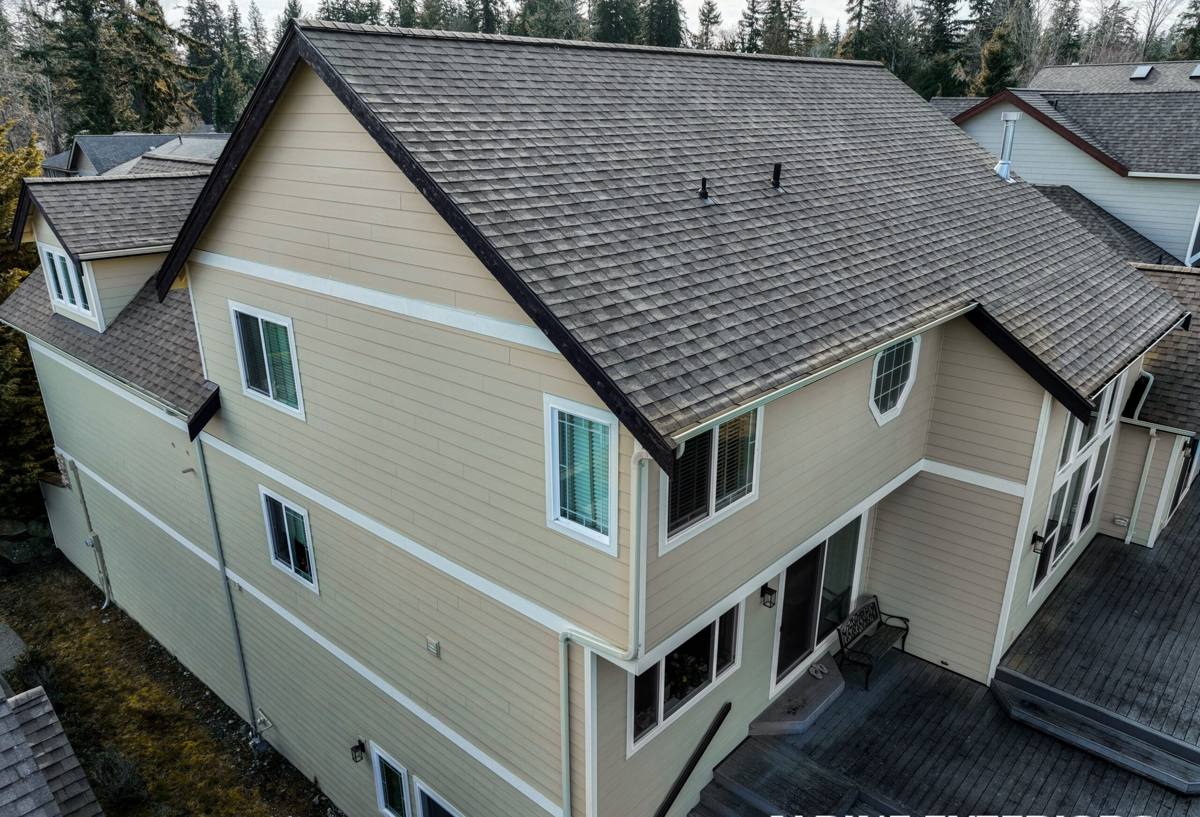
Most of the lots we see in this part of Bellingham have some tree cover, which is great for shade in July and murder on a deck surface the rest of the year. Shade plus damp air is exactly what moss and algae want. Decks tucked under trees or on the north side of a house stay wet longer after every rain, which matters when you're choosing decking material and figuring out drainage underneath.
A few things we design around for homes in this area:
- Orientation and shade — north-facing or heavily treed decks need better drainage and a lower-maintenance surface than a deck that gets afternoon sun
- Grade and drainage — Whatcom County clay soils don't drain fast, so water pooling under a low deck is a common problem if the ground isn't sloped away from the house first
- Ledger attachment to the house — this is the single most common point of rot on older Bellingham decks, and it has to be flashed correctly, not just bolted and caulked
- Wind and rain exposure — driving rain off the water pushes moisture sideways into railings and fascia boards, so end grain and joints need real protection, not just a coat of stain
Decking Material Options for the PNW
There's no single "best" decking material — there's a best material for your budget, your sun exposure, and how much maintenance you actually want to do. Here's how the common options hold up in a wet, mossy Whatcom County yard.
| Material | Moisture Behavior | Maintenance | Typical Lifespan Here |
|---|---|---|---|
| Pressure-treated fir/pine | Absorbs water, prone to checking and splintering if not sealed regularly | Annual cleaning and re-sealing recommended | 10-15 years before major repair |
| Cedar | Naturally rot- and insect-resistant, still needs sealing to hold color and shed moss | Cleaning and oil/stain every 1-2 years | 15-20 years with upkeep |
| Composite (wood-plastic blend) | Won't rot, but early-generation composites could hold surface moisture and grow algae | Periodic washing, no sealing or staining | 25+ years |
| Capped composite / PVC | Fully sealed shell resists moisture and moss growth best of the group | Occasional washing | 25-30+ years |
We install all of these depending on what a homeowner wants, but for shaded Cordata lots we're honest with clients that capped composite or PVC decking earns its higher upfront cost back in avoided maintenance. Real wood can absolutely work here — cedar especially — but it's a commitment to staying on top of cleaning and sealing, because a wood deck that gets neglected through one wet winter can start showing it by spring.
A Note on Uncapped Composite
Older or budget composite boards without a fully capped surface can wick moisture at the edges and cut ends, which is exactly the failure mode our climate exposes fastest. It's not that the product is bad — it's that it was engineered for a broader range of climates, and ours is on the demanding end of that range. When a client is comparing composite options, we walk through which lines are fully capped on all four sides versus capped on the face only, because that difference matters more here than it would in a drier state.
Framing and Substructure: Where Decks Actually Fail
Most deck failures we get called out to repair aren't about the decking boards at all — they're about what's underneath. The frame is doing the structural work, and it's also the part most exposed to standing moisture, splash-back off the ground, and condensation.
What a correctly built substructure includes in this climate:
- Ground-contact or better-rated lumber for posts, beams, and joists — not standard framing lumber
- Joist tape or a comparable moisture barrier on top of every joist, so fastener penetrations don't become entry points for rot
- Proper flashing at the ledger board where the deck meets the house, with a drainage gap so water can't collect between the deck and the wall
- Post bases set above grade on footings, never buried wood-to-soil
- Adequate airflow underneath the deck so the frame can dry out between rain events instead of staying damp for weeks
Skipping joist tape or ledger flashing doesn't show up as a problem on day one. It shows up three or five years later as soft spots, dark staining, or a railing post that's gone spongy at the base. By then it's a repair job instead of a five-minute step during construction.
Railings, Fasteners, and Hardware That Hold Up to Salt Air
Bellingham's proximity to the water means the air carries more salt than a lot of homeowners expect for a "Pacific Northwest" climate — it's not just rain we're building for, it's corrosion. Standard zinc-coated deck screws and brackets can start showing rust streaks on light-colored decking within a couple of seasons this close to the bay.
We spec stainless steel or coated fasteners rated for coastal/marine exposure on structural hardware — joist hangers, post bases, ledger bolts — and stainless screws on visible decking. It costs more than a standard hardware package. It's also the difference between a railing that still looks clean in ten years and one that's streaking rust down your siding by year four.
Railing Material Trade-Offs
Wood railings match a traditional deck but need the same sealing discipline as wood decking. Metal (aluminum or powder-coated steel) railings resist rot entirely and are a common upgrade for homes that want lower maintenance without switching the whole deck to composite. Cable railings look great and don't block a view, but the cable hardware needs to be marine-grade stainless or it will be the first thing to corrode.
Our Deck Building Process
We keep the process straightforward, and we don't push a homeowner toward the most expensive option — we tell you what actually makes sense for your yard, your sun exposure, and your budget.
- On-site visit to look at grade, drainage, existing structure (if replacing a deck), and sun/shade exposure
- Written estimate covering material options at a few price points, so you're comparing real numbers, not guessing
- Permit handling — we pull the necessary permits and coordinate inspections so you don't have to chase paperwork
- Demo of the old deck if applicable, with attention to what condition the ledger and framing were in underneath
- Framing built to current code with moisture protection and corrosion-resistant hardware throughout
- Decking, railing, and any stairs installed and finished
- Final walkthrough so you know how to care for the specific material we installed
Permits and Local Code Considerations
Most new and replacement decks in Bellingham require a building permit, and the requirements can depend on the deck's height, whether it's attached to the house, and its size. Rules change and vary by exact lot, so we don't guess — we confirm current requirements with the City of Bellingham (or Whatcom County, for properties outside city limits) before work starts and handle the permit application as part of the job. If a contractor offers to skip the permit to save time, that's a red flag, not a favor — an unpermitted deck can complicate a home sale and won't have had an inspector verify the ledger and framing work that matters most.
Maintenance Through Moss Season
Whatever material you choose, a little seasonal attention goes a long way in this climate. Moss and algae don't just look bad — moss holds moisture against the surface and, on wood decks, accelerates rot; on any decking, a mossy surface gets slick and dangerous in the rain.
- Sweep leaves and debris off the deck regularly through fall — trapped debris holds moisture against the boards
- Rinse or wash the surface at least once a year, more often on shaded decks, to knock back algae and moss before it establishes
- Keep gutters and downspouts clear so roof runoff isn't dumping extra water onto or near the deck
- Check railing posts and stair stringers annually for soft spots, especially where wood meets a concrete footing or the ground
- Re-seal wood decking on the schedule the product calls for — don't wait until it's visibly gray and dry
- Trim back overhanging branches where practical to let more light and air reach the deck surface
Why Hire a Crew That Already Works in Cordata
Deck-building advice that works in a dry climate can be actively wrong here. A crew that mostly builds in inland or drier regions may not think twice about standard hardware, skip joist tape as an "extra," or recommend a decking product that's a fine general-purpose choice but not suited to a shaded, salt-air, high-rainfall yard in north Bellingham. We build decks across Whatcom County and see, firsthand, how the local climate ages a deck over years, not just what it looks like on installation day.
That local track record shapes real decisions on your project — which fasteners we spec, how we detail the ledger flashing, which decking lines we'll stand behind for a shaded lot versus a sunny one, and how we grade the ground underneath before the first post goes in. It's the difference between a deck built to pass inspection once and a deck built to still be solid in twenty years of Bellingham winters.
If you're planning a new deck or replacing one that's showing its age, we're happy to take a look and give you a straightforward, no-pressure estimate — just fill out the form below.