 Bellingham
 Why South Hill Decks Wear Differently
South Hill sits up above the rest of Bellingham, with mature tree canopy, sloped lots, and a mix of older established homes and newer builds tucked into the hillside. That elevation and tree cover create a deck environment that's genuinely different from a flat, open subdivision. Shade from established evergreens and big-leaf maples means many South Hill decks dry out slower after a storm than decks in full sun, and Whatcom County gives them plenty of storms to dry out from. Add the marine air drifting up off Bellingham Bay and the Strait, and you've got a combination of moisture and salt exposure that ages wood fiber and corrodes hardware faster than most homeowners expect.
None of that means a South Hill deck is doomed — it means the repair work has to account for the actual conditions the deck lives in, not just patch what's visibly broken. A board replaced with the wrong fastener or a ledger reattached without proper flashing will fail again in a season or two, right back where you started.
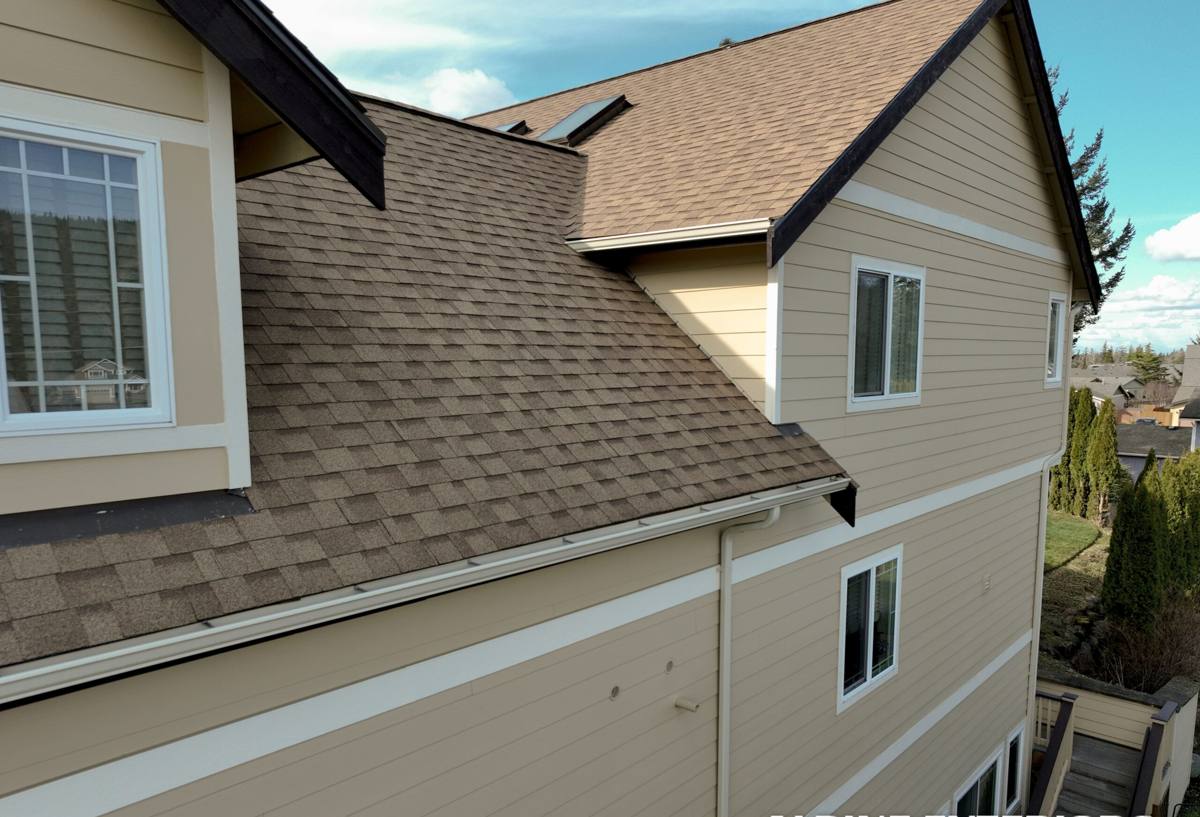
The Warning Signs We Look For
Soft or Spongy Decking
If a board gives slightly underfoot or feels damp to the touch even on a dry day, moisture is trapped inside the wood fiber, not just sitting on the surface. That's usually further along than it looks from above.
Rust Streaks and Failing Fasteners
Orange or black streaking around screw heads and nail holes is a sign the fastener is corroding faster than the wood around it — common on older decks built with standard hardware in a coastal-influenced climate like ours.
Ledger Board Separation
The ledger board — where the deck attaches to the house — is the single most important structural connection on most decks. Gaps, water staining on the siding above it, or visible movement where it meets the house framing are signs of a connection that's failing, and it's the most common cause of deck collapses nationally.
Loose or Wobbly Railings and Stairs
Railings that shift when leaned on, or stair stringers that flex, usually point to a post connection or framing member that's lost its grip — often from the same moisture and fastener corrosion showing up elsewhere on the deck.
What a Proper Repair Actually Involves
A real deck repair starts underneath, not on the surface. We look at the framing — joists, beams, posts, and the ledger connection — before we touch a single visible board, because replacing decking over compromised framing just hides the problem for another year.
- Structural inspection of joists, beams, posts, and footings for rot, splitting, or undersized framing
- Ledger board and flashing check where the deck meets the house
- Fastener and joist hanger condition — corrosion is often worse than it looks from the top side
- Railing and guardrail post connections, checked for both looseness and code compliance
- Stair stringer and tread condition, including attachment at the top and bottom
- Surface decking for rot, cupping, splintering, and moss or algae buildup
From there, the repair plan is specific to what's actually failing. Sometimes it's a handful of boards and a few fastener upgrades. Other times it's a joist that needs sistering, a ledger that needs to be pulled and reflashed correctly, or a railing system that needs to be rebuilt to meet current guardrail requirements.
Repair or Replace? How We Help You Decide
Not every deck problem calls for a full rebuild, and not every deck is worth patching indefinitely. The honest answer usually comes down to how much of the framing is still sound.
| Factor | Repair Usually Makes Sense | Replacement Usually Makes Sense |
|---|---|---|
| Framing condition | Joists and beams are solid, only isolated rot or damage | Widespread soft or rotted framing members |
| Ledger connection | Sound, or needs reflashing only | Failing, undersized, or improperly attached originally |
| Deck age | Under 15-20 years, built to a reasonable original standard | Older deck nearing or past typical wood-frame service life |
| Surface decking | Scattered bad boards among otherwise sound decking | Most boards cupped, split, or spongy throughout |
| Code compliance | Railings and stairs already meet current guardrail standards | Railing height, spacing, or stair geometry is out of code |
We'll walk the deck with you and point out exactly what we find in each category before recommending a direction — including telling you plainly if repair isn't the better value.
Our Process
We keep the process straightforward because deck repair shouldn't feel like a mystery.
- Free on-site inspection. We get under the deck, not just walk across the top, and check framing, fasteners, and the ledger connection.
- Written scope and estimate. You get a clear list of what's failing, what we recommend, and why — no vague line items.
- Repair work. Framing reinforcement or replacement first, then decking, then railings and stairs, using fasteners and flashing suited to our climate.
- Code check. Any railing, guardrail, or stair work is brought up to current standards as part of the repair, not left as-is.
- Cleanup and walk-through. We haul off old material and walk the finished repair with you before we call it done.
Materials We Use, and Why
Material choice matters more on a shaded, moisture-prone South Hill lot than it does on a dry, open one. We match materials to the specific deck and its exposure rather than defaulting to whatever's cheapest.
Fasteners and Hardware
Standard electro-galvanized screws and nails corrode faster in our damp, salt-tinged air than most homeowners expect, which is why we lean toward hot-dip galvanized or stainless fasteners and connectors, especially anywhere near the ledger, posts, or joist hangers. It costs a little more up front and saves you from doing the same repair again in a few years.
Decking Material
Pressure-treated lumber is the budget-friendly, proven option, but it needs regular cleaning and sealing to perform well under our tree cover and rain patterns. Cedar looks great and resists rot naturally, but it's a softer wood that needs consistent maintenance to stay ahead of moss and graying. Composite decking costs more upfront and doesn't need staining, but it still needs proper ventilation and drainage underneath — trapped moisture under composite boards can cause its own problems if the framing below isn't detailed correctly. We'll walk you through the honest tradeoffs of each rather than pushing whichever margin is best for us.
Flashing
Ledger flashing is one of those details that's invisible once the deck is finished but determines whether the connection lasts. We use proper metal or membrane flashing at the ledger every time, sloped to shed water away from the house rather than into the rim joist.
Moss, Algae, and Long-Term Deck Care
South Hill's tree cover is part of what makes the neighborhood attractive, but it also means a longer moss and algae season than a deck out in the open gets. Moss holds moisture directly against the wood surface, and over a wet Whatcom County winter that constant dampness is what actually causes rot — the moss itself is more of a symptom and an accelerant than the root cause. A little seasonal upkeep goes a long way toward avoiding another repair call in a few years.
- Sweep leaves, needles, and debris off the deck surface regularly through fall
- Keep gutters and downspouts near the deck clear so runoff isn't draining onto it
- Trim back overhanging branches where practical to let more light and air reach the surface
- Clean moss and algae off with a deck-safe cleaner rather than a pressure washer alone, which can damage wood fiber
- Reseal or stain wood decking on the manufacturer's recommended schedule, not just when it looks faded
- Check under the deck once a year for standing water, debris buildup, or early signs of rot
Building Codes and Permits for Deck Repair
Structural deck work — reattaching a ledger, replacing framing, or rebuilding railings — typically falls under permitting requirements in Bellingham, and guardrails, baluster spacing, and stair geometry all have to meet current code, not just whatever the deck was originally built to. This trips up a lot of homeowners doing a "simple" repair on an older deck, because bringing one element up to code sometimes means the railing height or spacing needs to change too. We handle the permit process and code compliance as part of the job so you're not left sorting it out after the fact.
Why Hire a Crew That Already Works in South Hill
Deck repair on a South Hill lot comes with practical challenges that a crew unfamiliar with the neighborhood can miss: sloped and terraced yards that complicate access and staging, mature trees whose root systems affect what can be dug near footings, and drainage patterns that are different lot to lot depending on where the house sits on the hill. A crew that's already worked decks in this neighborhood knows what to check first and what tends to fail here, which means a faster, more accurate inspection and fewer surprises once the work is underway.
We're not guessing at how Bellingham's rain, shade, and salt air affect a deck over time — it's what we see, repair, and build around every week.
If your deck has soft spots, wobbly railings, or you just haven't had it looked at in a few years, we'll come take an honest look. The estimate is free, there's no pressure, and you'll know exactly what condition your deck is really in before you decide anything.