 Bellingham
 Why Puget Decks Wear Out Faster Than the Rest of the House
If you live in the Puget area near Bellingham, you already know your deck takes a different kind of beating than the siding or the roof. It sits low, flat, and exposed — soaking up salt-laden air off the water, catching driving rain at an angle no overhang can fully block, and spending a good chunk of the year shaded and damp enough to grow moss between the boards. That combination is hard on wood, hard on fasteners, and hard on whatever is underneath the decking that you can't see from the top.
Most deck failures around here don't start with the boards. They start underneath — at the ledger board where the deck meets the house, at the footings, at the joist hangers and fasteners that were never rated for this kind of moisture exposure. By the time the surface looks bad enough to notice, the structure underneath has often been absorbing water for years. That's the case for replacement over patch-repair in a lot of Puget homes: the visible damage is usually the last symptom, not the first one.
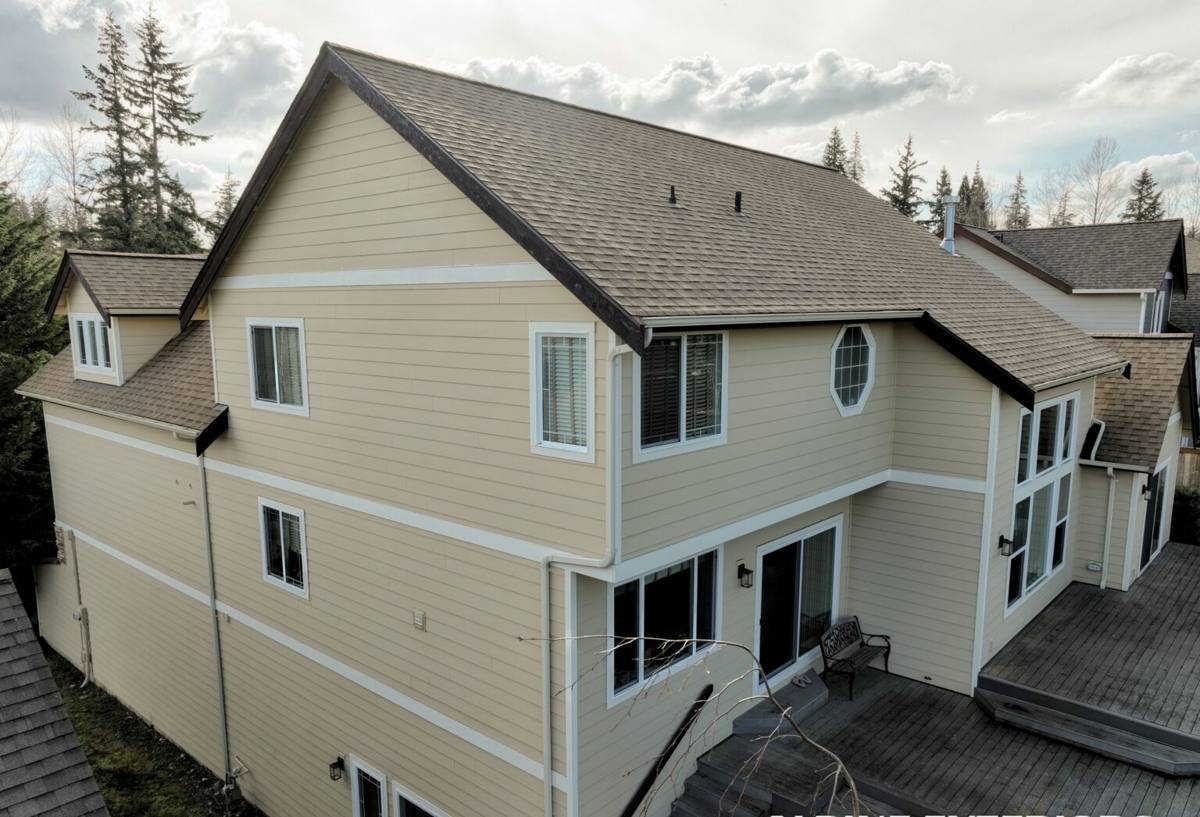
Repair or Replace? Signs Worth Taking Seriously
Not every tired-looking deck needs to come out. Cosmetic graying, a few loose boards, or a railing that's worked itself loose are often fixable without a full rebuild. But there's a point where patching stops making sense — where you're spending money to extend the life of a structure that's already compromised underneath. In our experience working on decks in this climate, these are the signs that point toward replacement rather than repair:
- Soft or spongy spots when you walk across the deck, especially near the house
- Visible rot, dark staining, or crumbling wood at the ledger board or where posts meet the ground
- Persistent moss or algae that comes back within weeks of cleaning
- Fasteners that are rusted, bleeding stains into the wood, or backing out on their own
- Railings or stairs that flex or feel less solid than they used to
- A deck older than 15–20 years that hasn't had the structure inspected, only the surface refinished
- Gaps opening up between boards that trap standing water instead of shedding it
If you're seeing two or more of these, it's worth having someone look at the framing before deciding between a repair and a full replacement — a deck that looks fine on top can still have a ledger board that's failing underneath.
What a Correct Deck Replacement Actually Involves
Removal and structural inspection
We start by pulling the old decking and railings off completely so the framing, ledger, and footings are exposed. This is the point where you find out what's really going on — whether the posts are solid, whether the footings are sized and set correctly, and how much moisture has already worked its way into the structure. Skipping this step and just laying new boards over old framing is how a deck ends up needing to be replaced again in five years instead of twenty-five.
Ledger board and flashing
The ledger board — where the deck attaches to the house — is the single most common failure point on decks in wet Pacific Northwest climates. Water that gets behind an improperly flashed ledger doesn't just rot the deck; it can work its way into the house's rim joist and wall framing. A correct replacement means proper flashing, a water-resistant barrier between the ledger and the house, and fasteners rated for exterior, high-moisture use — not a repeat of whatever caused the original problem.
Framing, footings, and fasteners
Joists, beams, and posts get replaced or upgraded to pressure-treated lumber rated for ground contact where needed, with joist hangers and structural screws rated for exterior exposure. Footings are checked against current code depth and bearing requirements — older decks in this area were often built to lighter standards than what's required now.
Decking, railings, and final grading
Once the structure is sound, we install the decking surface, railings, and stairs, and make sure water is shedding away from the house rather than pooling against the foundation. Small details — board spacing, fastener pattern, how the deck edge meets the ground — matter more here than in drier climates, because anything that traps water becomes a moss and rot problem within a season or two.
Choosing a Decking Material for This Climate
There's no single "best" decking material — it's a trade-off between upfront cost, maintenance commitment, and how the material actually behaves in constant damp and shade. Here's how the common options stack up for a Puget-area home:
| Material | Moisture & Moss Behavior | Maintenance | Typical Lifespan |
|---|---|---|---|
| Pressure-treated wood | Absorbs water; needs regular sealing to resist rot and moss growth in shaded, damp spots | Annual cleaning and re-sealing recommended | 10–15 years with upkeep |
| Cedar | Naturally rot-resistant but still absorbs moisture and grays without maintenance | Periodic cleaning and staining | 15–20 years with upkeep |
| Composite decking | Doesn't absorb water like wood, but can still stay damp on the surface and needs occasional cleaning to prevent moss film | Low — occasional wash, no sealing | 25–30 years |
| PVC / capped polymer | Fully resistant to moisture absorption and rot; best option where shade and moss are a persistent issue | Lowest — soap and water as needed | 25+ years |
We don't push one product on every job. Wood costs less up front and looks great, but it asks for real annual maintenance to hold up in a climate this wet — and a missed year or two of sealing is often what starts the rot cycle. Composite and PVC cost more initially but hold up with far less attention, which matters if your deck sits in shade for a good part of the day. The right call depends on your budget, how much upkeep you actually want to do, and how much sun and airflow your particular yard gets.
Our Process, Start to Finish
1. On-site assessment
We look at the existing deck — surface and structure — and talk through what's driving the replacement: age, damage, or just wanting something that holds up better to the moss and rain.
2. Written estimate
You get a clear scope and price before anything is scheduled, including material options if you're weighing wood against composite or PVC.
3. Permitting
Most deck replacements in and around Bellingham require a permit, especially when footings, framing, or railing height are involved. We handle that process rather than leaving it on you.
4. Demolition and rebuild
Old structure comes out, framing and ledger issues get corrected, and the new deck goes in — built to shed water instead of trap it.
5. Final walkthrough
We walk the finished deck with you, check railings and stairs for solidness, and go over any maintenance the material you chose will need going forward.
Permits and Code in Whatcom County
Deck work in the Bellingham area is generally subject to building permit requirements once you're beyond very small, low, freestanding structures — this covers footing depth, guardrail height, stair geometry, and ledger attachment. Older decks in Puget and the surrounding neighborhoods were often built before current code, which is part of why a straight repair sometimes isn't enough: bringing a deck up to current safety standards on railings or footings may require more than patching what's there. We pull the necessary permits and build to current code as a matter of course, not as an upsell.
Living With Moss Season
Even a well-built deck in this climate needs some seasonal attention. A few habits go a long way toward protecting the investment once the new deck is in:
- Sweep leaves and debris off regularly — trapped organic matter is what feeds moss and algae
- Rinse or lightly scrub the surface a couple of times a year, more often in heavily shaded areas
- Keep gutters and downspouts clear so runoff isn't dumping extra water onto the deck
- Trim back vegetation that's shading the deck and keeping it damp longer than it needs to be
- Reseal wood decking on the schedule the product calls for — don't wait until it's visibly gray
- Check the ledger board area annually for staining or softness, since that's where problems start
Why a Crew That Already Works Puget Makes a Difference
A lot of what determines whether a deck lasts 10 years or 30 years in this climate comes down to details that aren't obvious unless you've built and repaired decks here specifically — how much flashing overlap a ledger board actually needs in this rainfall pattern, which fastener coatings hold up against salt air off the water, where moss tends to establish first based on how a yard sits relative to sun and shade. A crew that works Puget and the surrounding Bellingham area regularly has already seen what fails and why, on decks with the same exposure your home has. That's different from applying a generic build spec and hoping it holds up.
We're not guessing at how this climate treats a deck — it's what we see and fix every week. If your deck is showing its age, or you just want an honest read on whether it's a repair or a replacement, we're happy to come take a look. Reach out for a free, no-pressure estimate using the form below.