 Bellingham
 Edgemoor's Setting Puts Real Demands on Siding
Edgemoor sits close to the water along Bellingham Bay, with wooded, often sloped lots and a tree canopy that shades a lot of exterior wall space for much of the year. That combination — salt-tinged air off the bay, heavy tree cover, and a marine climate that keeps things damp for months at a stretch — is tough on exterior materials in ways that inland Whatcom County neighborhoods don't deal with quite as much. Siding here isn't just a cosmetic choice. It's the one layer standing between a house and a climate that never really dries out.
We've worked on homes throughout this part of Bellingham long enough to know that the siding decision matters more here than in a lot of other places. A product or installation detail that's "fine" in a drier, more open subdivision can fail years early on a shaded, water-facing lot in Edgemoor. This page covers what that means for James Hardie fiber cement siding specifically — the only siding product we install — and what a correct job looks like on a home in this neighborhood.
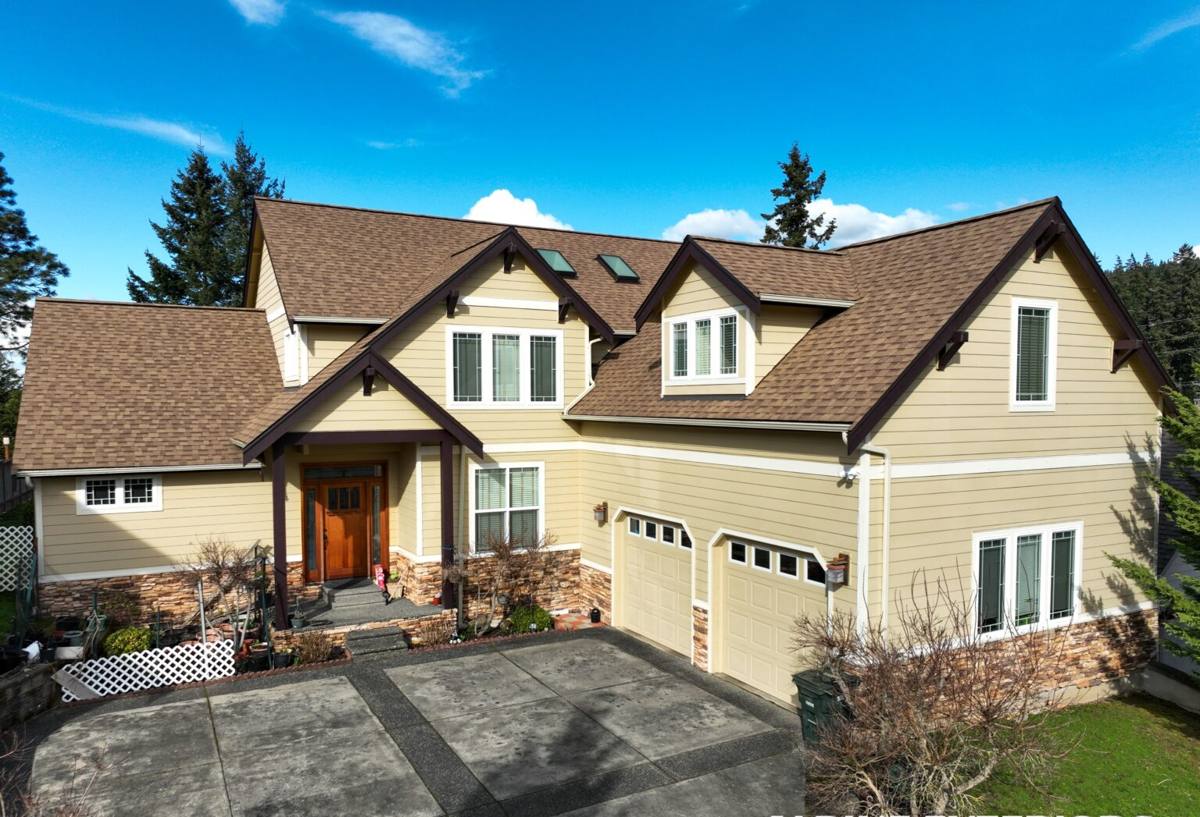
Salt Air, Driving Rain, and a Long Moss Season
Three climate factors do most of the damage to siding in Edgemoor, and they compound each other.
Salt Air
Proximity to Bellingham Bay means airborne salt settles on exterior surfaces and fasteners year-round. Over time, salt accelerates corrosion in unprotected metal — fasteners, flashing, trim screws — and can degrade lower-grade finishes faster than a manufacturer's inland test data would suggest.
Driving Rain
Storms off the water often come with real wind behind them, which pushes rain sideways into laps, seams, and penetrations instead of letting it run straight down. Siding that isn't detailed correctly at these points doesn't just get wet on the surface — it lets water track behind the cladding, where it can sit against sheathing and framing for weeks.
A Long Moss Season
Tree cover keeps shaded wall sections damp long after open areas have dried out, and that's exactly the environment moss and algae need to take hold. Once moss establishes on a wall, it holds moisture against the surface almost permanently, which is a slow, steady threat to any material underneath it that isn't built to handle sustained dampness.
None of these factors are dramatic on their own. The problem is they run nearly year-round in this neighborhood, and cheaper materials or shortcut installations that would hold up fine somewhere drier start showing problems within a handful of years here.
Why We Only Install James Hardie
We standardized on James Hardie fiber cement siding and don't install vinyl, LP SmartSide, primed spruce, cedar, or other fiber cement brands. That's a deliberate call, not a default. James Hardie siding is non-combustible fiber cement — a mix of cement, sand, and cellulose fiber — which behaves very differently from wood-based or polymer sidings when it comes to moisture, expansion, and long-term durability.
Two features matter most for a neighborhood like Edgemoor:
- HZ5 engineering. Hardie's HZ product line is climate-engineered by region, and the HZ5 designation is built for the wetter, freeze-prone conditions found in the Pacific Northwest and similar climates — it's formulated to hold up under sustained moisture exposure rather than just occasional rain.
- Factory-applied ColorPlus finish. Instead of being painted on site, the color is baked on at the factory under controlled conditions, which gives it better fade and wear resistance than field-applied paint and comes with its own finish warranty separate from the substrate warranty.
We're not going to tell you every other product is a bad product in general — vinyl and wood siding both have their place, and we explain the trade-offs on our other pages. What we will say plainly is that on a shaded, salt-exposed, rain-driven lot like the ones common in Edgemoor, we don't think those trade-offs work out in the homeowner's favor, and we'd rather not put our name on an installation we don't stand behind fully.
The Hardie Product Lines That Fit Edgemoor Homes
Edgemoor has a mix of older homes and larger custom builds, and the right Hardie product depends on the house.
HardiePlank Lap Siding
The most common choice for full re-sides. It comes in several surface textures — smooth, cedarmill woodgrain, and a few edge profiles — so it can match a traditional lap look or a more contemporary smooth finish depending on the home's style.
HardieShingle
A staggered or straight-edge shingle profile for homes where a shingle-style look is part of the architecture, without the moisture and maintenance issues that come with actual wood shingles in a damp climate.
HardiePanel
Vertical panel siding, often used as an accent on gables or as a full treatment on more modern homes.
HardieTrim
Fiber cement trim boards for corners, window and door surrounds, and fascia — installed alongside the field siding so the whole envelope is the same non-combustible, factory-finished material rather than mixing in wood trim that ages differently.
What a Correct Installation Involves Here
James Hardie siding is only as good as the installation behind it, and in a climate like Edgemoor's, the details that get skipped on a rushed job are exactly the ones that cause early failure.
- Weather-resistive barrier installed correctly over the sheathing, lapped shingle-style so water sheds outward rather than pooling behind seams.
- A drainage gap behind the siding so any moisture that does get past the cladding has somewhere to go instead of sitting against the wall assembly — especially important on shaded, damp wall faces.
- Flashing at every penetration — window and door heads, hose bibs, light fixtures, deck ledgers — since these are the points where wind-driven rain finds its way in first.
- Corrosion-resistant fasteners, sized and spaced to Hardie's published fastener schedule, with attention to fastener material in areas with heavier salt exposure.
- Correct clearance from grade, roof lines, and decks, so siding isn't sitting in a spot that stays wet or gets buried by soil, mulch, or debris.
- Joint and caulking details done to Hardie's specification — not every seam gets caulked, and getting this wrong is a common way installers unintentionally trap moisture instead of shedding it.
Any one of these done wrong can undercut the performance of an otherwise good product. This is why we treat installation quality, not just the material choice, as the real determinant of how long a job lasts.
How Materials Compare Under Edgemoor's Conditions
| Material | Moisture & Moss Resistance | Salt Air Durability | Ongoing Maintenance |
|---|---|---|---|
| James Hardie fiber cement (HZ5) | High — engineered for wet climates | High, with corrosion-resistant fasteners | Low — factory finish, no repainting cycle |
| Vinyl siding | Moderate — can trap moisture behind panels | Moderate — can become brittle over time | Low, but limited repair options if damaged |
| Untreated cedar or wood siding | Low without diligent upkeep | Low — accelerated weathering | High — regular painting, sealing, moss removal |
| LP SmartSide (engineered wood) | Moderate — dependent on sealed edges/joints | Moderate | Moderate — field-painted, periodic touch-up |
These are general performance patterns, not guarantees — proper installation and upkeep affect every material's real-world lifespan.
Our Process, From Estimate to Finished Siding
We keep the process straightforward and give you a clear look at your home's condition before any material decisions get made.
- On-site assessment. We look at your existing siding, check for signs of hidden moisture or soft sheathing, and take note of grade clearance, tree cover, and sun exposure on each wall face — all of which affect how we detail the installation.
- Product and color selection. We walk through the relevant Hardie product lines and ColorPlus color options for your home's style and budget.
- Permitting. Residential siding work in Bellingham and unincorporated Whatcom County typically requires permitting through the applicable jurisdiction — we handle that step as part of the project.
- Tear-off and sheathing inspection. Once old siding comes off, we inspect the sheathing and framing underneath for any moisture damage that needs to be addressed before new siding goes on — this is often where problems from a prior poor installation surface.
- Installation to manufacturer spec. Weather barrier, drainage gap, flashing, fastening, and trim work installed to James Hardie's published requirements, not shortcuts.
- Final walkthrough. We go over the finished job with you before calling it complete.
Maintenance to Expect in This Neighborhood
Correctly installed James Hardie siding is low-maintenance, but "low" isn't "none," especially in a shaded, salt-air environment. A short seasonal checklist helps siding last as long as it's built to:
- Rinse off moss, algae, or built-up grime on shaded wall sections once or twice a year before it gets a chance to establish.
- Keep gutters clear so overflow isn't running down wall faces or pooling at the base of the siding.
- Trim back branches and foliage that keep a wall section shaded and damp longer than the rest of the house.
- Check caulked joints periodically (around trim, windows, and penetrations) for cracking or separation.
- Watch for any staining, bubbling, or soft spots, which can signal a flashing or moisture issue worth checking before it spreads.
Why Hiring a Crew That Already Works Edgemoor Matters
A siding crew that mostly works drier, more open neighborhoods can do a technically fine installation and still miss the details that matter on a shaded, water-facing Edgemoor lot — because those details simply don't come up as often elsewhere. Knowing which wall faces in this kind of setting need extra attention to drainage and flashing, how much salt exposure to plan fastener material around, and how tree cover changes the moss risk on a given elevation isn't something you get from a spec sheet. It comes from having done the work here before.
That local familiarity also carries into practical things like anticipating permitting requirements for the jurisdiction your property falls under and giving you a realistic read on what your specific lot's exposure means for the job, rather than a generic answer that applies to Whatcom County as a whole.
Get a Free, No-Pressure Estimate
If your Edgemoor home's siding is showing moss buildup, staining, or just isn't standing up to the marine climate the way it should, we're happy to take a look and walk you through what James Hardie siding would involve for your specific house — no pressure, no obligation. Use the form below to request a free estimate.