 Bellingham
 Why Birch Bay Siding Takes a Different Approach
Birch Bay sits right on the water, and that changes what a house needs from its exterior. Homes a few blocks inland in Bellingham deal with plenty of rain, but Birch Bay properties also take on salt-laden air blowing off the water, near-constant wind exposure, and long stretches of shade and dampness that keep moss and algae active for most of the year. Siding here has to handle moisture intrusion, hold its finish against salt exposure, and resist the slow green film that builds up on north-facing walls and anything shaded by trees.
We install James Hardie fiber cement siding exclusively, and Birch Bay is one of the areas where that decision matters most. Fiber cement doesn't rot, doesn't feed moss the way wood fiber products can, and holds a factory finish that stands up to salt air far better than field-applied paint. This page walks through what correct fiber cement installation looks like for a Birch Bay home specifically, not siding in general.
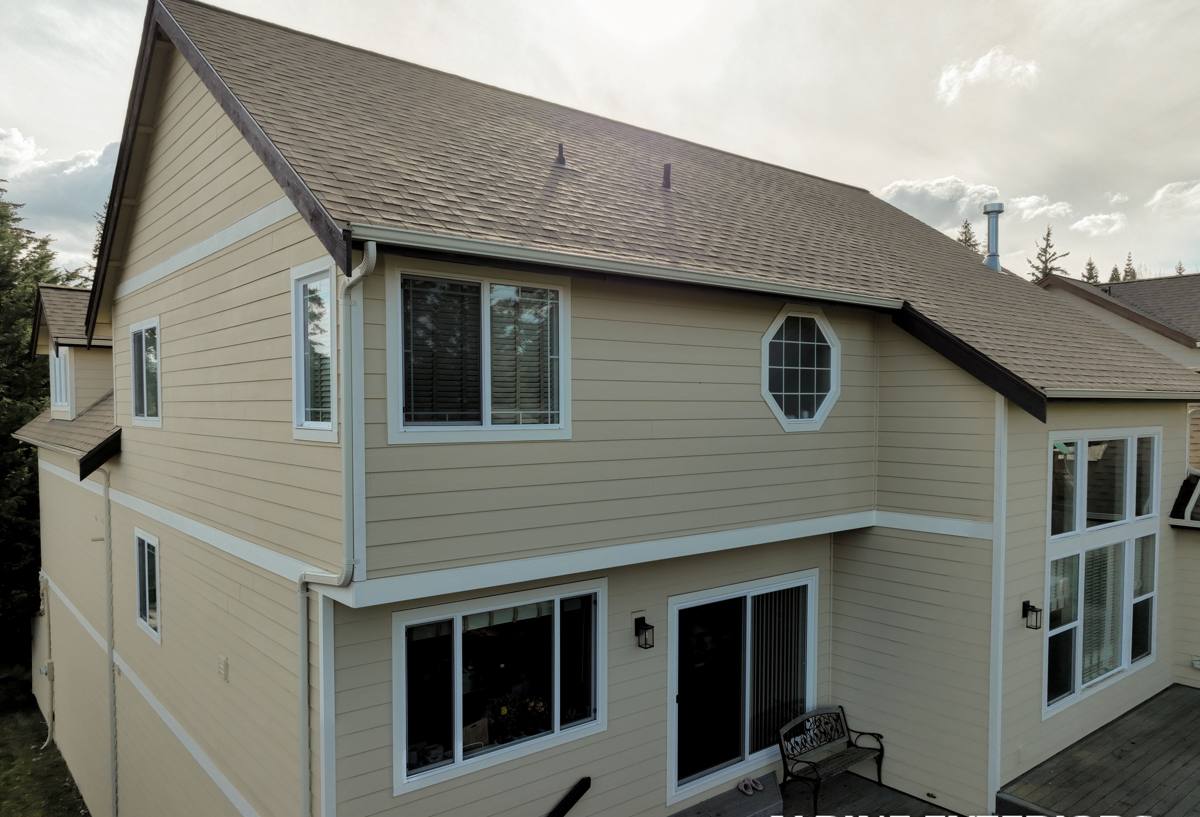
What Birch Bay's Climate Actually Does to Siding
Salt Air and Coastal Wind
Airborne salt accelerates corrosion on fasteners, flashing, and any exposed metal components. It also degrades cheap paint finishes faster than inland exposure would, leading to chalking and fading years ahead of schedule. Wind off the water drives rain sideways into wall assemblies far more aggressively than a still, inland rain event, which puts extra stress on every seam, joint, and penetration in the siding system.
Driving Rain and Moisture Load
Whatcom County gets a lot of rain overall, but Birch Bay's wind exposure turns ordinary rain into wind-driven rain that hits walls at an angle instead of running straight down. That means water finds its way into gaps that would stay dry on a more sheltered lot. A siding system's water-management details — house wrap, flashing, and drainage gaps — carry more of the load here than they would on a protected inland site.
Moss and Algae Season
Between the marine humidity and the tree cover common in Birch Bay's residential streets, siding can stay damp for extended periods, especially on north- and west-facing walls. That damp, shaded environment is exactly what moss and algae need to establish themselves. Once a porous surface takes hold of moss, it's a recurring cleaning problem, not a one-time fix.
Why We Install Only James Hardie Fiber Cement Here
We don't install vinyl, LP SmartSide, primed wood, cedar, or other fiber cement brands. That's a deliberate standard, not a supply issue, and Birch Bay's conditions are a good illustration of why.
- Non-combustible core: Hardie's fiber cement won't ignite, feed a fire, or warp from heat exposure the way vinyl can.
- Moisture-resistant composition: Fiber cement doesn't absorb and hold water the way wood-based products do, which matters directly in a high-moisture, wind-driven-rain environment.
- ColorPlus factory finish: A baked-on, UV-cured finish holds color and resists chalking far longer than field-applied paint exposed to salt air and constant damp.
- Engineered for the Pacific Northwest: Hardie's HZ10 product line is formulated specifically for wetter, cooler climates like ours, as opposed to the HZ5 line built for hot, dry regions.
- Real warranty backing: A transferable, manufacturer-backed warranty that assumes the product is installed to Hardie's own specifications.
Other products aren't necessarily bad products in every context. But on a Birch Bay lot facing direct salt exposure and heavy shade, the maintenance burden and moisture risk of alternatives is a trade-off we're not willing to install and then leave a homeowner to manage.
What Correct Installation Looks Like in a Coastal Wind Zone
Water Management Comes First
Before a single piece of siding goes up, the wall needs a properly lapped weather-resistant barrier, correctly flashed windows and doors, and a drainage plane that lets any moisture that does get behind the siding find its way back out. In a wind-driven-rain environment like Birch Bay, skipping or rushing this step is where problems start, regardless of how good the siding material itself is.
Fastener and Clearance Details
Hardie specifies fastener type, spacing, and penetration depth, and those specs exist for a reason — under-driven or over-driven nails, wrong fastener material, or improper spacing all create failure points that salt air and wind will find first. We also hold ground clearance and keep siding off roof lines and decks per Hardie's minimum gaps, so splashback and trapped moisture don't get a foothold at the bottom edge.
Joints, Caulking, and Trim
Every butt joint, corner, and trim transition is a potential water entry point. Correct installation means back-caulking where specified, using compatible sealants, and finishing joints so wind-driven rain can't work its way in sideways. This level of detail is where a lot of rushed installs cut corners — and it's exactly the detail that matters most a block from the water.
Pre-Install Checklist We Walk Through on Every Birch Bay Job
- Inspect existing sheathing and framing for hidden moisture damage before covering anything
- Confirm house wrap or building paper is intact, correctly lapped, and free of tears
- Verify window and door flashing integrates properly with the new water-resistive barrier
- Plan starter strip and ground clearance to current Hardie minimums
- Select the correct HZ10 product for our climate zone
- Map fastener schedule and confirm corrosion-resistant fastener material for coastal exposure
- Identify and pre-plan flashing details at every roof-to-wall and deck-to-wall intersection
Choosing a Profile and Finish for a Birch Bay Home
James Hardie's lap siding, shingle-style panels, and vertical board-and-batten options all perform the same structurally, so the choice usually comes down to how a homeowner wants the house to read against the neighborhood and the waterfront setting. ColorPlus finishes are worth prioritizing over field-painted options here specifically because of the salt air — a factory finish holds up to that exposure in a way that a repaint every several years doesn't need to compete with.
| Factor | Why It Matters in Birch Bay |
|---|---|
| ColorPlus vs. field-painted | Factory finish resists salt-air fading and chalking far longer than site-applied paint |
| HZ10 climate formulation | Built for wetter, cooler coastal conditions rather than hot-dry regions |
| Fastener material | Corrosion resistance matters more with salt-laden air moving off the water |
| Ground and roof clearance | Reduces splashback and trapped moisture in a high-rainfall, wind-driven setting |
| Shaded, tree-covered walls | Affects how much moss/algae exposure a wall will see and how it should be detailed |
Why a Crew That Already Works Birch Bay Matters
Installing fiber cement correctly requires following the manufacturer's specifications exactly — but doing it well in a specific location means also understanding how that location's conditions stress the system over time. A crew that has worked other homes in Birch Bay has already seen where wind-driven rain tends to concentrate on a given lot orientation, how much moss pressure a shaded north wall typically sees, and where coastal wind loads change the way trim and flashing details need to be handled. That local pattern recognition doesn't replace following spec — it's what makes following spec effective on this specific stretch of coastline.
It also means fewer surprises during the project. Permitting norms, typical soil and drainage conditions near the water, and the practical realities of scheduling around Whatcom County's wetter months are all things a local crew has already worked through.
Maintenance After Installation
Correctly installed Hardie siding is low-maintenance, not no-maintenance. In a Birch Bay setting, that means periodically rinsing salt residue and organic buildup off the surface, keeping gutters clear so water isn't sheeting down the wall face, and trimming back vegetation that keeps a wall shaded and damp. None of this is heavy labor, but it's worth doing on a regular schedule given the environment, rather than waiting until moss or grime becomes visibly established.
What This Costs to Do Right
Pricing on any siding project depends on the size of the home, the condition of the existing wall assembly, the amount of trim and detail work, and the specific Hardie products and finish chosen. Homes with hidden moisture damage behind old siding, or with extensive trim and multiple roof-wall intersections, take more time to detail correctly than a straightforward rectangular elevation. We give straight, itemized numbers once we've actually looked at the house — there's no honest way to price a coastal-exposure job without seeing the walls first.
If you own a home in Birch Bay and want a straight look at what your siding needs — whether that's a full replacement or just an honest opinion on what's there now — we're glad to come take a look. The estimate is free, there's no pressure, and you'll get a clear answer either way.