 Bellingham
 Why Siding Choice Matters More in Sunnyland Than People Think
Sunnyland sits close enough to Bellingham Bay that homes here deal with a steady mix of moist marine air, wind-driven rain off the water, and a moss season that can run from October through May in a wet year. That combination is hard on exterior building materials, and it's especially hard on siding products that weren't engineered for it. A siding job that looks fine going up in June can start showing problems by its second or third winter if the material, the install details, or both weren't right for this climate.
This page is about one thing: fiber cement siding, done correctly, on homes in the Sunnyland area. Not a general siding overview — the specific climate pressures this neighborhood deals with, what a correct installation looks like here, and why we only put James Hardie fiber cement on the houses we work on.
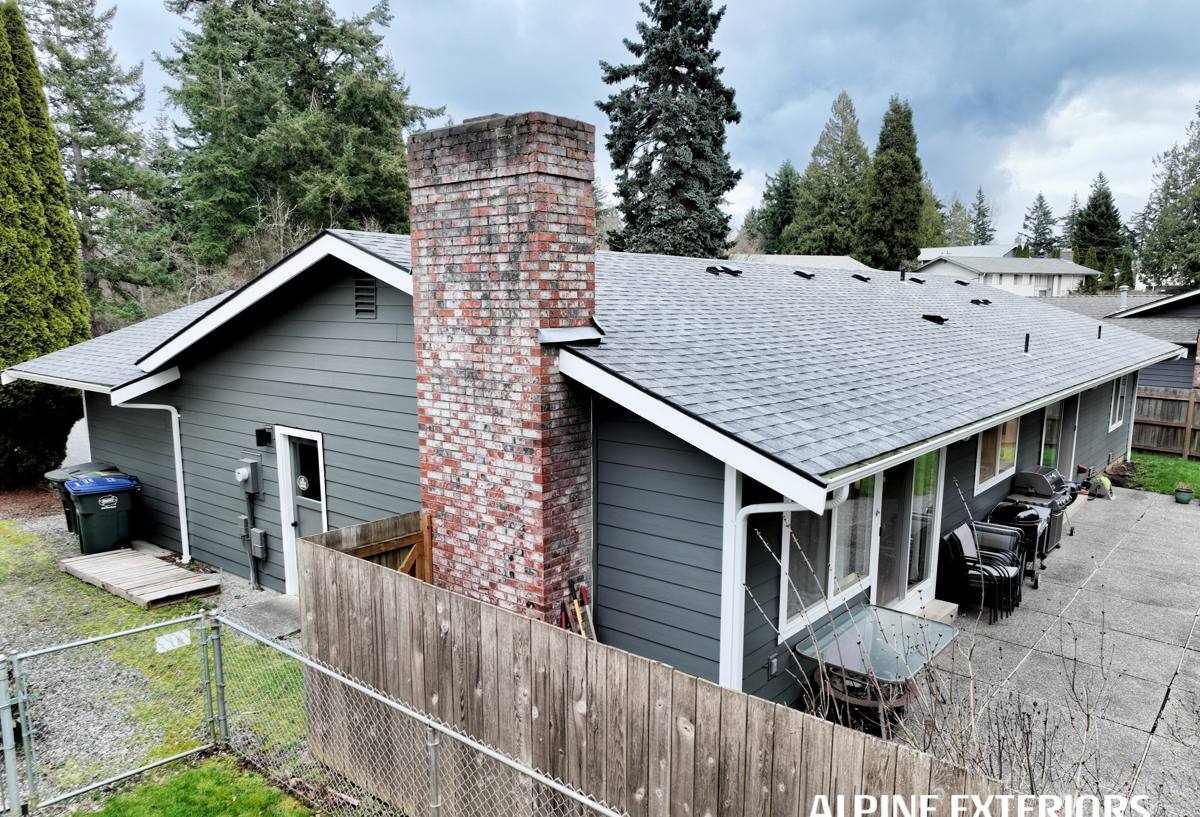
What Bellingham's Climate Actually Does to Siding
Salt Air and Moisture
Homes within a few miles of Bellingham Bay pick up salt-laden air, especially on days with onshore wind. Salt air accelerates corrosion on exposed metal fasteners and trim, and it interacts with paint films in ways that inland siding never has to deal with. Cheap or improperly sealed fasteners rust and stain before the siding itself shows its age.
Driving Rain
Whatcom County storms rarely fall straight down. Wind pushes rain sideways into wall assemblies, which means the water-management details behind the siding — flashing, house wrap, weep paths, caulk joints — matter as much as the siding material itself. A beautiful siding job with a poorly lapped weather barrier underneath will still leak.
A Long Moss and Mildew Season
Shaded lots, mature trees, and consistent dampness give moss, algae, and mildew a long growing window on north- and west-facing walls. Materials that hold moisture at the surface — or that have seams and butt joints prone to trapping water — stay damp longer and give organic growth more time to take hold.
Why This Adds Up to a Durability Problem, Not Just a Cosmetic One
None of these three factors is dramatic on its own. Together, over years, they're what separates a siding job that still looks tight at year fifteen from one that's swelling, staining, or delaminating by year eight. The material has to resist moisture intrusion at the panel level, and the installation has to manage water at every joint, corner, and penetration.
Why We Install Only James Hardie Fiber Cement
We don't install vinyl, LP SmartSide, primed wood, cedar, or other fiber cement brands. That's a deliberate standard, not a sales pitch, and it comes down to how each of those products handles the exact conditions described above.
- Vinyl expands and contracts with temperature swings, can warp or crack in wind-driven storms, and its seams are a chronic point where water can get behind the panel.
- Wood-based composite siding (like LP SmartSide) is an engineered wood product — it performs well when kept dry and properly maintained, but any breach in its factory coating exposes wood fiber that can swell, and cut edges need diligent field-sealing that's easy to skip under schedule pressure.
- Primed wood and cedar are beautiful materials with a real maintenance commitment attached — repainting, caulking, and moisture monitoring on a cycle that most homeowners underestimate, and the combustible nature of solid wood is a factor some owners weigh heavily.
- Other fiber cement brands use the same basic cement-fiber technology as Hardie but don't all match its factory-baked ColorPlus finish, its climate-specific HZ engineering, or its transferable warranty structure.
James Hardie fiber cement is non-combustible, dimensionally stable across our wet-to-dry seasonal swings, and manufactured in an HZ5 formulation suited to the Pacific Northwest's freeze-thaw and moisture cycle. The ColorPlus factory finish is baked on under controlled conditions — far more consistent and fade-resistant than field-applied paint on wood or composite siding. That's the whole reason we standardized on it: it's the product that holds up to what Bellingham weather actually does, not just what it looks like on install day.
What a Correct Fiber Cement Installation Involves
Fiber cement is only as good as its installation. Hardie's own warranty requires installation to their published specifications, and in a climate like Sunnyland's, cutting corners on the details below is where problems start.
Before the Siding Goes Up
- Inspection and repair of sheathing — any soft or water-damaged wood gets replaced, not covered over
- A correctly lapped weather-resistive barrier (house wrap) with all seams taped
- Proper flashing at every window, door, and roof-to-wall intersection
- Rain screen or furring strategy where called for, to let the wall assembly drain and dry
During Installation
- Correct fastener type, spacing, and penetration depth per Hardie's specs — stainless or hot-dip galvanized fasteners to resist our salt air
- Proper clearance between siding and grade, decks, and roof lines so water doesn't wick up into the panel
- Field-cut edges sealed per manufacturer instructions
- Butt joints and corners flashed and caulked correctly, not just butted together
Finishing Details
- Trim and caulking compatible with ColorPlus finishes
- Touch-up paint matched to factory color, used sparingly and only where genuinely needed
- A final walk-through checking every penetration — vents, hose bibs, light fixtures — for proper sealing
Skip any one of these steps and the siding itself can be perfect while the wall behind it still fails. This is the part of the job that separates a crew that installs Hardie occasionally from one that installs it as its full-time trade.
Comparing Siding Options for a Sunnyland Home
| Material | Moisture Resistance | Maintenance | Fire Resistance | Typical Lifespan |
|---|---|---|---|---|
| James Hardie Fiber Cement | Engineered for wet climates (HZ5) | Low — factory finish, occasional wash | Non-combustible | 30+ years to warranty limits |
| Vinyl | Seams vulnerable to wind-driven rain | Low, but prone to warping/cracking | Combustible, can melt/deform | 15–25 years typical |
| Wood Composite (LP SmartSide) | Good if coating stays intact | Moderate — edges need sealing diligence | Combustible (treated) | 20–30 years with upkeep |
| Cedar / Primed Wood | Depends heavily on upkeep | High — repainting, caulking cycle | Combustible | Varies widely with maintenance |
Our Process, Start to Finish
- Free on-site estimate — we look at your current siding, sheathing condition, and any trouble spots (north walls, shaded corners, areas with visible moss or staining)
- Written scope and product selection — HardiePlank lap siding, HardieShingle, or HardiePanel depending on your home's style, with ColorPlus color selection
- Tear-off and sheathing inspection — old siding removed, substrate checked and repaired before anything new goes up
- Weather barrier and flashing installation — the unglamorous part that determines whether the job lasts
- Siding installation — to Hardie spec, with attention to fastening, clearances, and joint treatment
- Final inspection and cleanup — walk-through with the homeowner before we consider the job done
What Fiber Cement Siding Costs In Sunnyland
Every home is different, but the main cost drivers on a Sunnyland fiber cement project are consistent:
| Factor | Why It Affects Cost |
|---|---|
| Sheathing/substrate condition | Water damage found during tear-off adds repair scope |
| Home size and wall complexity | More corners, dormers, and trim details mean more labor |
| Siding profile | Lap siding, shingle-style, and panel systems price differently |
| Access | Steep lots, tight setbacks, or multi-story walls affect equipment and labor time |
| Existing siding removal | Multiple layers of old siding add tear-off time |
We give a firm written estimate after seeing the house in person — not a phone quote — because these factors vary too much house to house to guess accurately.
Living With Fiber Cement Siding After It's Installed
One of the practical advantages of James Hardie siding in a climate like this is how little it asks of you afterward. An occasional rinse with a garden hose to knock off pollen, dust, or the beginnings of surface grime is usually enough. Because the ColorPlus finish is baked on at the factory rather than applied on-site, it resists the fading and chalking that field-painted materials show after a few Bellingham winters. You're not on a repainting cycle the way you would be with cedar or primed wood.
That said, no siding is maintenance-free. Keep an eye on caulk joints around windows and trim over the years, keep gutters clear so water isn't sheeting down the wall, and trim back vegetation that shades a wall and keeps it damp longer than it needs to be — that's the kind of thing that feeds moss growth regardless of what siding is underneath it.
Why Hiring Local Experience Matters
A siding crew that already works in and around Sunnyland has seen how the neighborhood's older housing stock, mature tree cover, and proximity to the bay actually play out on a wall assembly — not in theory, but on real jobs. That experience shows up in small decisions: where to add extra flashing attention, which walls need a closer look at the sheathing before covering them, how to sequence a job around Whatcom County's wetter months. It's the difference between a crew executing a generic install and one that's solving for the conditions your specific street deals with.
If you're weighing a siding replacement or repair in Sunnyland, we're happy to come take a look and give you a straightforward, no-pressure estimate — no obligation, just an honest read on your home's current siding and what it would take to get it right with James Hardie fiber cement.