 Bellingham
 Why Sehome's Climate Is Harder on Siding Than It Looks
Sehome sits close enough to Bellingham Bay and the surrounding water to catch salt-laden air on a regular basis, and that air doesn't stay put — it settles into siding seams, fastener heads, and any spot where the surface finish has started to fail. Add Whatcom County's long wet season, where driving rain comes in sideways off the water more often than it falls straight down, and you have a climate that tests every seam, joint, and butt edge on a house. Then there's moss. Bellingham's combination of shade, moisture, and mild temperatures gives moss and algae a long growing window on north- and west-facing walls, and once organic growth takes hold on a porous or poorly sealed surface, it holds moisture against the wall long after the rain has stopped.
None of this is unique to Sehome specifically, but it's a real, everyday condition for homes here, not an abstract "coastal Pacific Northwest" talking point. Siding on Sehome homes needs to shed water fast, resist moisture absorption at the material level, and hold a factory finish that doesn't give algae and moss an easy foothold. That's the standard we hold every job to, and it's why we install James Hardie fiber cement exclusively rather than offering a menu of siding materials.
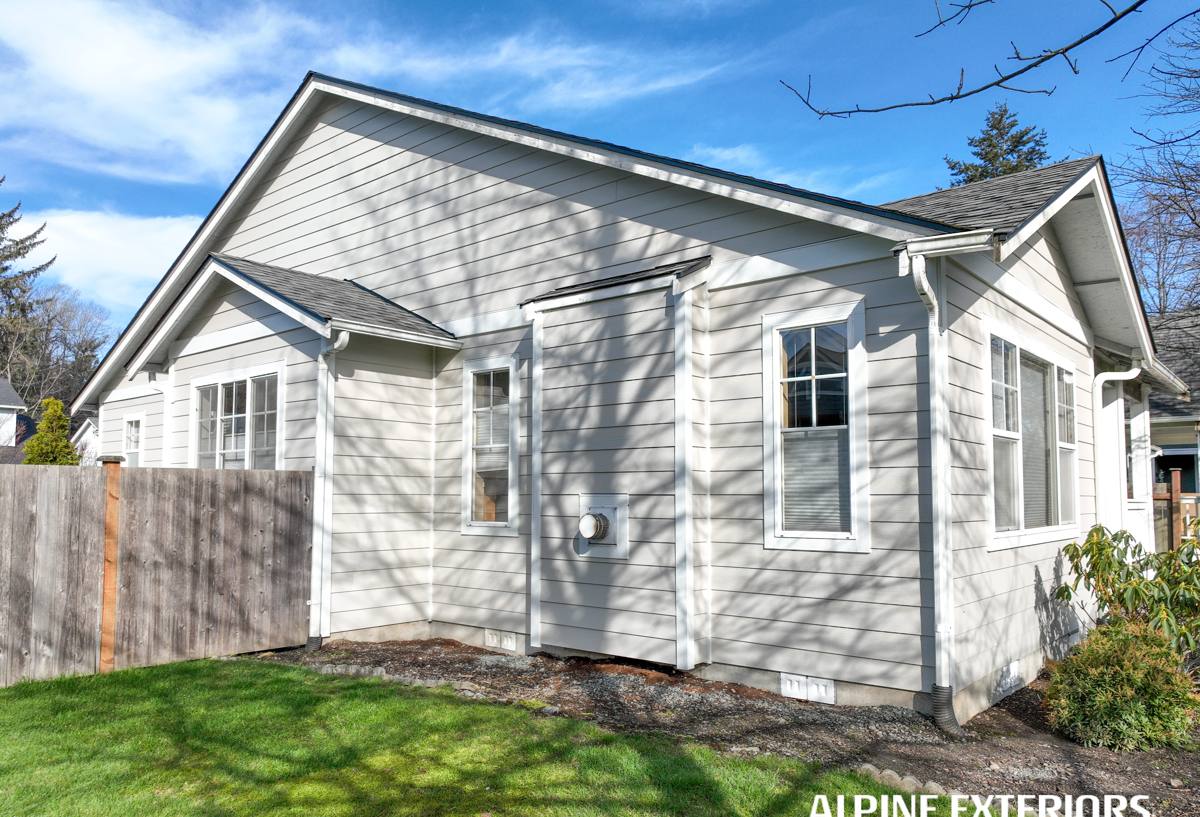
What James Hardie Siding Actually Brings to a Sehome Home
James Hardie fiber cement is engineered from cement, sand, and cellulose fiber, which makes it dimensionally stable in a way wood-based and vinyl products aren't. It doesn't swell and split the way untreated or lightly primed wood products can when they take on repeated moisture, and it doesn't warp or go brittle in cold snaps the way vinyl can over time. For a neighborhood dealing with sustained damp exposure and salt air, that stability matters more than it does in a drier inland climate.
Built for This Region, Not a National Average
James Hardie manufactures climate-specific product lines, and the HZ5 line is engineered for wetter, harsher regions like ours — different moisture resistance and performance characteristics than a formulation meant for a dry southwestern climate. We install the HZ5-engineered product on Sehome homes because it's built for exactly the conditions the neighborhood sees: sustained rain exposure, humidity, and coastal air.
ColorPlus Finish and Salt Air
Standard field-painted siding is only as good as its paint job, and paint is the first thing salt air and UV exposure degrade. James Hardie's ColorPlus finish is baked on in a factory-controlled process, which gives it more consistent coverage and better fade and wear resistance than a field-applied coat, and it comes backed by its own finish warranty separate from the substrate warranty. In a neighborhood where a compromised paint film is an invitation for moisture and algae to take hold, that finish durability is a real functional advantage, not just a convenience.
Non-Combustible Material
Fiber cement is non-combustible, which matters for insurance conversations and for straightforward peace of mind. It's not the primary reason most Sehome homeowners call us, but it's part of why we standardized on Hardie rather than wood-based or vinyl alternatives.
What a Correct Installation Actually Involves
James Hardie siding is only as good as the installation behind it. The material is engineered to perform, but poor installation — wrong fasteners, missing flashing, tight caulked joints where there should be gaps — will undercut all of that engineering and let moisture in exactly where you can't see it until there's a problem underneath.
- Correct water-resistive barrier and flashing detail at every window, door, and penetration, lapped so water sheds outward and down, not into the wall assembly
- Proper starter strip installation at the base of the wall so the first course sits at the correct angle and drains correctly
- Fasteners driven to Hardie's specification — correct type, length, and placement, not simply "close enough" nailing
- Minimum clearance maintained between siding and grade, roof lines, decks, and other abutting surfaces so water has somewhere to go
- Butt joints and panel seams treated per Hardie's installation instructions, including any required caulking or flashing behind the joint — not just caulk smeared over a gap
- Correct field-cutting and edge-sealing practices so cut ends aren't left exposed to moisture absorption
Every one of these details is spelled out in James Hardie's published installation instructions, and every one of them affects whether the manufacturer's warranty actually holds if there's ever a problem. Skipping steps doesn't just risk a callback — it risks the whole reason a homeowner chose Hardie in the first place.
How We Approach a Sehome Siding Project
1. On-Site Assessment
We walk the property and look at what's actually happening on the walls — moisture patterns, moss and algae concentration, existing flashing condition around windows and rooflines, and any signs of what's underneath the current siding. This tells us whether we're dealing with a straightforward re-side or whether there's sheathing or moisture damage that needs to be addressed before new siding goes on.
2. Product and Profile Selection
We go over Hardie's product lines and profiles — lap siding, vertical panel, shingle-style — and colors, matched to the home's style and to what performs well in this specific setting. This is also where we talk through exposure on each elevation, since a north-facing wall with heavy shade needs the same conversation about moss resistance that a west-facing wall needs about driving rain.
3. Prep and Removal
Old siding comes off, the wall assembly gets inspected, and any water-resistive barrier, sheathing, or framing issues get addressed before anything new goes up. Covering a compromised wall with brand-new siding just hides the problem for a few more years.
4. Installation to Manufacturer Specification
Installation follows James Hardie's published fastening, flashing, and clearance requirements, not shortcuts. This is also what keeps the manufacturer's transferable warranty intact if the home changes hands.
5. Final Walkthrough
We walk the finished job with the homeowner, check caulking and trim details, and make sure everything lines up with what was scoped at the start.
Why It Matters That We Already Work in Sehome
A lot of what makes a siding job hold up here isn't in the product spec sheet — it's judgment calls made on-site. Knowing which elevations in a given micro-area tend to hold moss longer, how much rain-driven exposure a particular orientation typically sees, and where salt air exposure tends to concentrate all comes from having done the work locally, not from a generic installation manual. A crew that regularly works Bellingham and Whatcom County jobs brings that judgment to every flashing detail and every clearance measurement, instead of applying a one-size-fits-all approach built for a different climate.
There's also a practical warranty argument. James Hardie's transferable warranty depends on correct installation, and if there's ever a question about how a detail was handled, working with a contractor who's still local, still reachable, and has a track record on similar homes in the area is worth more than a lower bid from a crew that isn't sticking around.
Cost Factors on a Sehome Siding Project
| Factor | Why It Affects Cost |
|---|---|
| Home size and wall complexity | More corners, gables, and dormers mean more cutting, flashing, and labor time |
| Current siding removal and disposal | Tear-off and haul-away adds labor and disposal cost beyond a direct install |
| Sheathing or moisture repair | Damage found during removal has to be addressed before new siding goes on |
| Product line and profile | Lap, panel, and shingle-style profiles carry different material and labor costs |
| Trim and accessory work | Fascia, trim boards, and detail work around windows and doors add scope |
| Site access | Tight lots, multi-story walls, or limited staging space affect labor time |
We give homeowners a real number after walking the property, not a phone estimate, because so much of the cost depends on what's actually happening behind the existing siding.
James Hardie vs. Other Common Siding Choices
We're often asked why we don't offer alternatives like vinyl, LP SmartSide, or untreated wood siding alongside Hardie. The honest answer is a matter of standards, not that every other product is without merit.
| Material | Where It Falls Short for This Climate |
|---|---|
| Vinyl siding | Can warp or become brittle with temperature swings and UV exposure over time; seams and panels rely on overlap rather than a rigid, factory-finished surface |
| Engineered wood (LP SmartSide and similar) | Wood-based core is more vulnerable to sustained moisture exposure than fiber cement if any finish or seal fails |
| Primed cedar or spruce | Requires ongoing field paint maintenance to keep moisture out, which is a real burden in a climate with this much sustained rain |
| James Hardie fiber cement | Dimensionally stable, factory-finished, engineered product line for wetter climates, backed by a transferable warranty |
Maintenance: What Owning Hardie Siding Actually Looks Like
- Rinse siding periodically to keep salt residue, pollen, and organic buildup from accumulating, especially on shaded elevations
- Keep gutters and downspouts clear so water isn't sheeting down the wall face during heavy rain
- Trim back vegetation and tree cover that keeps a wall section shaded and damp longer than the rest of the house
- Inspect caulked joints around windows, doors, and trim annually and have any cracked or failed caulk redone
- Watch for early moss or algae growth and address it before it spreads, rather than after it's established
Compared to a field-painted wood product, this is a light maintenance load — there's no repainting cycle to manage as long as the ColorPlus finish is intact, and the material itself isn't absorbing moisture the way wood does.
Get a Straight Answer for Your Home
Every Sehome property carries its own mix of sun exposure, shade, and wind-driven rain, and that affects which Hardie product and detailing makes sense for your walls. If you're weighing a re-side or dealing with siding that's already showing wear, we're happy to take a look and give you a straightforward, no-pressure estimate using the form below.