 Bellingham
 Why Fairhaven Siding Wears Differently Than Siding Inland
Fairhaven sits close enough to Bellingham Bay that homes here deal with a combination of stresses that inland Whatcom County neighborhoods simply don't face as often. Salt-laden air moves in off the water and settles on exterior surfaces, accelerating corrosion on fasteners, trim, and anything with exposed metal. Add in Bellingham's long stretch of driving rain each fall and winter, plus a moss season that can run from October well into spring on shaded, north-facing walls, and you get a siding system that's under nearly constant moisture pressure for most of the year.
None of this means Fairhaven homes need exotic materials or unusual construction. It means the repair work has to account for how moisture actually moves through a wall assembly in this specific environment, not just patch the visible damage and move on. A repair that looks fine from the sidewalk but doesn't address the underlying moisture path will fail again, usually within a season or two.
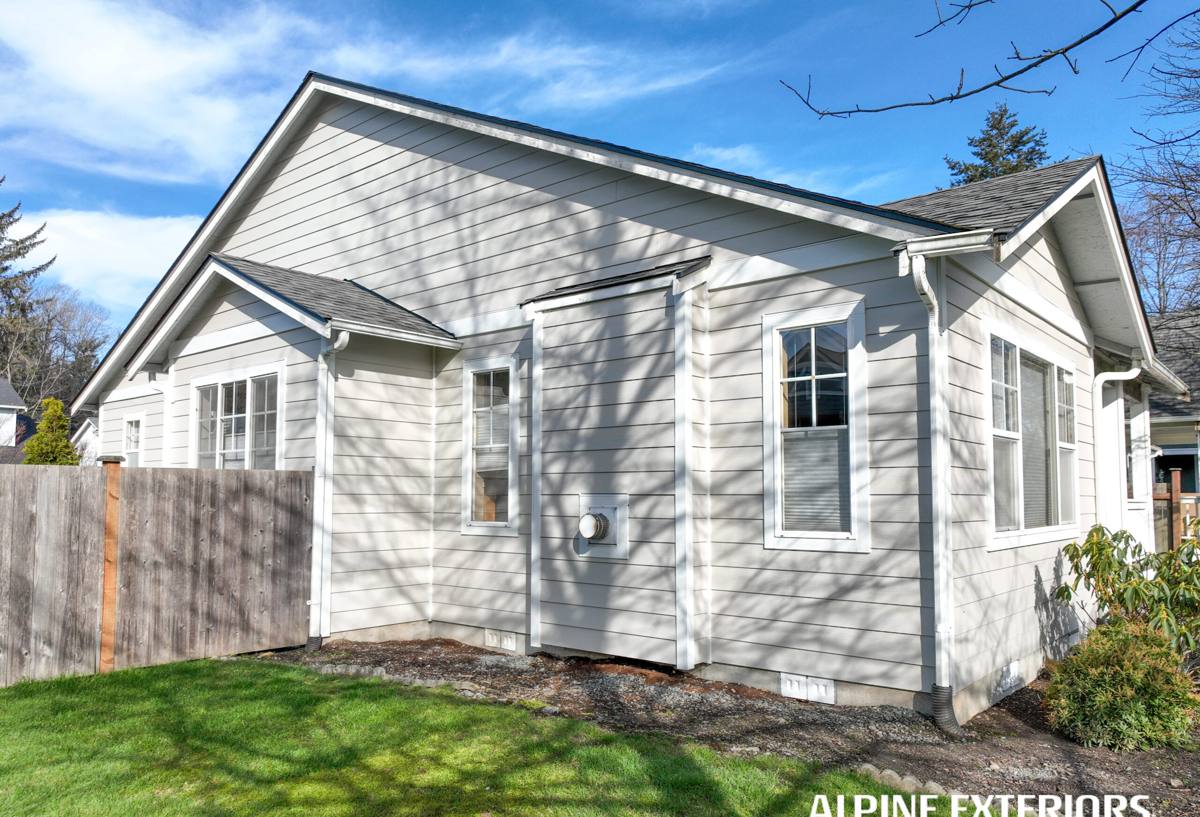
What Coastal Exposure Does to Different Siding Materials
Not every siding material handles salt air, standing moisture, and moss growth the same way. Understanding how your existing material behaves helps explain why a repair might be more involved than simply swapping a board.
| Material | Response to Salt Air | Response to Sustained Moisture | Moss/Algae Resistance |
|---|---|---|---|
| Cedar / primed wood | Fasteners corrode faster; finish breaks down sooner | Absorbs water, swells, and rots at joints and bottom courses | Low without frequent cleaning and re-coating |
| Vinyl | Fasteners and trim pieces are the weak point | Doesn't rot, but traps moisture behind it if installed too tight | Moderate; moss and algae still cling to the surface |
| OSB-based lap siding | Edge sealant is critical; exposed edges swell quickly | Prone to swelling and delamination if moisture reaches the core | Low once the surface coating is compromised |
| James Hardie fiber cement | Non-combustible core resists corrosion-driven failure | Cement composition doesn't rot or swell like wood-based products | Factory finish holds up well; still benefits from periodic cleaning |
This is why the same-looking crack or stain on two different homes can mean two very different repairs. A soft spot in a wood board usually means rot has already spread into the framing behind it. The same spot on fiber cement is more often a caulking or flashing issue at the surface, which is a much simpler fix.
Common Siding Repair Issues We See Around Fairhaven
Certain problems show up more often in this neighborhood because of its exposure and tree cover. The most frequent ones include:
- Moss and algae staining on north- and west-facing walls that stay shaded and damp longer through the day
- Caulk failure at butt joints and trim from repeated wet-dry cycling driven by wind-blown rain
- Corroded or backed-out fasteners where salt air has attacked exposed nail heads or trim screws over the years
- Rot at the bottom courses of older wood or OSB-based siding, especially near grade, downspouts, or splash zones
- Warped or cupped panels on walls that get direct, driving rain without adequate overhang protection
- Cracked or missing caulk around penetrations such as hose bibs, vents, and light fixtures, which lets moisture track behind the siding
Individually, each of these looks minor. Left unaddressed through a full Bellingham winter, several of them together are usually what turns a repair into a much larger sheathing or framing repair.
What a Correct Repair Actually Involves
A siding repair that's done right starts with figuring out how moisture is getting in, not just replacing what's visibly damaged. That means pulling back enough siding to inspect the house wrap or weather barrier, checking flashing at windows, doors, and butt joints, and confirming the sheathing underneath hasn't already started to soften.
Diagnosing Before Patching
We look at the pattern of damage, not just the spot itself. A stain that runs downward from a single point usually traces back to a flashing gap or failed caulk joint above it. Damage spread evenly across a wall section is more often a drainage or ventilation problem behind the siding, which a surface patch won't fix.
Matching Material and Method
Repairs need to match the performance of the surrounding siding, not just its color. That means using compatible fasteners, correct clearances at grade and hard surfaces, and proper lap and joint treatment so the repaired section sheds water the same way the rest of the wall does.
Addressing the Cause, Not Just the Symptom
If moss growth is the issue, that often points to a wall that stays wet longer than it should — sometimes from vegetation too close to the house, sometimes from a gutter or downspout dumping water where it shouldn't. A repair that ignores that cause is a repair you'll be paying for again in a few years.
Repair or Replace? How We Help You Decide
Not every siding problem calls for a full re-side, and not every problem should be treated as a quick patch. The right call depends on how far the damage has spread and what's driving it.
| Factor | Favors Targeted Repair | Favors Full Re-Side |
|---|---|---|
| Extent of damage | Isolated to one or two wall sections | Present on multiple elevations or throughout |
| Sheathing condition | Solid and dry once opened up | Soft, delaminating, or previously water-damaged |
| Material age | Newer siding with years of service life left | Original siding is at or past its expected lifespan |
| Cause of damage | A single identifiable, fixable source | Systemic issues — poor original install, missing flashing details |
| Long-term goals | Homeowner plans to sell or hold short-term | Homeowner wants decades of low-maintenance performance |
We'll tell you honestly which category your home falls into. There's no upside for us in talking a homeowner into a full re-side when a properly diagnosed repair will hold up fine — and no upside in patching a wall that's going to need the same fix again in two years.
Why We Repair and Rebuild Using James Hardie Fiber Cement
When a repair calls for replacement material — whether it's a few boards or a full section — we use James Hardie fiber cement, and only James Hardie. It's the material we install on every project, and it's what we use to patch and match existing Hardie siding as well.
Fiber cement doesn't absorb and swell the way wood or OSB-based products do, which matters directly in a climate like Bellingham's where siding rarely gets a long dry stretch to fully recover between rain events. Hardie's HZ5 product line is engineered specifically for climates with freeze-thaw cycling and sustained moisture exposure, which fits the Pacific Northwest better than a general-purpose formulation. The factory-applied ColorPlus finish also resists the fading and staining that moss, algae, and salt air cause faster on field-applied paint, so a repaired section holds its color closer to the surrounding wall over time.
We don't install vinyl, LP SmartSide, primed spruce, cedar, or other fiber cement brands, and that applies to repair work too. It's a narrower lineup than most contractors offer, but it means every repair we perform is backed by material we trust and understand thoroughly, with a manufacturer warranty structure that holds up.
Our Process for a Fairhaven Siding Repair
- On-site inspection. We walk the exterior, identify every problem area, and check for moisture intrusion at penetrations, joints, and grade-level contact.
- Opening up the wall where needed. If there's any sign the damage extends past the surface, we pull siding back far enough to inspect the weather barrier and sheathing directly.
- Honest scope and estimate. You get a clear explanation of what's causing the problem, what repair option addresses it, and what it costs — no upsell to a full re-side unless the inspection genuinely calls for it.
- Correct repair execution. Damaged material is removed, the substrate is confirmed sound (or repaired if not), and new material is installed with proper flashing, clearances, and fastening.
- Final detailing. Caulk joints, trim, and touch-up finishing are matched as closely as possible to the surrounding siding.
Why a Crew That Already Works Fairhaven Matters
Siding repair in a coastal Whatcom County neighborhood benefits from knowing the conditions before you show up. A crew that regularly works Fairhaven already understands which wall orientations hold moss the longest, how far wind-driven rain typically reaches under an eave, and how salt air factors into fastener and trim choices. That local pattern recognition shortens the diagnostic phase and reduces the chance of a repair that only addresses what's visible.
It also means scheduling around Bellingham's wet season with realistic expectations, since some repairs are better timed for a stretch of dry weather rather than squeezed in during the heaviest part of the fall and winter rains.
Signs Your Fairhaven Home May Need a Siding Repair
- Dark green or black staining that keeps returning to the same wall section after cleaning
- Caulk that's cracked, shrunk, or pulling away from trim and joints
- Soft or spongy spots when you press on the siding, especially near the bottom courses
- Rust streaks running down from fasteners or trim pieces
- Visible warping, cupping, or gapping between boards
- Peeling or bubbling paint concentrated in one area rather than across the whole house
- Musty smells or interior wall staining on the room behind a suspect section of exterior wall
If any of these sound familiar, it's worth having the area looked at before the next round of Bellingham rain has a chance to work its way further in. We're happy to take a look and give you a straightforward, no-pressure estimate for what a proper repair would involve — just fill out the form below to get started.