 Bellingham
 Siding Replacement Is a Different Job Than a Patch or a Repair
A lot of siding work that happens on Lynden homes is small-scale — a cracked panel swapped out, a section repaired after storm damage, a caulk joint redone. Full siding replacement is a different project entirely. It means the whole exterior wall assembly gets opened up, inspected, and rebuilt from the sheathing out, which is exactly why it's worth doing once and doing it correctly rather than as a series of patches over the years. This page is about that specific project — full siding replacement for a Lynden home — not general repair work.
Lynden sits inland from Bellingham Bay but still well within reach of the marine weather that shapes exterior work across Whatcom County. Salt-laden air, driving rain that hits walls sideways instead of straight down, and a moss season that can run most of the year on shaded siding all put real, sustained stress on whatever goes back up on the wall. A replacement project is the point where a homeowner gets to fix not just the visible wear but the underlying decisions — material, flashing, sheathing condition — that determine whether the next twenty-five years look better or worse than the last one.
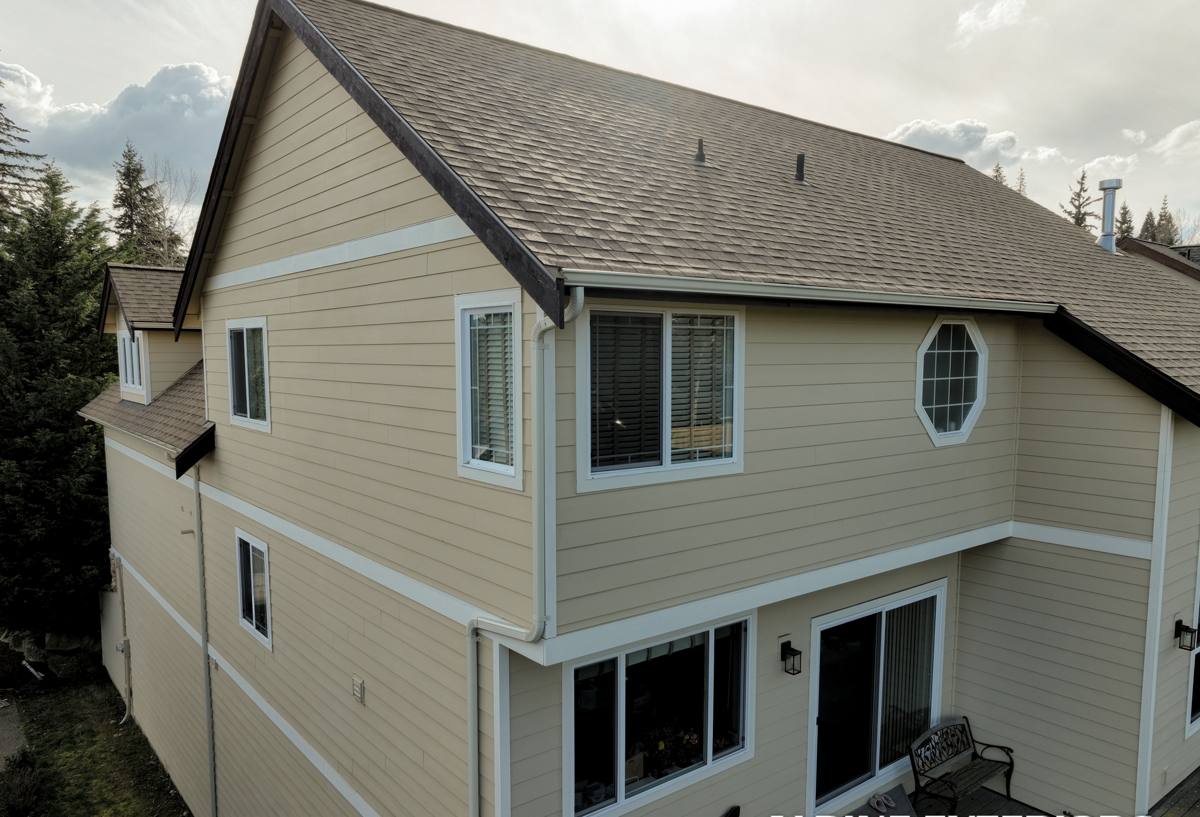
What Lynden's Climate Demands From a Replacement
Salt Air
Even set back from the immediate shoreline, Lynden gets a steady dose of marine air moving in across this part of Whatcom County. Over years, that salt exposure accelerates corrosion on fasteners, flashing, and lower-grade trim hardware. A replacement project is the right time to upgrade hardware quality, since it's far cheaper to spec corrosion-resistant fasteners during install than to chase rust stains and loosening trim a decade later.
Driving Rain
Rain through fall and winter rarely falls straight down here — wind pushes it sideways into wall assemblies, window flashing, and every joint where trim meets siding. A replacement done without careful attention to flashing and water-resistive barrier detail can look fine for a year or two and still fail from the inside, because wind-driven rain finds the gaps that vertical rain never would. This is the single biggest reason a full replacement outperforms an overlay or a patch: it's the only approach that lets a crew actually fix those hidden details instead of building over them.
A Long Moss Season
Mild temperatures, tree cover, and near-constant moisture add up to a moss and mildew season that can run close to year-round on shaded walls. Lynden's mix of open farmland and tree-sheltered residential lots means this varies a lot from house to house — a wall facing open field dries quickly after rain, while a wall shaded by mature trees may stay damp for days. A siding material that's porous, or that traps moisture against the substrate, becomes a growth surface over time regardless of how well it's cleaned.
Signs a Lynden Home Is Due for Replacement, Not Just Repair
Repair makes sense when damage is isolated and the rest of the wall assembly is sound. Full replacement becomes the right call once problems are widespread, recurring, or tied to what's happening behind the siding rather than on its surface. Signs worth a professional look include:
- Moss or dark staining that returns within weeks of cleaning, especially on shaded or north-facing walls
- Soft, spongy, or bubbling siding in multiple locations, not just one isolated spot
- Paint that's peeling or siding that's visibly cupping or warping across large sections
- Cracked, buckled, or missing panels in more than one area after wind events
- Rust staining running from fasteners across several sections of the wall
- Musty smells or staining on interior walls that back up to exterior siding
- Siding original to a home built more than 20-25 years ago with no documented replacement
- A pattern of repeated small repairs that keep turning up new problems nearby
Any one of these on its own might just need a repair. Several together, especially spread across different walls, usually mean the underlying material or the original installation has reached the end of what it can reasonably do, and a full replacement will cost less over time than continuing to chase individual failures.
What a Correct Full Replacement Actually Involves
Complete Tear-Off, Not an Overlay
We remove the existing siding down to the sheathing rather than installing new siding over the old material. Overlaying hides problems instead of fixing them, and it's the single most common shortcut that turns a siding replacement into a wasted expense — any rot or moisture damage underneath just keeps working while it's covered up.
Sheathing Inspection and Repair
With the old siding off, we check the sheathing underneath for rot, soft spots, or prior water damage before anything new goes up. This is the step a rushed or overlay-based job skips entirely, and it's often where the real value of a full replacement shows up — catching damage while it's still repairable instead of finding out years later that it spread.
Weather-Resistive Barrier and Flashing
Given how much siding failure in this region traces back to water getting behind the cladding rather than through it, the house wrap, window flashing, and every wall penetration get careful, deliberate attention during a replacement. This is the step that's easiest to rush and hardest to inspect once new siding is up, so we treat it as non-negotiable rather than optional.
Installation to Manufacturer Spec
James Hardie's warranty depends on installation following their published specifications: correct fastener spacing and type, proper clearances above grade, roofline, and decks, and correct field-cutting and sealing practices. We install to that spec as the baseline on every job, not as an upgrade.
Trim, Caulking, and Final Details
Trim work and joint sealing are where a lot of the long-term weather performance actually lives. Done correctly, these details shed wind-driven rain instead of channeling it into a seam; done poorly, they're often the first place a new installation starts leaking within a few wet seasons.
Why We Replace With James Hardie Fiber Cement Only
We install James Hardie fiber cement exclusively for full replacement projects. That's a professional standard, not a sales position, based on what actually holds up in this climate over time.
- Non-combustible core: Fiber cement doesn't feed a fire the way wood-based siding products can, which matters for safety and can matter for insurance underwriting.
- Factory-applied ColorPlus finish: The finish is baked on in a controlled factory process rather than brushed on in the field, holding color and adhesion far longer under sustained moisture and UV exposure than site-applied paint.
- Climate-engineered HZ product lines: Hardie's HZ5 formulation is built specifically for regions with significant moisture exposure and freeze-thaw cycling, which describes Lynden and the surrounding county closely.
- Dimensional stability: Fiber cement doesn't swell, cup, or warp the way engineered wood siding can after repeated wetting cycles over a wet season.
- A strong transferable warranty: Hardie backs the product with a robust warranty structure, provided installation follows its published specs — which is exactly what a full replacement, done correctly, delivers.
We don't install LP SmartSide, vinyl siding, Cemplank, Allura, primed spruce, or cedar. Each has a place in the market, and plenty of homeowners are satisfied with them. Our call is a professional one: for a full replacement in a climate with this much sustained moisture and salt exposure, we'd rather stand fully behind one system than offer a cheaper alternative that quietly shifts maintenance risk back onto the homeowner within a few years.
| Product | Trade-off worth knowing before a full replacement |
|---|---|
| Vinyl siding | Can warp or crack under sustained UV and temperature swings; panel seams give wind-driven rain an entry point |
| LP SmartSide / engineered wood | Wood-strand core is more moisture-sensitive at cut edges and fastener points than fiber cement |
| Primed spruce or cedar | Needs ongoing paint and moisture maintenance to avoid rot — a heavier long-term cost than the upfront price suggests |
| Other fiber cement brands | May lack a climate-specific HZ-style line or the same factory-finish warranty depth as James Hardie |
How Our Replacement Process Works, Start to Finish
- Inspection and estimate: We walk the whole exterior, checking current siding condition, signs of trapped moisture, and how sun, shade, and wind exposure differ across walls. That drives the estimate, not a flat per-square-foot guess.
- Material and color selection: We go over James Hardie product lines and ColorPlus color options against the home's exposure and the homeowner's preferences.
- Tear-off: Existing siding comes off completely, with debris hauled and disposed of as part of the job.
- Sheathing repair: Any rot or soft spots found underneath get addressed before new material goes up.
- Weather barrier and flashing: House wrap, window flashing, and penetrations are installed or corrected to shed wind-driven rain.
- Installation to spec: New Hardie siding goes up following manufacturer fastening, clearance, and sealing requirements.
- Final walkthrough: We cover care and maintenance expectations and confirm everything matches what was estimated before calling the job complete.
What Affects the Cost of a Full Replacement
| Factor | Why it matters |
|---|---|
| Home size and number of stories | More wall area and more difficult access both add labor time |
| Trim and detail complexity | Homes with more windows, gables, and architectural trim require more precise cutting and flashing work |
| Sheathing condition once old siding is off | Rot or water damage found underneath needs repair before new siding goes up |
| Product line and profile | Different Hardie lines and lap-width or panel profiles carry different material costs |
| Color selection | Factory ColorPlus finishes vary in price by color and product line |
Every estimate is specific to the property. We walk through these factors during the inspection rather than handing over a number without an explanation behind it.
Timeline and What to Expect During the Project
A full siding replacement on a typical single-family Lynden home generally runs from a little over a week to a few weeks, depending on size, trim complexity, and what turns up once old siding comes off. Weather plays a real role in scheduling here — driving rain and a long wet season mean tear-off and sheathing work need dry windows to be done properly, and we plan around that rather than pushing critical steps through weather that compromises them. Homeowners can expect noise and site activity during active work days, with debris removed as part of the job rather than left to accumulate.
Why a Crew Already Working Lynden Matters for a Replacement
Full siding replacement is the kind of project where local, repeated experience shows up in specific decisions: which wall orientations on a Lynden property stay wet longest, where extra flashing attention pays off given the area's driving rain, and which sheathing issues are common enough locally to watch for closely during tear-off. A crew that works this county through every season, not just when weather cooperates, brings that judgment to the job rather than applying a generic approach built for a different climate. It also means that if a warranty question or a maintenance question comes up years down the road, it's a call to a crew still working in the same area, not one that's moved on.
If your Lynden home is due for a full siding replacement, we're glad to come take a look and walk you through what we find, with no pressure to move forward. Reach out using the form below to schedule a free estimate.