 Bellingham
 Why South Hill Asks More of a Siding Job
South Hill sits above downtown Bellingham on a wooded slope, with mature tree canopy shading many lots and a clear line down to Bellingham Bay on the clearer days. That combination is exactly what makes siding age faster here than in a lot of inland neighborhoods. Salt-laden air moves in off the bay and the Strait, driving rain comes in sideways during fall and winter storms, and the shade from big conifers and maples keeps north- and east-facing walls damp long after the rain stops. Put those three things together for a few decades and you get exactly the failure patterns we see over and over on South Hill: soft trim at the bottom courses, moss and algae staining that keeps coming back no matter how many times it's pressure-washed off, and paint that won't hold past a few years on the shaded sides of the house.
None of that is a South Hill-specific mystery — it's straightforward building science. But it does mean a siding replacement here needs to be planned around moisture and shade, not just around color and curb appeal.
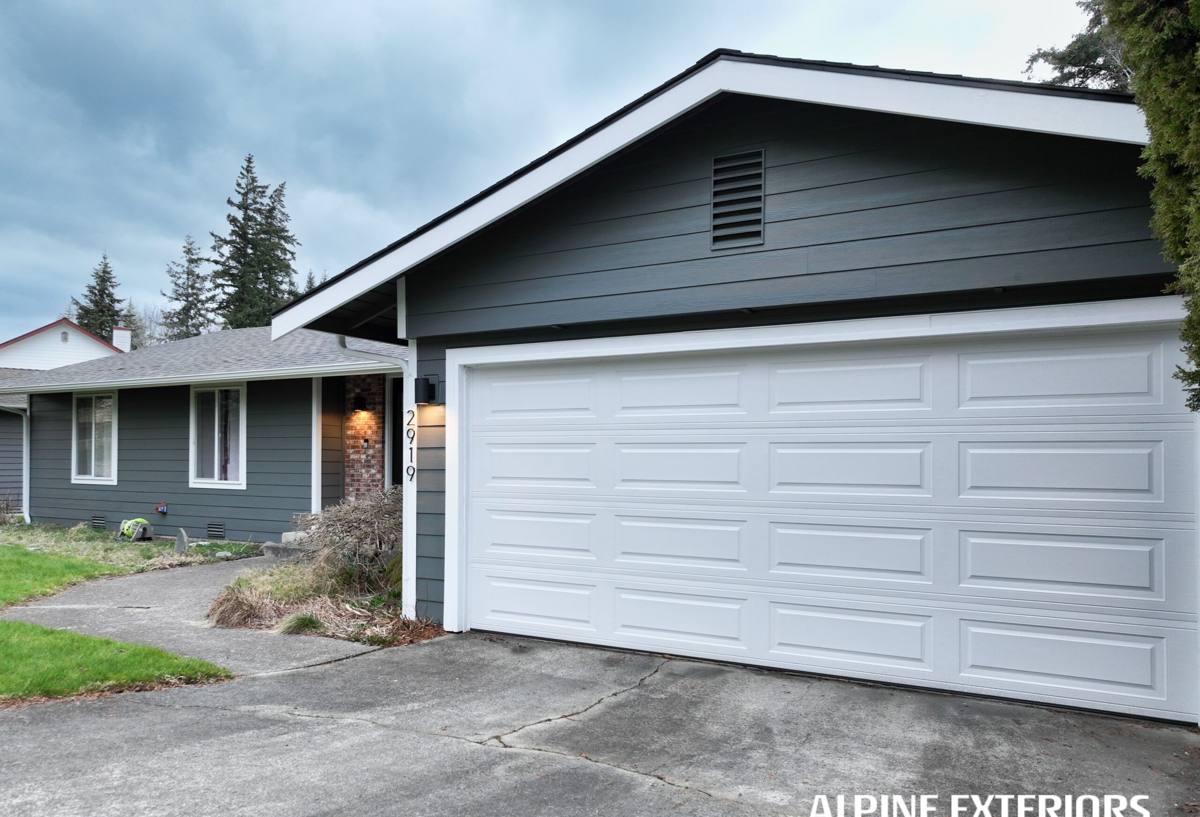
Signs a South Hill Home Needs Replacement, Not Just Repair
Not every tired-looking exterior needs a full tear-off. But there's a point where patching becomes false economy, and homes on South Hill tend to hit that point in a fairly predictable pattern because of the neighborhood's mix of older, character-rich houses and newer infill construction.
- Soft or spongy spots when you press on the siding, especially near the ground, under windows, or where two roof planes meet
- Bubbling, peeling, or chalky paint that returns within a year or two of repainting, particularly on shaded walls
- Persistent moss or black-green streaking that comes right back after cleaning
- Visible cupping, warping, or delamination in wood-based or engineered wood siding
- Nail pops, gaps at seams, or caulk lines that keep failing every season
- Rot found during a re-side estimate that goes deeper than the surface once a piece is pulled
If you're only seeing one or two of these in isolated spots, spot repair may still make sense. If you're seeing several at once, or the same repair keeps failing in the same spot, that's usually moisture working its way into the wall assembly — and that's a replacement conversation, not a caulk-gun conversation.
What's Usually Under the Old Siding
South Hill's housing stock spans early-1900s character homes through newer construction, so what we find once the old siding comes off varies. Older homes often have original wood siding that's been painted many times over, sometimes with newer product layered over it in a past remodel. Homes from the past few decades are more likely to have LP SmartSide, vinyl, or an earlier generation of fiber cement. In every case, tear-off is the moment to actually see the wall — the sheathing, the flashing around windows and doors, and whether a drainage plane exists at all. On a hillside, shaded, rain-exposed neighborhood like South Hill, that inspection matters more than it would on a drier, more open lot, because any moisture that's already gotten in has had more time and more opportunity to do damage.
Why We Standardize on James Hardie
We install James Hardie fiber cement exclusively, and South Hill's climate is a good illustration of why. Fiber cement doesn't rot, doesn't feed moss the way wood fiber products can, and holds paint or its factory finish far longer in shaded, damp conditions than wood-based alternatives. It's also non-combustible, which matters in a region where wildfire smoke seasons have become a normal part of Pacific Northwest summers even without a fire at the door.
We chose not to install several common alternatives, and we think homeowners deserve the honest reasoning rather than a sales pitch:
| Product | What it does well | Why it's a harder fit for South Hill's climate |
|---|---|---|
| Vinyl siding | Low upfront cost, low maintenance in dry climates | Can warp or bow with temperature swings, seams and moisture management are less forgiving in constant damp shade, and it's not a match for older homes' architectural detailing |
| LP SmartSide | Engineered wood strength, workable cost | Wood-based core is more vulnerable to edge swelling and moisture intrusion if a seam, cut edge, or caulk joint fails — a real risk under year-round rain and tree drip |
| Cedar / primed spruce | Traditional look, especially on older character homes | Needs disciplined recoating on a strict schedule; in shaded, damp spots it's the first material to show rot if maintenance slips even one season |
| James Hardie fiber cement | Won't rot, resists moss growth, holds factory finish for decades, non-combustible | Higher material cost and requires correct installation technique — the trade-off we consider worth it |
Hardie's ColorPlus factory finish is baked on and backed by its own finish warranty, so you're not repainting on the same schedule you would with wood or primed products — a real advantage on shaded South Hill walls where paint has always struggled to last.
HZ Product Lines and the Bellingham Climate
James Hardie engineers its siding by climate zone (HZ5 and HZ10), tuning the product's moisture resistance to the region it's installed in. Western Washington's wet, marine climate is exactly what these zone-specific formulations are built to handle, and it's part of why we don't treat Hardie as a one-size-fits-all product — we install the version engineered for exactly the weather South Hill actually gets.
What a Correct Installation Actually Involves
Fiber cement siding is only as good as the installation behind it. A rushed or corner-cut job can undercut even the best material, and this is where a lot of siding problems on older homes actually start. On a South Hill home, we pay particular attention to:
- Drainage plane and rain screen gap — a small air gap behind the siding lets any moisture that does get past the cladding drain and dry out instead of sitting against the wall
- Flashing at every penetration — windows, doors, hose bibs, light fixtures, and roof-to-wall transitions are where driving rain finds its way in first
- Correct fastening pattern — Hardie specifies fastener type, spacing, and placement, and deviating from that spec is one of the most common causes of premature failure and voided warranty coverage
- Proper clearance — siding held off the ground, roofline, and deck surfaces at the manufacturer's minimum clearance so it isn't sitting in standing water or leaf litter
- Caulking only where it belongs — sealant is a backup, not the primary water management strategy; over-caulking a joint that should drain can trap moisture instead of shedding it
Our Process on a South Hill Project
Every siding replacement we do starts with a walk-around assessment — not just of the siding itself, but of the trim, flashing, gutters, and grading around the house, since those all affect how water moves across the wall. From there:
- Tear-off of the existing siding, with the sheathing inspected as it's exposed
- Repair or replacement of any damaged sheathing or framing found underneath
- Installation of a weather-resistant barrier and drainage gap sized for the wall assembly
- Flashing detail at all windows, doors, and penetrations before a single piece of siding goes up
- Installation of James Hardie siding and trim to manufacturer fastening and clearance specifications
- Final walkthrough covering caulking, touch-up, and cleanup
On sloped, tree-covered lots — common on South Hill — we also plan around site access and protecting landscaping, since narrower or steep driveways and mature plantings change how staging and material handling need to work compared to a flat, open lot.
What Affects the Cost of a South Hill Siding Job
Every home is different, but the factors that move the price on a South Hill re-side project are fairly consistent:
| Factor | Why it matters |
|---|---|
| Tear-off scope | Full removal down to sheathing costs more than siding over an already-sound assembly, but it's the only way to properly inspect and address hidden rot |
| Home size and story height | More square footage and taller walls mean more material, more staging, and more labor time |
| Trim and architectural detail | Older South Hill homes with more decorative trim, dormers, or multiple roof planes take longer to detail correctly than a simple rectangular wall |
| Site access | Steep or narrow lots common on the hill can slow material staging and require more careful protection of landscaping |
| Underlying damage | Rot found during tear-off adds sheathing or framing repair costs that can't be known until the old siding is off |
| Siding profile chosen | Lap siding, shingle-style panels, and board-and-batten each carry different material and labor costs |
Why It Matters That We Already Work South Hill
A crew that's already replaced siding on South Hill's hillside lots knows the practical realities before the first estimate: which walls take the brunt of the driving rain, where tree cover means moss will be a recurring issue no matter what's installed, and how to stage a job on a steep or tight driveway without tearing up a yard. That local familiarity shows up in the details — the flashing choices, the clearances, the way a crew sequences a job around a Whatcom County fall storm system — more than it shows up in any brochure.
Questions Worth Asking Before You Hire
- Will you inspect and repair sheathing damage before re-siding, or just cover it up?
- What drainage plane or rain screen approach do you use behind the siding?
- Are you a certified James Hardie installer, and do you follow their published fastening spec?
- What does your workmanship warranty cover, and for how long?
- Can you walk me through how you'll protect landscaping and manage access on my specific lot?
If your South Hill home is showing soft trim, recurring moss staining, or paint that won't hold, we're happy to take a look and give you a straight answer on whether it's a repair or a replacement — no pressure, no obligation. Use the form below to request a free estimate.