 Bellingham
 Siding Repair Built Around How Sudden Valley Actually Weathers
Sudden Valley is a wooded, hilly community on the south shore of Lake Whatcom, and it puts a specific kind of stress on exterior siding that's different from what a house closer to downtown Bellingham deals with. Heavy tree canopy keeps whole wall sections shaded and slow to dry. Terrain and lake exposure mean wind-driven rain hits different elevations of the same house with very different force. And like most of Whatcom County, the broader Bellingham area sits close enough to the water that homes pick up a steady dose of salt-tinged marine air on top of everything else, which adds to the corrosion and finish-wear load on fasteners, flashing, and trim. Add a moss season that runs long under all that shade, and siding here takes more of a beating than the same product would on an open, sunny lot twenty minutes inland.
That's the environment we're repairing into whenever we get a call from a Sudden Valley homeowner about a damaged panel, a soft spot near a window, or a section of siding that's started to separate at a seam. This page is specifically about siding repair — not full replacement, not roofing or windows — and what a correct repair looks like on a home in this particular setting.
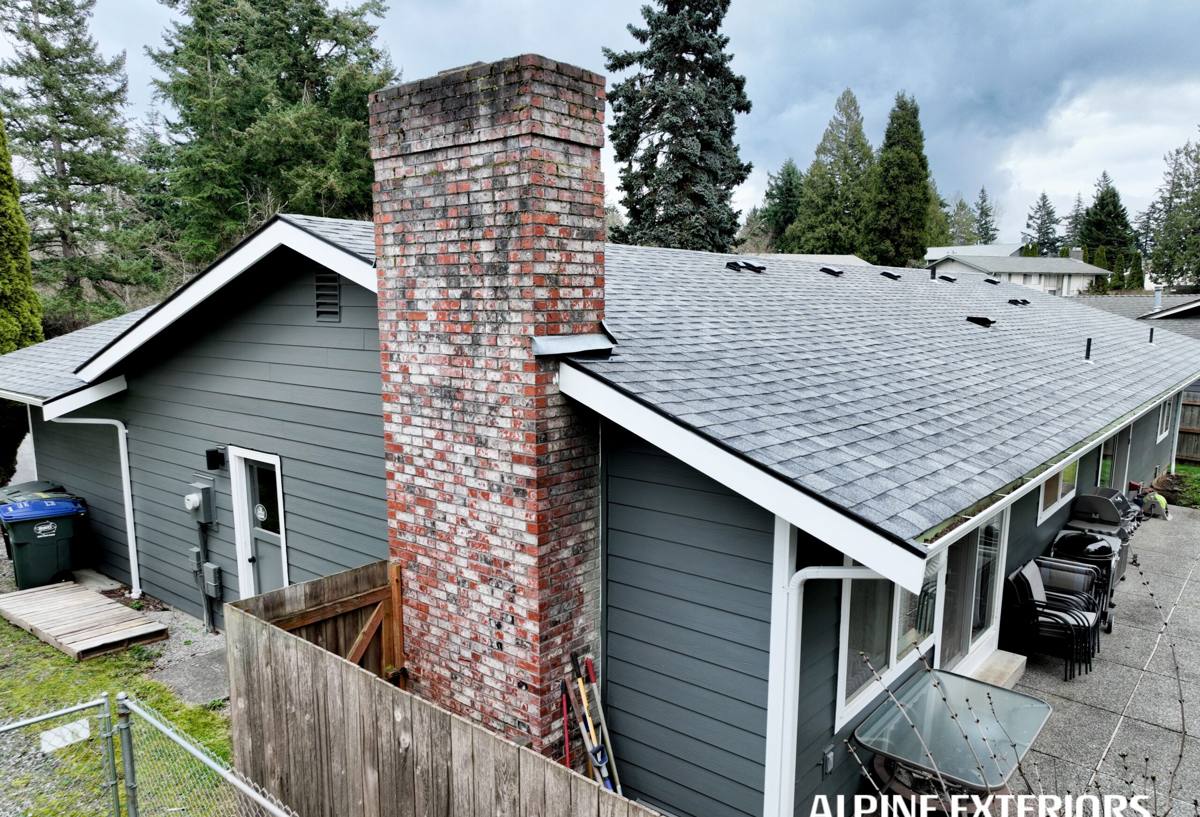
What Damages Siding Fastest in Sudden Valley
Shade That Never Lets a Wall Fully Dry
A lot of Sudden Valley lots have at least one wall face that gets very little direct sun for most of the year. After a storm, that wall stays damp far longer than a sunlit elevation would. If there's already a gap in the siding's protective layer — a cracked caulk joint, an unsealed cut edge, a fastener that backed out slightly — that persistent dampness is exactly what turns a small flaw into a real problem underneath the surface.
Wind-Driven Rain Off the Lake
Because Sudden Valley sits at varying elevations relative to the lake and surrounding ridgelines, storms don't hit every wall the same way. One elevation might take rain almost straight-on during a windy system while another stays relatively sheltered. Repairs need to account for that — a patch that would hold fine on a sheltered wall can fail fast on an exposed one if the water management behind it isn't done right.
Moss, Mildew, and Debris From the Tree Canopy
Dense tree cover means a steady supply of needles, leaves, and debris settling against the lower courses of siding and in corners where two wall planes meet. That debris holds moisture against the surface and accelerates moss and mildew growth, which is cosmetic at first but can mask or worsen underlying damage if it's left to sit for a season or two.
Physical Damage
Falling branches and debris from surrounding trees are a real source of cracked or punctured panels here in a way that's less common on an open lot. Impact damage tends to be sudden and localized, which usually makes it a good candidate for a clean repair rather than a full re-side — provided it's addressed before water gets behind the panel.
Repair or Replace: How We Make the Call
Not every damaged section needs a full re-side, and not every damaged section should just be patched and left alone. The right call depends on how much of the wall is affected, what's happening behind the siding, and how the existing material is holding up everywhere else.
| Situation | Usually a Repair | Usually Points to Replacement |
|---|---|---|
| Damage extent | One or a few isolated panels or a single section | Damage scattered across multiple elevations |
| Cause | Impact damage, a failed caulk joint, isolated fastener issue | Widespread moisture intrusion or rot in the sheathing |
| Underlying sheathing | Sound and dry once opened up | Soft, discolored, or already rotted |
| Age and condition of remaining siding | Rest of the siding is sound and well past its early years | Siding is near end of life or was never a durable product to begin with |
| Color match | Newer Hardie ColorPlus batch or a less visible elevation | Older or discontinued color where a visible mismatch is unavoidable |
We won't sell a homeowner a full re-side when a targeted repair will genuinely hold up, and we won't patch a section that's really telling you the whole wall assembly has a moisture problem. Part of an honest repair estimate is telling you which one you're actually looking at.
What a Correct Siding Repair Involves
A repair that's done right is more than swapping a damaged board for a new one. On a shaded, moisture-heavy property like a typical Sudden Valley lot, the steps around the visible repair matter as much as the patch itself.
- Open it up and check underneath: Before anything gets replaced, we look at the sheathing and water-resistive barrier behind the damaged area. A repair that goes back over compromised sheathing just hides the real problem.
- Match the product and profile: We repair with James Hardie fiber cement to match existing Hardie siding wherever possible, matching plank width, exposure, and texture so the repair reads as part of the wall, not a patch.
- Address the color honestly: Hardie's factory-applied ColorPlus finish is extremely consistent, but a repair years after the original install may not match a weathered, sun-faded wall exactly. We'll tell you upfront whether a seamless match is realistic or whether the honest answer is a close match, a less visible placement, or repainting the affected section.
- Correct the water management, not just the panel: Flashing, house wrap, and drainage details behind the repair area get restored to spec, not just tucked back into place. This is the step that determines whether the repair lasts one season or twenty years.
- Re-fasten and re-seal to spec: Correct fastener type, spacing, and caulk at the joints — all Hardie's published requirements, not shortcuts, even though it's a smaller job than a full install.
- Clear the debris and address moss before closing up: Any moss, mildew, or trapped debris in the repair area gets cleaned out, since sealing it in place just relocates the problem.
A Homeowner's Pre-Repair Checklist
- Note where the damage is and roughly how it happened — impact, a failed joint, a slow leak you noticed indoors
- Check for soft spots, staining, or bubbling paint on interior walls near the damaged area, which can signal water has already gotten past the siding
- Look at nearby sections of siding for early signs of the same problem — cracked caulk, gapping seams, or moss buildup
- Have your Hardie color and product line on hand if you know it (from your original installer or a prior invoice), since it speeds up sourcing a matching repair panel
- Get a written scope that specifies what's being repaired, what materials are used, and what's being checked underneath before you sign anything
Why We Only Repair With James Hardie Fiber Cement
We install and repair exclusively with James Hardie fiber cement. We don't install or repair with LP SmartSide, vinyl siding, Cemplank, Allura, primed spruce, or cedar. That standard applies to repair work the same way it applies to a full re-side, for the same reasons:
- Non-combustible core: Fiber cement doesn't feed a fire the way wood-based products can, which is relevant for any wooded Whatcom County community, Sudden Valley included.
- Factory-applied ColorPlus finish: The color is baked on under controlled conditions, so it resists fading, chalking, and moisture intrusion far longer than field-applied paint on a shaded wall that stays damp longer between storms.
- Climate-engineered HZ formulations: Hardie's HZ5 line is built for regions with heavy moisture exposure and freeze-thaw cycling, which matches this area's lake humidity, salt-tinged marine air, and long wet season.
- Dimensional stability: Fiber cement doesn't swell, cup, or warp the way wood-based siding can after repeated wetting cycles, which matters most exactly where a repair patch meets the original wall.
- A repairable, well-documented product: Because Hardie's product lines, profiles, and colors are well documented and consistently manufactured, a repair years later has a real shot at matching the original installation — something that's much harder with discontinued or inconsistent product lines.
Other products aren't necessarily bad on their own terms, but we've made a professional call to stand fully behind one system rather than mix materials on a home, especially in a climate that doesn't forgive shortcuts.
Why Hiring a Crew That Already Works Sudden Valley Matters
Sudden Valley is a private community with its own internal road network and an HOA, and a contractor who regularly works here already understands the practical side of that — access, scheduling, and how much exposure varies from one lot to the next even within the same development. That familiarity carries over into the repair itself: knowing which walls in this kind of setting tend to hide moisture problems behind a small visible flaw, how debris and moss accumulate differently on a shaded, tree-lined lot, and which fastener and sealant choices actually hold up in a damp, wooded microclimate instead of failing again in a year or two.
A repair crew unfamiliar with this specific environment can do competent work and still miss the underlying cause, because the failure patterns here don't always look like the ones on a typical open, sunny lot. Experience with this particular stretch of Lake Whatcom shoreline is part of what makes a repair actually last.
Our Repair Process
We start with an on-site inspection of the damaged area and the surrounding wall, checking not just the visible flaw but the flashing, drainage detailing, and sheathing condition behind it, since that's where the real story is on a shaded, moisture-exposed property like a typical Sudden Valley home. From there we give you a straight read on whether it's a repair or something bigger, along with a written scope and price before any work begins. We source matching Hardie material where a true match is realistic and tell you plainly when it isn't. Every repair gets fastened, sealed, and flashed to Hardie's published specifications — the same standard we hold a full installation to — because a repair that skips those details just fails again, usually sooner than the original damage took to show up.
If you've got a damaged, cracked, or separating section of siding on a Sudden Valley home, we're happy to take a look and give you an honest read on what it actually needs. Reach out below for a free, no-pressure estimate.