 Bellingham
 Windows Built for Columbia's Weather, Not Just Its Style
The Columbia neighborhood sits close enough to Bellingham Bay that homes here take a different kind of weather beating than houses further inland in Whatcom County. Salt-laden air off the water, wind-driven rain that comes in sideways during fall and winter storms, and a moss season that can stretch from October well into spring all put extra stress on window systems that weren't built or installed with that combination in mind. When we talk about "energy-efficient windows" for a Columbia home, we're not just talking about a good U-factor rating on a spec sheet. We're talking about a window and installation system that keeps that marine climate on the outside of the wall, where it belongs.
A lot of window failures we get called out to look at in this part of Bellingham aren't really glass failures at all — they're installation and flashing failures that let moisture behind the window over several wet seasons. Good glass in a poorly flashed opening will still rot the framing around it. That's the piece a lot of window-only companies gloss over, and it's the piece we treat as the actual job.
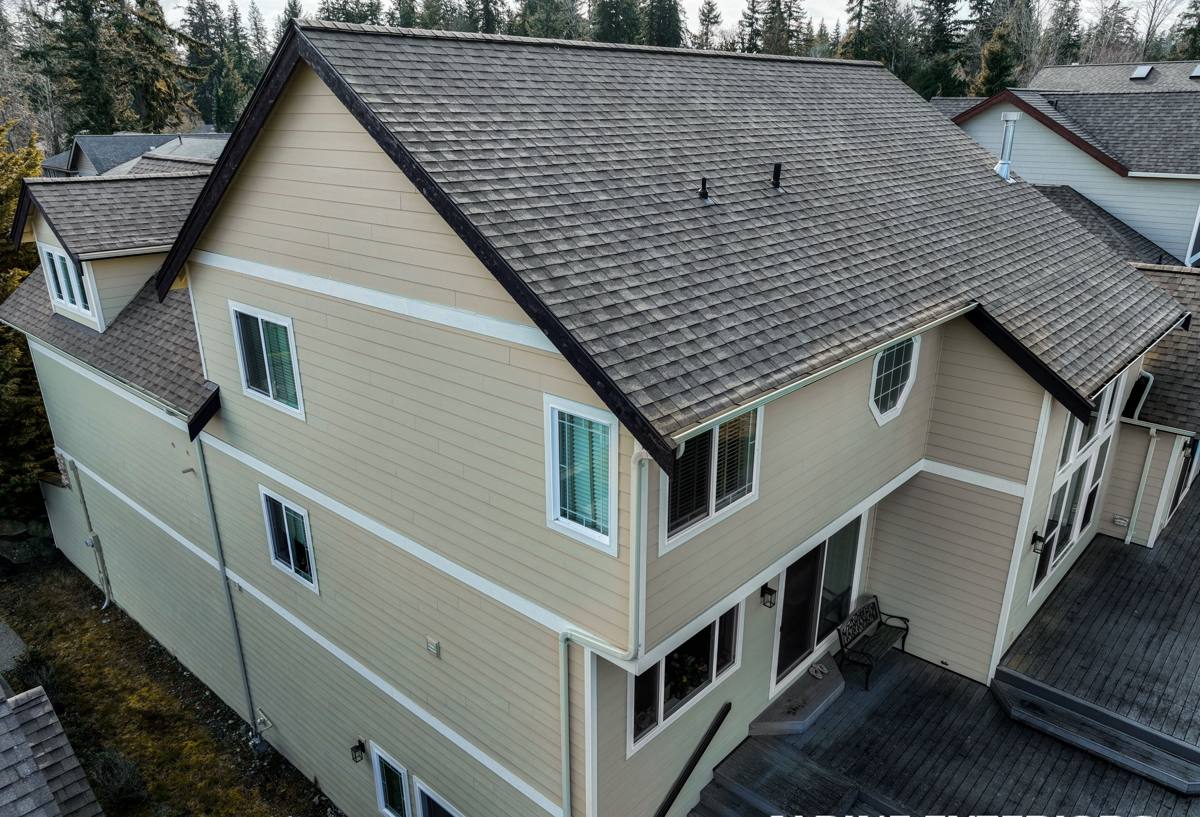
What the Local Climate Actually Does to Windows Over Time
Salt Air and Hardware Fatigue
Proximity to the bay means airborne salt settles on exterior surfaces, including window hardware, cladding, and fasteners. Over years, this accelerates corrosion on lower-grade aluminum components, cheap cranks and locks, and unprotected fasteners. It doesn't happen overnight, but it's a steady, cumulative process — which is why hardware and cladding material choice matters more for a Columbia home than for a comparable house twenty miles inland.
Driving Rain and Water Intrusion
Storms coming off the Strait of Georgia and the Sound don't just drop rain straight down — wind pushes it sideways and upward under trim, sills, and poorly sealed joints. A window that would perform fine in a calmer climate can leak here if the flashing details, sill pans, and sealant joints aren't done to handle wind-driven rain specifically. This is the single most common root cause we find behind interior sill staining and soft framing on older Columbia homes.
Moss Season and Trapped Moisture
Bellingham's long wet season keeps moss, algae, and lichen active on north-facing and shaded walls for months at a time. Around windows, that translates to organic growth holding moisture against trim, caulk lines, and cladding longer than they'd otherwise stay wet. Trapped moisture is what breaks down old caulk, swells wood trim, and eventually finds its way into the wall cavity. Windows installed with proper drainage paths and durable, low-maintenance trim materials handle this far better than older wood-trimmed openings that rely on paint and caulk alone to stay sealed.
Signs a Columbia Home Is Due for Window Attention
Most homeowners don't think about their windows until something's obviously wrong, but the early signs are usually visible if you know where to look. Walk your exterior and interior sills and check for:
- Soft, discolored, or bubbling paint on interior or exterior sills and trim
- Visible daylight or a noticeable draft around the sash when the window is closed and locked
- Condensation or fogging between panes on double- or triple-glazed units — a sign the seal has failed
- Difficulty opening, closing, or locking windows that used to operate smoothly
- Moss or dark staining concentrated right at the window head or sill, more than on the surrounding wall
- A noticeable rise in heating costs without a clear other cause
- Single-pane or original-to-the-house windows on a home built before the 1990s
Any one of these on its own might not mean full replacement, but a few of them together — especially soft trim plus fogged glass — usually means the window and the wall around it need a real look, not just a caulk touch-up.
What Goes Into a Correct Installation
Frame Material
Frame material choice matters more here than in a drier climate because of the salt air and constant moisture cycling. There's no single right answer for every home — it depends on the house's age, siding type, and budget — but the trade-offs are worth understanding up front.
| Frame Material | How It Handles This Climate | Maintenance |
|---|---|---|
| Vinyl | Good moisture and salt resistance; won't rot or corrode | Low — occasional cleaning |
| Fiberglass | Excellent stability in wet, temperature-swinging conditions; holds paint well | Low |
| Aluminum | Strong but conducts cold and is more prone to corrosion near the bay without quality coatings | Moderate |
| Wood (clad or unclad) | Best look for older Columbia homes, but unclad wood is vulnerable to the wet season without diligent upkeep | High — repainting/resealing needed |
For most Columbia homes we recommend vinyl or fiberglass for straightforward efficiency and low upkeep, and clad-wood only when matching a historic look is a priority and the homeowner is comfortable with the added maintenance.
Glazing and Coatings
Double-pane with a low-E coating and argon fill is the practical baseline for this region — it cuts heat loss through the glass significantly compared to older single-pane or clear double-pane units. Triple-pane can make sense on north- or west-facing walls that catch the worst of the wind-driven rain and cold, but it adds cost and weight, so we size it to the specific exposure rather than specifying it across the board.
Flashing and Water Management
This is the part that actually determines whether a window stays dry for the next twenty years in a climate like this. A correct installation includes a sloped sill pan so any water that gets past the exterior seal drains back out instead of pooling against the framing, properly lapped flashing tape integrated with the house wrap (not just caulked over it), and end dams at the sill corners — the most common point of failure we find in older installs. Sealant is the last line of defense, not the first, and we treat it that way.
Our Process for a Columbia Window Project
- On-site assessment — we look at each window opening individually, not just the units themselves, checking for existing water damage, framing condition, and exposure to prevailing wind and rain direction.
- Honest scoping — we tell you plainly which windows need full replacement, which could get by with repair, and why, rather than defaulting to "replace everything."
- Product selection — matched to your home's exposure, siding type, and budget, with frame and glazing options explained in plain terms.
- Removal and opening prep — old units come out carefully so we can inspect the framing and sheathing underneath before anything new goes in.
- Flashing and sill pan installation — done to shed water outward, sequenced correctly with the house wrap.
- Window installation and shimming — set plumb, level, and square, with insulation in the gap around the frame (not just foam sprayed in blind).
- Interior and exterior finish — trim, caulk, and sealant applied as the final layer, not the only layer, of weather protection.
- Walkthrough — we show you the operation of each window and go over any care specific to the materials used.
Cost Factors Worth Understanding
Window project costs vary widely based on size, count, material, and how much of the surrounding wall needs repair. Rather than quote a number that won't mean much without seeing your home, here's what actually drives the cost up or down:
| Factor | Effect on Cost |
|---|---|
| Frame material (vinyl vs. fiberglass vs. clad wood) | Vinyl is typically the most affordable; clad wood and fiberglass cost more upfront |
| Existing water or rot damage found during removal | Adds cost for framing repair, but skipping it just delays a bigger repair later |
| Number and size of openings | Larger and more numerous windows increase material and labor |
| Glazing package (double vs. triple pane, coatings) | Higher-performance glass adds cost but reduces long-term energy loss |
| Access and wall height | Second-story or hard-to-access windows add labor time |
We'd rather walk through your specific home and give you real numbers than throw out a broad range that doesn't reflect what your project actually needs.
Why a Crew That Already Works Columbia Matters
General contractors from outside the area can install a window competently in a dry climate and still get it wrong here, because the details that matter — sill pan slope, flashing sequencing, hardware corrosion resistance — are exactly the details that don't show up as a problem until a few wet seasons in. A crew that regularly works Columbia and the rest of Bellingham has already seen what fails on homes in this specific exposure, which means we're not guessing at how to handle a north-facing wall near the water or a house that catches the brunt of storms rolling in off the bay. That local pattern recognition is worth more than a lower bid from a crew installing the same way they would in a dry inland climate.
After Installation: Keeping New Windows Performing
Energy-efficient windows are a long-term investment, and a little seasonal attention keeps them performing the way they're supposed to in this climate:
- Rinse salt residue and grime off exterior frames and hardware a couple of times a year, especially after storms
- Clear moss or debris buildup at sills and tracks before it holds moisture against the frame
- Check and refresh exterior caulk lines every few years, since even good sealant has a service life
- Operate locks and cranks periodically through the wet season so hardware doesn't seize
- Watch interior sills after heavy storms for the first year to confirm everything is sealing as expected
If you're weighing whether your Columbia home's windows need repair or full replacement, or you just want an honest look at what condition they're in, we're happy to come take a look. Fill out the form below for a free, no-pressure estimate — we'll tell you what we actually see, not just what sells the biggest job.