 Bellingham
 Why Composite Decking Makes Sense in Blaine
Blaine sits right on the water at Semiahmoo Bay, close enough to the Strait of Georgia that homes here deal with a steady mix of salt-laden air, wind-driven rain, and long stretches of gray, damp weather that can run from October well into spring. That combination is hard on any exterior building material, and outdoor decks take more of it than almost anything else on a house because they're horizontal, exposed on all sides, and in near-constant contact with moisture that has nowhere to drain but through the boards themselves.
Composite decking was developed specifically to handle this kind of exposure better than solid wood does. It doesn't absorb water the way lumber does, it doesn't need to be refinished every couple of years, and it doesn't offer the same foothold for the moss and algae that thrive in Whatcom County's wet season. For a lot of Blaine homeowners, that's the whole appeal: a deck that still looks and performs well after five or ten winters of coastal weather, without a maintenance routine that eats up every dry weekend.
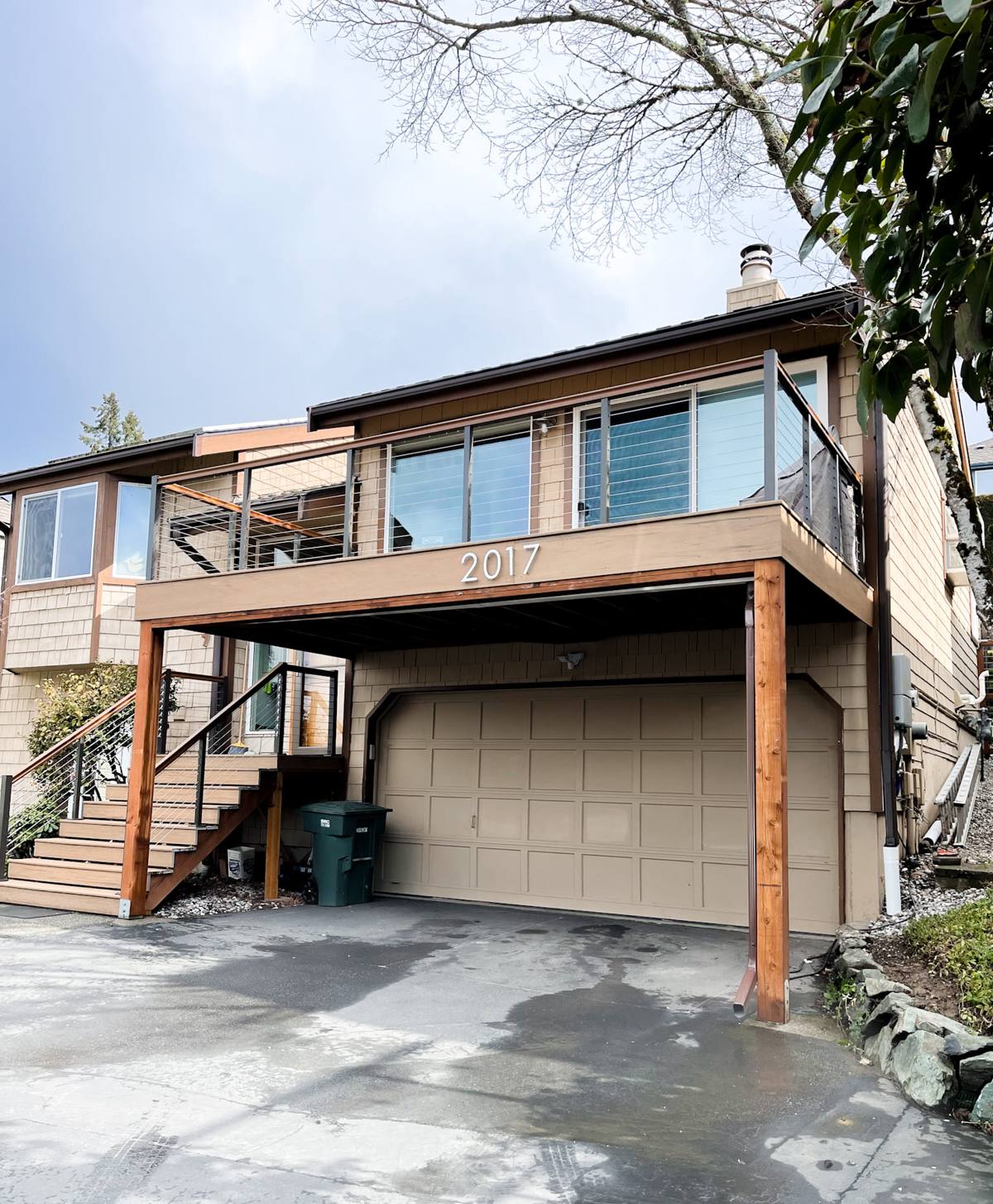
What Blaine's Weather Actually Does to a Deck
Salt Air
Homes closer to the bay get a fine mist of salt in the air on windy days, and it settles on everything, including deck boards and any exposed metal fasteners or hardware. Salt accelerates corrosion in ordinary fasteners and can leave a dull, gritty film on wood surfaces over time. It's a slower process than what you'd see right on open ocean, but it's real, and it's part of why fastener choice matters as much as board choice on a Blaine deck.
Driving Rain
Rain here rarely falls straight down. Wind off the water pushes it sideways, which means it gets up under railings, into board gaps, and against the house at the ledger connection — the single most common place decks fail from water intrusion, regardless of decking material. A deck surface can be perfectly moisture-resistant and still develop rot problems underneath if the structure and flashing weren't built to shed water correctly.
Moss Season
Whatcom County's moss and algae season is long — realistically most of the year in shaded or north-facing spots. Any organic debris that collects between boards or in low spots holds moisture and gives moss something to grow on. Once established, moss holds even more water against the surface and can make a deck genuinely slick and unsafe underfoot, on wood or composite alike.
Composite vs. Wood vs. PVC: An Honest Comparison
There's no single "best" decking material for every situation, but here's how the common options actually compare for a coastal Whatcom County property:
| Material | Moisture Behavior | Maintenance | Typical Lifespan Here |
|---|---|---|---|
| Pressure-treated wood | Absorbs water readily; prone to cupping, splitting, and rot at fastener points | Annual cleaning, periodic staining/sealing | 10–15 years with upkeep |
| Composite decking | Minimal absorption; capped boards resist moisture penetration | Periodic washing to prevent surface mildew/moss | 25–30 years, manufacturer-dependent |
| PVC/cellular decking | Essentially non-absorbent | Similar washing needs; can be more prone to surface expansion/contraction | Comparable to composite, higher material cost |
We install a range of composite products because they hit a practical middle ground for this climate: strong moisture performance without the higher material cost of full PVC, and far less upkeep than wood. That said, we'll tell you honestly if a particular product or design detail isn't a good fit for your site conditions rather than push whatever's easiest to sell.
What a Correct Composite Installation Actually Involves
Composite boards are more forgiving than wood in some ways, but a poor installation will still fail early — usually not because the decking itself failed, but because the structure underneath or the fastening method was wrong for the product. A correct job includes:
- A structural frame built or verified to current code span tables for the specific composite product being used — composite boards often require tighter joist spacing than wood
- Proper ledger flashing and separation from the house band board, so wind-driven rain can't work its way into the wall assembly
- Hidden or approved fastening systems matched to the manufacturer's specifications, using corrosion-resistant hardware suited to a coastal environment
- Correct board gapping for drainage and for the material's expansion and contraction across temperature swings
- Proper end-grain and cut-edge treatment where boards are trimmed on site
- Railing and stair connections built to hold up under both structural load and repeated wet-dry cycling
Substructure and Fasteners: Where Failures Actually Start
Most complaints about "bad" composite decks trace back to what's underneath the boards, not the boards themselves. Undersized joists, wood substructure that wasn't protected from moisture, or fasteners that weren't rated for the environment will cause problems no matter how good the decking material is. In a place like Blaine, where salt air and standing moisture are both realities, we pay particular attention to:
Joist Protection
Composite boards shed water well, but water still reaches the framing underneath through gaps and edges. Joist tape or an equivalent moisture barrier on top of wood joists is standard practice on our installs, not an upsell.
Fastener Selection
We use fasteners rated for coastal and treated-lumber environments, matched to what the decking manufacturer specifies. Using the wrong screw type is a common shortcut that shows up as rust streaking and loosening boards within a few years.
Ventilation Underneath
Low-clearance decks close to grade need adequate airflow underneath to let moisture escape rather than sit trapped against the framing — a bigger issue on lots with limited drainage or heavy shade, both common around Blaine.
How Our Process Works
- On-site assessment — we look at your existing deck or build site, drainage, sun/shade exposure, and proximity to the water, since that affects material and fastener recommendations.
- Product selection — we walk through composite options and trade-offs honestly, including cost, color/fade performance, and warranty structure, so you're picking based on your priorities, not ours.
- Structural plan — framing, ledger, and drainage details are worked out before any decking goes down, since this is the part that determines how long the deck actually lasts.
- Installation — built to the manufacturer's specifications for spacing, fastening, and expansion gaps, with attention to clean board layout and edge finishing.
- Final walkthrough — we go over the finished deck with you, including what maintenance (if any) it actually needs going forward.
Choosing the Right Board for a Blaine Property
Not every composite product performs the same way in a marine climate, and picking one shouldn't just come down to color and price. Things worth weighing for a Blaine home specifically:
- Cap type: fully-capped boards (protected on all four sides) resist moisture and staining better than boards capped only on the top and sides
- Fade and stain warranty terms: read what's actually covered — some warranties exclude mold/mildew staining, which matters in a wet climate
- Surface texture: a texture that stays slip-resistant when damp matters more here than in a dry climate, given how often the surface will actually be wet
- Color: very dark boards run hotter in direct sun and can show mineral or salt residue more visibly than mid-tone colors
Maintenance: What a Composite Deck Actually Needs Here
Composite doesn't mean maintenance-free, especially in a climate with a long moss season. Realistic upkeep for a Blaine deck looks like:
- Periodic washing (a soft-bristle brush and mild soap, or a low-pressure rinse) to clear pollen, salt residue, and organic buildup before moss gets established
- Keeping gutters and nearby drainage clear so runoff isn't sheeting directly onto the deck surface
- Clearing debris out of board gaps in fall, since trapped leaves and needles hold moisture against the surface all winter
- Checking railing posts and stair connections annually for any movement, since these take the most structural stress over time
None of this is heavy work, but skipping it entirely — treating composite as truly zero-maintenance — is how moss and surface staining get a foothold faster than they should.
Why Hiring a Crew That Already Works This Area Matters
A lot of decking problems in coastal Whatcom County towns come from installation details that make sense in a dry climate but don't hold up here — fastener choices, drainage gaps, or ledger flashing that would be fine in an inland, low-moisture region but fail faster with Blaine's salt air and driving rain. A crew that regularly works this stretch of coastline already knows which details to get right the first time, rather than learning it through a callback.
We're based out of the Bellingham area and work throughout Whatcom County, including Blaine and the communities around Semiahmoo Bay, so the framing, fastening, and drainage decisions on your deck are based on what actually holds up in this specific climate — not a generic install.
If you're planning a new composite deck or replacing an aging wood one, we're happy to take a look and put together a straightforward, no-pressure estimate using the form below.