 Bellingham
 Why Happy Valley Siding Wears Differently Than You'd Expect
Happy Valley sits close enough to Bellingham Bay that salt-laden air reaches the neighborhood on a regular basis, and it's shaded by enough mature tree cover that moss and moisture linger on siding long after a storm has passed. Add in the driving rain that comes sideways off the water during Whatcom County's wetter months, and you've got a combination that ages siding faster than a lot of homeowners expect. It's not any one factor doing the damage — it's the stacking of all three, season after season, on homes that in many cases were built decades before anyone was thinking about climate-engineered siding products.
We see the pattern a lot in this part of Bellingham: siding that looks fine from the street but is quietly failing at the seams, behind trim, or low near grade where splashback and shade keep the material wet for days at a time. Repair work here isn't just patching a crack — it's understanding where water is actually getting in and why.
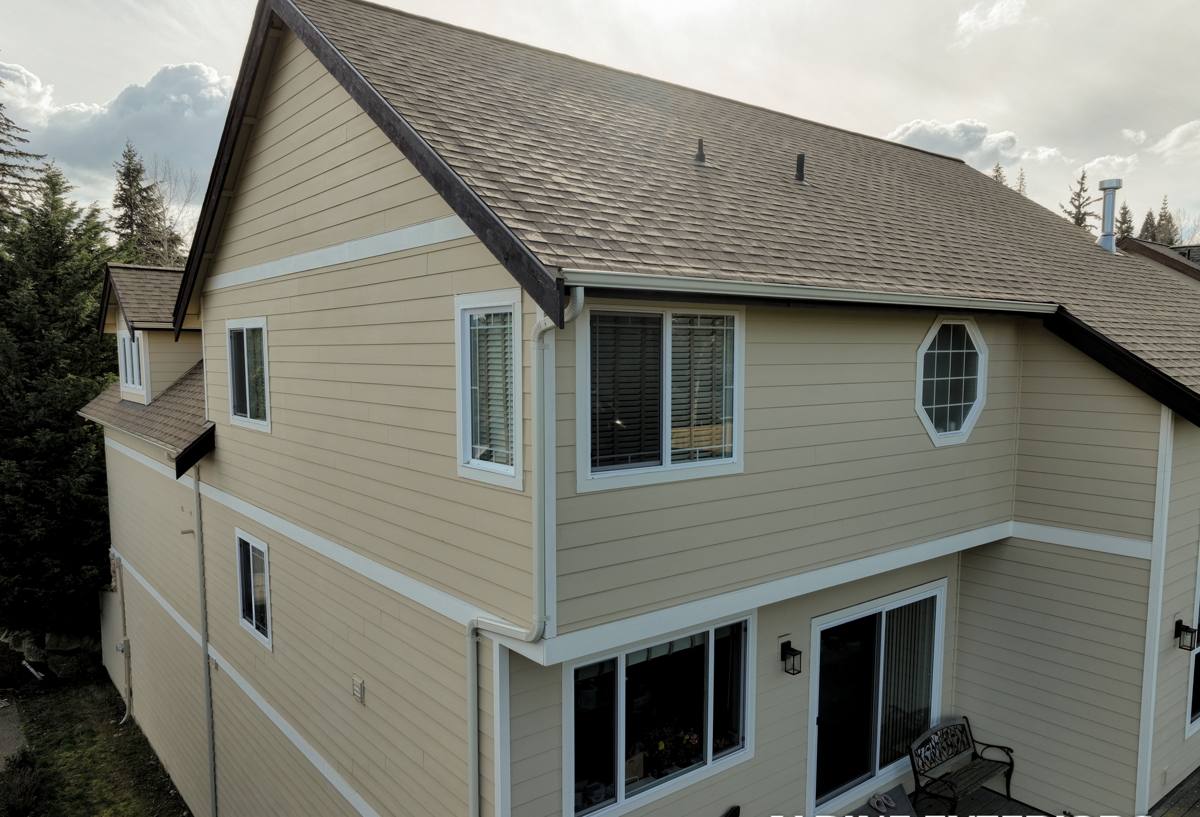
The Real Culprits: Salt Air, Rain, and Moss
Salt Air
Proximity to the bay means airborne salt settles on exterior surfaces and accelerates corrosion on fasteners, flashing, and any exposed metal trim. On wood-based sidings it also speeds up finish breakdown, which lets moisture in faster than the paint film can shed it.
Driving Rain
Wind-driven rain doesn't just wet the surface of siding — it forces water sideways and upward, testing every lap joint, seam, and piece of flashing. Siding that's rated for vertical rainfall but installed with tight or undersized laps can let water track behind the cladding during a real Whatcom County storm.
Moss Season
Shaded, tree-covered lots in and around Happy Valley hold moisture on siding surfaces far longer than sun-exposed walls. Moss and algae aren't just cosmetic — a moss mat holds water against the siding face for weeks, and on porous or wood-based materials that constant dampness is what eventually causes rot, delamination, or paint failure underneath.
Signs Your Siding Needs Repair
Most siding problems don't announce themselves. They show up as small, easy-to-miss cues long before anything looks obviously broken. Walk your exterior and check for:
- Soft or spongy spots when you press on siding, especially near the bottom courses and around windows
- Visible gaps, cracks, or warping at seams and butt joints
- Paint or finish that's bubbling, peeling, or chalking unevenly
- Dark staining or streaking below trim, gutters, or roof valleys
- Moss or algae buildup that keeps returning even after cleaning
- Siding that flexes or feels loose when you push on it
- Interior signs — musty smell, peeling interior paint, or soft drywall on exterior-facing walls
- Insect activity near siding edges or at ground-level trim
Any one of these on its own might be minor. Several together, especially clustered in one area, usually means water has been getting behind the siding for a while.
What a Correct Repair Actually Involves
A siding repair that's done right isn't just cutting out a bad board and nailing in a new one. It starts with figuring out why that section failed in the first place — otherwise you're patching a symptom and the same spot fails again in a year or two.
Diagnose Before You Patch
We check the house wrap or building paper behind the damaged section, look at flashing details around windows, doors, and penetrations, and confirm whether the original installation left adequate clearance at grade and at horizontal surfaces like decks and porch roofs. In a lot of older Bellingham homes, the siding itself is fine — the flashing or the water management behind it is what actually failed.
Match the Material, or Don't
If the existing siding is still sound and simply needs a section replaced, we'll match it when that's the right call. But if the damaged area is wood, LP SmartSide, or an aging fiber cement product that's showing the same failure pattern in multiple spots, patching in more of the same material just delays the same conversation. We'll tell you honestly when that's the case instead of quietly doing a repair we know won't hold.
Rebuild the Water Management, Not Just the Surface
Proper repair means correcting flashing, re-establishing the drainage plane, and making sure new material is fastened and gapped to manufacturer spec — not just cosmetically matched to what's next to it.
Why Repair on Older Homes Gets Complicated
A lot of the housing stock in and around Happy Valley predates the fiber cement era, so we're regularly working on original wood siding, older vinyl, or LP SmartSide that's now 15-25 years old. That creates a real decision point during repair:
| Situation | What We Recommend | Why |
|---|---|---|
| Isolated damage, siding otherwise sound, less than ~10 years old | Targeted repair, matched material | The rest of the wall system is still performing; a full re-side isn't justified |
| Repeated moisture damage in the same wall section | Investigate flashing/drainage first | Surface repair without fixing water intrusion just fails again |
| Widespread soft spots, delamination, or paint failure across multiple elevations | Plan for replacement, likely with James Hardie | At that point you're paying repair-level labor repeatedly instead of fixing it once |
| Original wood or LP siding showing edge swelling near grade or trim | Case-by-case; often repairable short-term | Early-stage moisture damage can sometimes be caught before it spreads |
Repair vs. Replace: How We Help You Decide
We're not going to sell a full re-side to a homeowner who needs a $600 repair, and we're not going to keep patching a wall that's failing in five places. The honest version of this conversation usually comes down to three questions:
- Is the damage isolated, or is it a pattern across the house?
- Is the underlying water management (flashing, house wrap, drainage) intact, or has it failed too?
- What's the remaining useful life of the existing siding material, realistically?
If the answers point to a solid wall with one bad section, we repair it and move on. If they point to a siding system that's aging out across the board, we'll say so plainly and talk about what replacement with James Hardie fiber cement would actually look like and cost — not as an upsell, but because continuing to spend on repairs to a failing system isn't the better deal for you long-term.
Why We Only Install James Hardie When Replacement Is the Right Call
When a repair conversation turns into a replacement conversation, we install James Hardie fiber cement exclusively — not vinyl, not LP SmartSide, not primed wood or cedar. In a climate like this one, with salt air, extended wet seasons, and heavy moss pressure, that choice matters more than it might in a drier region.
Non-Combustible, Moisture-Resistant Composition
Fiber cement doesn't absorb and swell the way wood-based products can, and it isn't prone to the heat-related warping issues that come up with some vinyl products on sun-exposed walls. It holds up to repeated wetting and drying cycles — exactly the cycle Happy Valley's tree cover and rainfall put siding through all year.
Climate-Engineered for the Pacific Northwest
James Hardie's HZ10 product line is engineered specifically for wetter, moisture-heavy climates like ours, with a moisture-resistant formulation built for regions that see extended damp seasons rather than dry heat.
ColorPlus Factory Finish
A factory-applied, baked-on finish holds color and resists the fading and chalking we see on field-painted wood and some vinyl siding after a few Whatcom County winters — which matters directly for reducing future repair calls.
Warranty Backing
James Hardie's transferable warranty coverage gives homeowners a real backstop that most of the products we chose not to install simply don't offer at the same level.
Our Process for Happy Valley Homes
- On-site inspection — we look at the damaged area and the surrounding wall system, not just the obvious spot
- Honest diagnosis — repair, targeted replacement, or full re-side, explained in plain terms with the reasoning behind it
- Written scope and estimate — no vague line items, no pressure to upgrade beyond what the house needs
- Correct execution — proper flashing, drainage plane, and fastening to spec, whether it's a patch or a full wall
- Walkthrough — we show you what we found and what we did about it
Why Local Experience in Happy Valley Matters
Crews that don't regularly work this specific mix of Bellingham microclimates tend to treat every repair the same way, regardless of exposure. A wall that's shaded most of the day and holds moss for weeks needs a different look than a sun-exposed wall on the same street. Knowing which Happy Valley lots run wetter, which homes have the older wood or LP siding most prone to edge damage, and how salt air factors into fastener and flashing choices isn't something you get from a one-time visit — it comes from working the neighborhood repeatedly and seeing how these houses actually age.
If your siding is showing damage — or you're just not sure whether what you're looking at is a simple repair or the start of something bigger — we're glad to take a look. Reach out for a free, no-pressure estimate using the form below, and we'll give you a straight answer about what your home actually needs.