 Bellingham
 Edgemoor's Roofs Work Harder Than Most
Edgemoor sits along Bellingham Bay, and that location shapes what a roof out here has to put up with. Homes are often tucked under mature conifers, close enough to the water to pick up salt-laden air and wind-driven rain, and shaded enough that moss and moisture never really take a season off. A roof that would hold up fine on an open lot a few miles inland can wear out faster in Edgemoor simply because of where it sits.
Metal roofing has become a common answer for homeowners in this part of Whatcom County who are tired of replacing shingles every couple of decades or scraping moss off a roof every spring. Done correctly, it handles the combination of salt air, driving rain, and shade better than most other roofing materials available. Done poorly — wrong fasteners, wrong underlayment, wrong details at the flashing points — it can fail in ways that are expensive to fix. This page covers what Edgemoor conditions actually demand from a metal roof, what a correct installation looks like, and how we approach the work.
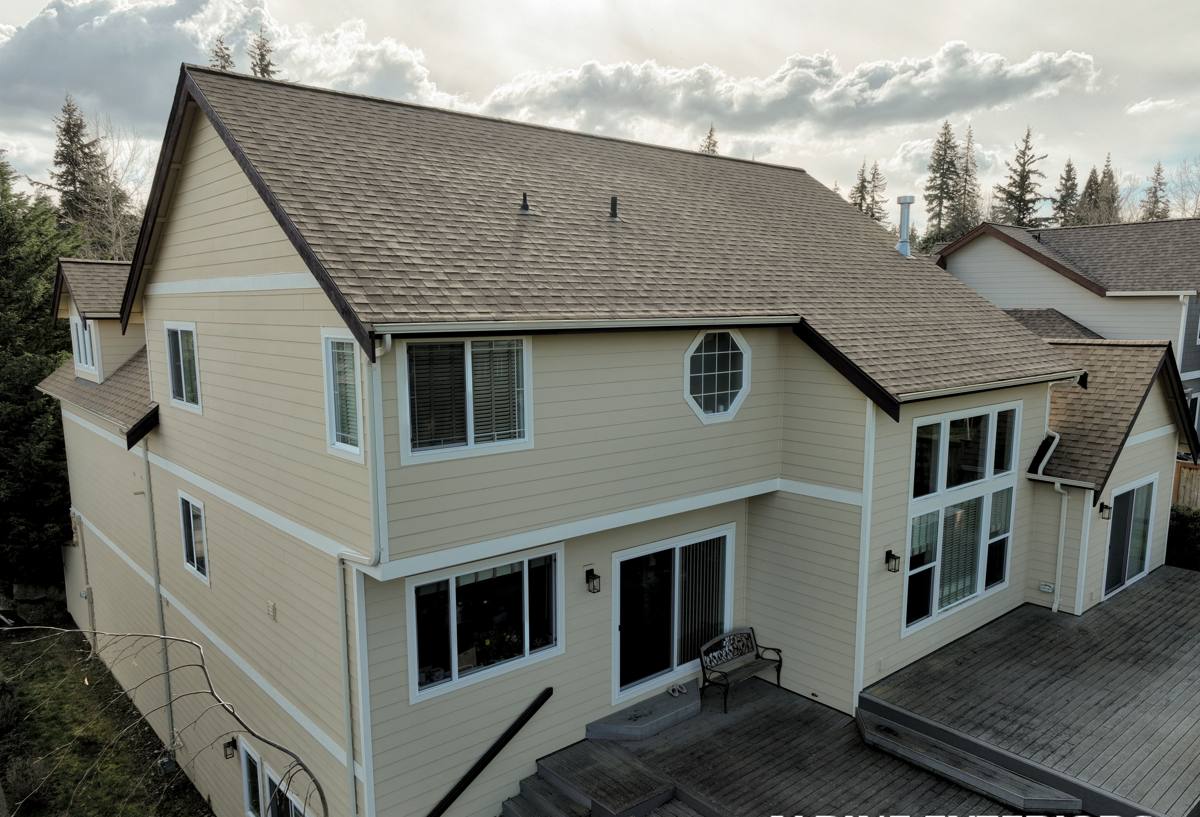
What Salt Air, Rain, and Shade Do to a Roof Over Time
Salt Air and Corrosion
Proximity to Bellingham Bay means airborne salt is a real factor for homes in Edgemoor, especially on roofs facing the water or exposed to prevailing wind. Salt accelerates corrosion on unprotected or poorly coated metal, and it also degrades fasteners, flashing, and any exposed hardware faster than it would a few miles inland. Not every metal roofing product is built with this in mind — some coatings and base metals hold up to salt exposure far better than others, and the fasteners matter just as much as the panels.
Moss, Needles, and Trapped Moisture
Tree cover is part of what makes Edgemoor attractive, but it's also what makes moss and organic debris a constant maintenance issue. Needles and leaf litter collect in valleys and behind chimneys, hold moisture against the roof surface, and give moss a foothold. On asphalt shingles, that moss works its way under the tab edges and lifts them over time. On wood shakes, it holds moisture directly against the material. Metal sheds this kind of debris far more readily, but only if the roof was designed with enough slope and clean detailing to actually let water and debris move off rather than pool.
Wind-Driven Rain at Penetrations
Bellingham's marine climate means rain that doesn't just fall straight down — wind off the bay can drive it sideways, up under laps, and into any gap around a vent, chimney, or skylight. Most roof leaks don't happen in the open field of the roof; they happen at these penetrations and transitions. That's true for any roofing material, but it's especially important to get right with metal, where the flashing details are what actually keep the system watertight over decades of exposure.
Why Metal Roofing Fits Edgemoor Conditions
We recommend metal roofing to Edgemoor homeowners for a few practical reasons that line up directly with local conditions, not because it's trendy:
- Debris and moss shed more easily than on shingles or shakes, which matters under heavy tree cover.
- Corrosion-resistant coatings are available specifically for coastal and near-coastal exposure, which suits homes closer to the bay.
- Steep water-shedding profile handles sustained, driving Pacific Northwest rain without relying on granules or overlapping tabs that degrade over time.
- Long service life reduces how often a roof needs to be disturbed — fewer tear-offs mean fewer chances for something to go wrong at the flashing details that matter most here.
- Fire resistance is a genuine plus for wooded lots, even though wildfire risk in this climate is lower than it is east of the Cascades.
None of this means metal is automatically the right call for every home. Roof pitch, existing structure, budget, and how a house looks from the street all factor in. Part of our job is telling you honestly when a different approach makes more sense for your specific roof.
Choosing the Right Metal and Finish
Not all metal roofing is built for salt air, and this is where a lot of the real decision-making happens. The panel profile affects how the roof looks and performs, but the base metal and coating affect how long it actually lasts near Bellingham Bay.
| Option | Best fit for Edgemoor | Trade-offs |
|---|---|---|
| Standing seam steel (Galvalume or similar coated steel) | Good general-purpose choice for most Edgemoor homes not directly on the waterfront | Needs a quality factory coating; concealed fasteners reduce future leak points |
| Aluminum standing seam | Strong choice for homes closer to the water or fully exposed to salt spray | Naturally corrosion-resistant even if the coating is eventually compromised; typically a higher material cost |
| Exposed-fastener steel panels | Workable on secondary structures or budget-driven projects | More fastener penetrations to maintain over time; not our first recommendation this close to the bay |
| Uncoated or bare metal accents | Decorative use only | We don't recommend bare or minimally coated metal for main roof surfaces in a salt-air environment |
We also pay attention to fastener and flashing metal compatibility. Mixing incompatible metals — for example, certain fasteners against certain panel types — can set up galvanic corrosion that eats away at the contact point over time, and salt air speeds that process up. This is a detail that's easy to get wrong if a crew doesn't install metal roofing regularly.
What a Correct Metal Roofing Installation Involves
The panels get the attention, but most metal roof failures we've seen trace back to what's underneath and around them, not the panels themselves. A correct installation in a climate like this includes:
- A full tear-off and deck inspection rather than roofing over existing material, so hidden rot or soft spots don't get sealed in under the new roof
- A high-temperature, self-adhering underlayment at eaves, valleys, and penetrations — the areas most exposed to wind-driven rain
- Panel clips or fastening systems that allow the metal to expand and contract with temperature changes without buckling or tearing loose
- Corrosion-appropriate fasteners and flashing matched to the panel metal, not just whatever is on hand
- Proper attic and roof ventilation, so moisture from inside the home doesn't condense against the underside of the panels
- Custom-formed flashing at chimneys, skylights, and wall intersections rather than relying on generic trim pieces
- Gutter and drip edge detailing that accounts for the volume of debris coming off surrounding trees
Any one of these done wrong can undercut everything else about the material. A premium panel with a poor underlayment or the wrong fasteners will still leak.
Our Process for an Edgemoor Metal Roofing Project
Assessment
We start with an on-site look at the existing roof, the tree cover and sun exposure around the house, and how close the home sits to the water. That combination tells us how much salt and moisture exposure the new roof actually needs to be built for, and it's different from one Edgemoor property to the next.
Proposal and Material Selection
We walk through panel and finish options with you directly, including the honest trade-offs between them, rather than defaulting to one product for every job. You'll know why we're recommending a given metal and coating for your specific roof.
Installation
Tear-off, deck repair where needed, underlayment, flashing, and panel installation follow in sequence, with the detail work at valleys, penetrations, and edges treated as the priority — not an afterthought once the panels are up.
Walkthrough and Cleanup
We clean the site thoroughly, including magnetic sweeps for stray fasteners, and walk the finished roof with you before calling the job done.
Maintaining a Metal Roof Near the Water and Under Trees
Metal roofing needs far less upkeep than shingles or shakes, but "low maintenance" isn't "no maintenance" in this environment. A short annual routine keeps a metal roof performing for its full service life:
- Clear needles and leaf debris from valleys and behind chimneys before they compact and hold moisture
- Keep gutters and downspouts free-flowing so water isn't backing up against roof edges
- Check sealant at flashing points periodically, since sealant degrades faster than the metal itself
- Rinse off salt residue where a roof faces the water directly, especially after long dry spells
We're happy to point out what to watch for on your specific roof rather than handing you a generic list — the maintenance a shaded, inland Edgemoor lot needs is different from what a home facing the bay directly needs.
Cost Factors Worth Understanding
Metal roofing carries a higher upfront cost than asphalt shingles — generally a meaningful multiple of it, depending on panel type and roof complexity — but that has to be weighed against a service life that typically runs several times longer, with far less maintenance along the way. The biggest cost drivers on an Edgemoor project tend to be:
- Panel type and metal (aluminum generally costs more than coated steel)
- Roof complexity — valleys, dormers, and multiple planes take more time and material than a simple gable roof
- Tear-off scope and what condition the deck is in underneath the existing roof
- Site access, given how many Edgemoor lots involve trees, slope, or limited staging space
We give straightforward, itemized numbers so you can see exactly what's driving the price, rather than a single lump figure.
Why Local Experience in Edgemoor Matters
A crew that already works this neighborhood knows what tree cover does to roof valleys, what salt exposure does to fasteners and coatings over time, and how wind off the bay behaves against a roofline. That's not something you can fully substitute with a generic install — it changes real decisions, from which metal and coating we recommend to how we detail the flashing around a chimney. We'd rather walk your roof and give you a straight answer than sell you the same package we'd sell someone twenty miles inland.
If you're weighing a metal roof for your Edgemoor home, we're glad to take a look and give you an honest read on what your roof actually needs. Use the form below to request a free, no-pressure estimate.