 Bellingham
 Why Edgemoor Roofs Wear Differently
Edgemoor sits close enough to the water that homes here take on a different kind of weather than roofs just a few miles inland. Salt-laden air off Bellingham Bay accelerates corrosion on exposed metal fasteners, flashing, and vents. Driving rain off the water pushes water sideways under normal wind conditions, finding gaps that a calmer climate would never expose. And the long, wet Pacific Northwest moss season means organic growth has months at a time to establish itself on north-facing slopes and shaded valleys. None of this is exotic weather, but the combination is specific to this stretch of Whatcom County, and it means a roof repair done right here looks a little different than one done in a drier part of the state.
We've worked on enough Edgemoor roofs to know the failure points repeat themselves: flashing around chimneys and skylights that was never properly stepped, nail heads that have corroded and backed out, valleys packed with moss and debris that hold moisture against the roof deck, and gutters that overflow during a hard rain and send water behind the fascia. A roof repair that only patches the visible symptom without addressing why it happened in the first place tends to come back within a year or two.
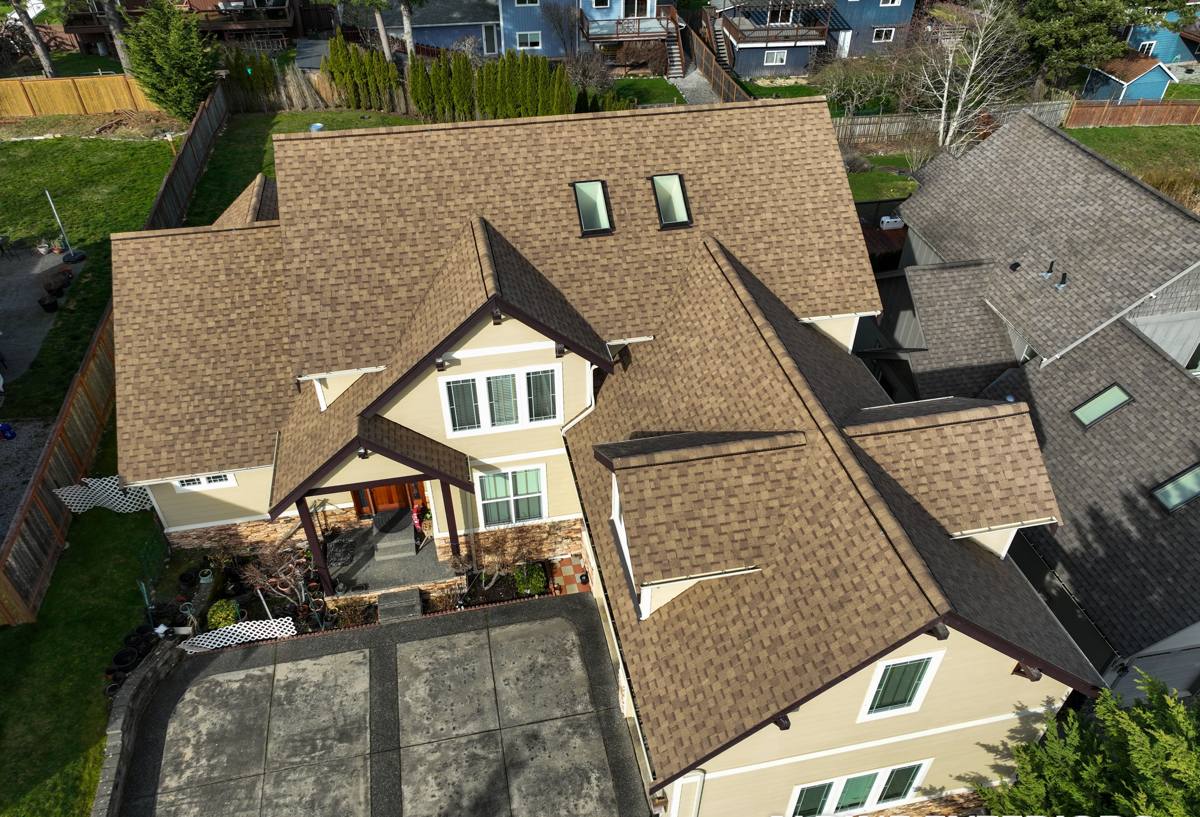
Signs an Edgemoor Roof Needs Repair
Most roof problems give warning signs well before they become emergencies. Homeowners who catch these early save money, because a contained repair almost always costs less than water damage repair, drywall replacement, or mold remediation.
- Water stains on interior ceilings or upper walls, especially near exterior walls or below valleys
- Moss or algae buildup thicker than a light green film, particularly on north-facing slopes
- Granules collecting in gutters or at downspout outlets, a sign of asphalt shingle wear
- Shingles that are curling, cracked, or missing after a windstorm
- Rust streaking below metal flashing or vent boots
- Soft or spongy spots when walking the roof (we check this, not a DIY step)
- Daylight visible through the attic roof deck
- Higher than usual heating bills, which can point to moisture-compromised insulation
Any one of these on its own may be minor. Several together usually mean the roof needs a real inspection rather than a guess-and-patch fix.
What a Correct Roof Repair Actually Involves
A repair that holds up through another Whatcom County winter starts with figuring out the actual path water is taking, not just where it's showing up inside the house. Water rarely enters directly above the stain on your ceiling — it travels along rafters, sheathing, and underlayment before it drips somewhere convenient. Get that wrong and you'll fix the wrong spot.
Flashing Comes First
Most leaks we find in this area trace back to flashing, not the shingles themselves. Step flashing at chimneys and dormers, counter-flashing, valley metal, and vent boot flashing are the seams in a roof system, and seams are where water gets in. A proper repair replaces failed flashing rather than caulking over it. Caulk is a temporary answer at best; against driving rain off the bay, it fails faster than it would in a sheltered inland location.
Underlayment and Deck Condition
If water has been getting past the surface for a while, the underlayment and roof deck underneath may already be compromised. We check for soft sheathing, delaminated plywood, and saturated felt or synthetic underlayment before we ever put a new shingle down. Covering a damaged deck with a fresh patch just hides the problem until it fails again, often in a worse spot.
Matching Materials
On an older Edgemoor roof, matching the existing shingle color and profile isn't always straightforward — manufacturers change product lines and older colors get discontinued. We're upfront when an exact match isn't available and talk through the realistic options, whether that's a close match, a slightly larger repair area to blend the transition, or accepting a visible patch on a roof that's a good candidate for full replacement in a few years anyway.
Roofing Materials Common in Edgemoor and How They Repair
The material on your roof changes what a repair actually looks like, how long it lasts, and what it costs. Here's how the common types compare for repair purposes in this climate.
| Material | Common Failure Mode Here | Repair Considerations |
|---|---|---|
| Asphalt composition shingle | Granule loss, curling, wind-lifted tabs, nail pops | Straightforward to patch section-by-section; color matching can be limited on older roofs |
| Cedar shake/shingle | Moss and moisture retention, splitting, rot at butt ends | Individual shakes can be replaced but require matching weathered color and careful weaving into existing courses |
| Metal roofing | Fastener corrosion from salt air, seam separation | Repairs often mean re-fastening or resealing seams with corrosion-resistant hardware; full panel replacement if rust has spread |
| Flat/low-slope membrane | Ponding water, seam failure, UV degradation | Membrane repairs need clean, dry conditions and compatible patch material — not a same-day fix in wet weather |
We'll tell you plainly if your roof's age or condition means a repair is a short-term fix rather than a long-term solution. That's a judgment call worth making honestly rather than selling a patch that won't hold.
Our Roof Repair Process
We keep the process straightforward because homeowners deserve to know what's happening on their own roof.
- Inspection. We get on the roof (not just a ground-level look) and check the suspect area along with the rest of the roof system — flashing, vents, valleys, and gutters — since one leak often points to a second problem starting elsewhere.
- Diagnosis and explanation. We show you what we found and explain what's causing it, in plain terms, before any work starts.
- Written scope and estimate. You get a clear description of what will be repaired and what it will cost before we schedule the work.
- The repair. We replace what's failed — shingles, flashing, underlayment, or deck sections — rather than layering a patch over a problem.
- Cleanup and walkthrough. We clear debris and nails from the yard and gutters, and walk you through what was done.
Moss, Algae, and Salt Air: Managing the Long-Term Load
Even a well-repaired roof needs ongoing attention in this climate. Moss doesn't just look bad — it holds moisture against the shingle or shake surface, and over a long wet season that moisture works its way into seams and fastener holes. On north-facing and heavily shaded roof sections, moss growth is close to unavoidable without some maintenance.
A few things make a real difference over the life of a roof in Edgemoor:
- Keeping gutters and downspouts clear so water doesn't back up under the roof edge during heavy rain
- Removing moss buildup with proper technique rather than aggressive pressure washing, which can strip granules and shorten shingle life
- Trimming back tree cover where practical to reduce shade and debris buildup on north-facing slopes
- Using corrosion-resistant fasteners and flashing on any repair work, given the salt air exposure this close to the bay
None of this eliminates maintenance entirely — that's just the reality of roofing this close to Bellingham Bay — but it stretches the time between repairs considerably.
Repair vs. Replacement: Making the Right Call
Not every roof problem needs a full replacement, and not every leak should be patched indefinitely. The right call depends on a few honest factors.
| Factor | Leans Toward Repair | Leans Toward Replacement |
|---|---|---|
| Roof age | Under 15 years for asphalt, roof otherwise sound | Nearing or past manufacturer's expected lifespan |
| Extent of damage | Localized — one slope, one flashing point, storm damage in one area | Widespread granule loss, multiple leak points, or deck damage in several areas |
| Underlying deck condition | Solid, dry sheathing under the damaged area | Soft, delaminated, or repeatedly wet sheathing |
| Material availability | Matching material still available | Discontinued profile or color, poor match likely |
| Repair history | First or second repair in this area | Same spot has needed repair multiple times |
We'll never push a full replacement when a solid repair will genuinely do the job — and we'll say so directly if a repair is just delaying an inevitable and more expensive fix later.
Why a Crew That Already Works Edgemoor Matters
Roofing crews who mostly work drier, inland areas sometimes underestimate what Whatcom County's coastal weather does to a roof over time. Knowing that salt air corrodes standard fasteners faster here, that moss season runs longer on shaded north slopes near the water, and that driving rain off the bay tests flashing details that would hold up fine elsewhere — that's knowledge that comes from working this specific area repeatedly, not from a general roofing background.
It also matters for the practical side of scheduling and access. A crew familiar with Edgemoor's housing stock — the roof pitches, the common material choices, the typical age of homes in the neighborhood — can diagnose faster and give a more accurate estimate on the first visit, rather than needing extra trips to figure out what they're dealing with.
Get a Straight Answer on Your Roof
If you're dealing with a leak, storm damage, or just want an honest read on a roof that's showing its age, we're glad to take a look. The estimate is free, there's no pressure to sign anything on the spot, and if a small repair is genuinely all your roof needs, that's what we'll tell you. Use the form below to get in touch and we'll schedule a time to come take a look at your Edgemoor home.