 Bellingham
 Why Window Performance Matters More in Lynden
Lynden sits inland from Bellingham Bay, in the flat farm country of Whatcom County near the Canadian border. That location shapes the weather your windows have to deal with every day: long stretches of steady, driving rain in fall and winter, high humidity off the surrounding fields and waterways, and the kind of damp cold that settles into a house and stays there for months. Coastal parts of the county deal with salt-laden air; Lynden deals more with sustained moisture, condensation, and wide seasonal temperature swings between a hot, dry summer and a wet, gray winter. Both conditions punish windows that aren't sealed and flashed correctly, just in different ways.
Old or poorly installed windows in this climate don't fail dramatically. They fail slowly — a little more condensation each winter, a slightly higher heating bill each year, a sash that sticks a little more every season — until one day the homeowner realizes the windows are actively working against the house instead of protecting it.
What "Energy-Efficient" Actually Means Here
The term gets used loosely in the window industry. For a Lynden home, three factors matter more than any sticker on the glass:
U-Factor (Heat Loss)
U-factor measures how much heat escapes through the window. Lower is better. This is the number that affects your heating bill most directly during our long, damp winters — a low U-factor window keeps furnace-heated air inside instead of letting it bleed out through the glass and frame.
Low-E Coatings and Gas Fills
A low-emissivity (low-E) coating is a microscopic layer on the glass that reflects heat back into the room in winter and blocks excess solar heat in summer. Combined with an argon or krypton gas fill between panes, it's one of the most cost-effective upgrades available in a modern window — and it does real work here, where the sun is scarce for half the year and homeowners want to hold onto every degree they can.
Air and Water Sealing
On paper, this is the least glamorous spec. In practice, it's the one that matters most in this climate. A window can have excellent glass and still perform poorly if the seals around the sash or the flashing behind the frame aren't done right — driving rain will find that gap eventually, and once water gets behind a window frame, energy efficiency is the least of your problems.
Frame Material Comparison
| Frame Material | Moisture Resistance | Maintenance | Typical Cost |
|---|---|---|---|
| Vinyl | Good — won't rot, but seams and welds matter | Low | Lower |
| Fiberglass | Excellent — dimensionally stable in wet/dry cycles | Low | Higher |
| Wood / Wood-Clad | Fair — needs an intact exterior clad or coating | Higher | Higher |
| Aluminum | Fair — prone to condensation without a thermal break | Low | Mid |
We don't push one material as universally "best." A well-built vinyl window with quality hardware will outperform a poorly made fiberglass one, and vice versa. What we won't do is install a frame material that's a poor match for a specific installation — for example, an uncoated wood frame on a wall with heavy weather exposure and no covered overhang. That's a maintenance headache we'd rather steer a homeowner away from up front than deal with as a callback in three years.
Signs Your Current Windows Are Costing You Money
Most homeowners don't think about window replacement until something forces the issue. In our experience working on homes throughout Lynden and the surrounding area, these are the warning signs worth acting on before they turn into bigger repairs:
- Condensation or fogging between the panes (not just on the inside surface) — this means the seal has failed and the insulating gas has escaped
- Visible gaps or you can feel a draft when standing near the window on a windy day
- Soft, discolored, or swollen wood at the sill or bottom corners of the frame
- Windows that are difficult to open, close, or lock — often a sign the frame has shifted or swollen
- Noticeably higher heating bills compared to similarly sized homes nearby
- Moss or dark streaking on the exterior trim around the window — a sign moisture is sitting there longer than it should
- Single-pane glass, especially on a home that hasn't been updated since it was originally built
Any one of these on its own might not mean urgent replacement. Several of them together, especially on a wall that takes the brunt of our prevailing wind and rain, usually means the windows are past the point where caulk and weatherstripping can fix the problem.
What a Correct Installation Actually Involves
The window itself is only part of the job. Most of the performance and longevity comes down to installation details that aren't visible once the trim goes back on.
Flashing and Water Management
Every window opening needs to be flashed so that any water reaching the wall behind the siding is directed out, not trapped behind the frame. In a climate with as much sustained rain as Whatcom County sees, this step is not optional — it's the difference between a window that lasts decades and one that causes hidden rot inside the wall cavity within a few years.
Air Sealing at the Rough Opening
The gap between the window frame and the rough framing needs to be sealed and insulated correctly — not stuffed with excess spray foam, which can bow the frame, and not left loose, which lets air and moisture through. This is a step that's easy to rush and hard to inspect after the fact, which is part of why we treat it as a checklist item on every install rather than something left to judgment in the moment.
Integration With the Siding
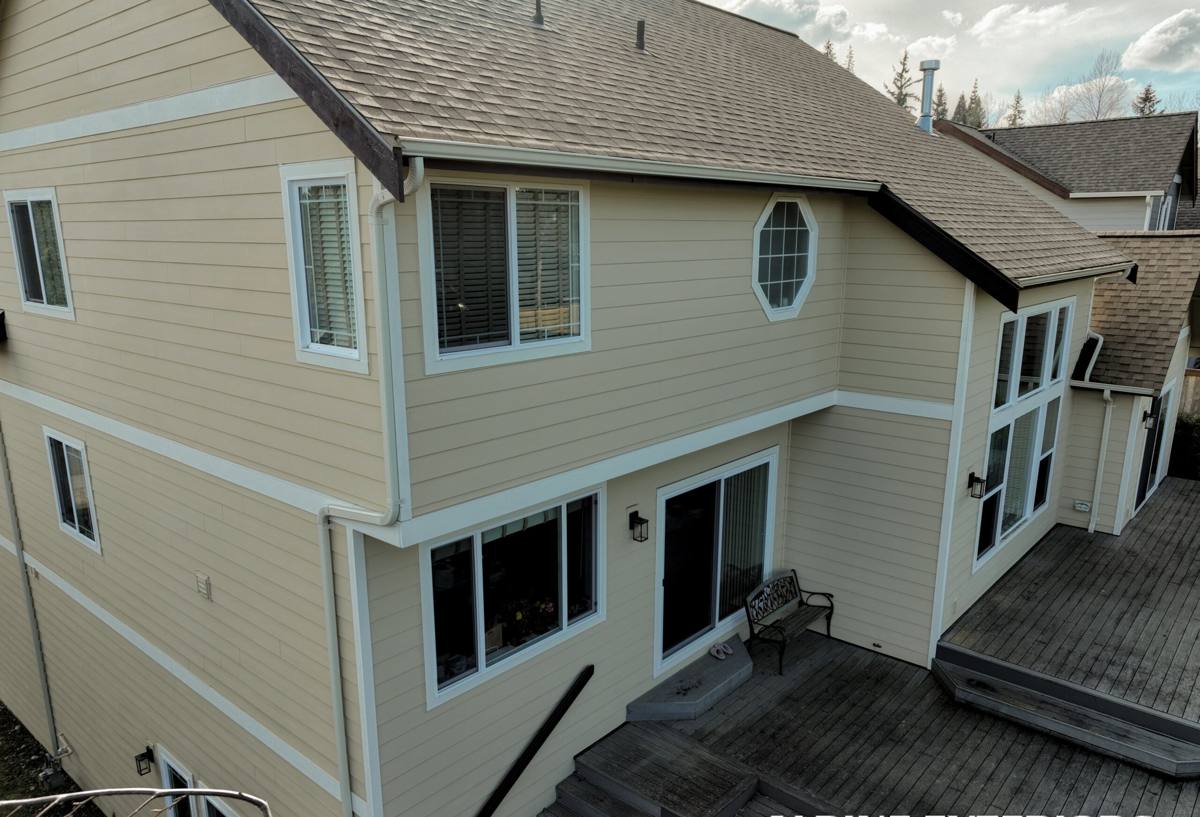
Because we do siding work in addition to windows, we pay close attention to how the window meets the surrounding wall cladding. A window installed correctly but poorly integrated with the siding around it — wrong overlap, missing kick-out flashing, a gap where caulk was used as a substitute for proper flashing — will still leak. Getting the window-to-siding transition right is one of the areas where a crew that handles both trades has a real advantage over one that only touches windows.
Our Process
- On-site assessment — we look at each window individually, not just the house as a whole, since sun exposure, wind direction, and wall construction can vary from one side of a home to another
- Product selection — we walk through frame material, glass package, and grille style based on your budget and the specific exposure of each window
- Written estimate — clear pricing per window, with the reasoning behind any price differences between them
- Installation — proper removal of the old unit, inspection of the rough opening for hidden damage before the new window goes in, correct flashing and sealing, and careful attention to trim and siding tie-in
- Final walkthrough — every window opens, closes, and locks properly before we consider the job done
If we find rot or water damage in the wall framing once an old window is removed, we'll stop and show you before covering it back up. That's a more honest way to work than quoting a number up front and hoping nothing unexpected turns up.
What Affects the Cost
| Factor | Why It Matters |
|---|---|
| Number and size of windows | Larger openings and full-house jobs have different economies of scale than single-window replacements |
| Frame material | Vinyl, fiberglass, and wood-clad carry different material costs |
| Glass package | Double-pane vs. triple-pane, and the specific Low-E coating, affects both price and performance |
| Condition of the existing opening | Hidden rot or framing issues add labor once discovered |
| Accessibility | Second-story or hard-to-reach windows take more time and equipment |
| Trim and siding work | Matching or repairing surrounding trim and siding adds scope beyond the window unit itself |
We'd rather walk a homeowner through these factors honestly than quote a flat per-window price that doesn't hold up once we're actually on site.
Why It Matters to Hire a Crew That Already Works in Lynden
Window performance is local. A crew that mostly works in a drier climate, or one that treats every job the same regardless of exposure, is more likely to miss the details that matter here — the flashing detail that keeps driving rain out, the ventilation consideration that keeps condensation from building up during a wet winter, the moss and mildew growth that shows a wall isn't drying out the way it should. Working regularly in Lynden and the surrounding Whatcom County area means we've seen how different window installations hold up over years of this specific weather pattern, not just how they look on installation day.
It also matters for accountability. A local, established contractor is easier to reach if something needs adjustment after the install, and has a reputation in the area worth protecting.
Windows and Your Siding Work Together
Windows don't perform in isolation from the rest of the exterior envelope. The siding, trim, and flashing around a window all have to work as one system to keep water out and heat in. Because we install both, we look at a window replacement as part of the whole wall assembly — not a standalone product swap. If your siding is aging or was installed with inadequate flashing to begin with, that's worth addressing at the same time as a window project, since reopening the same wall twice costs more than doing it once, correctly.
If your windows are drafty, fogged, or just older than you'd like them to be, we're happy to take a look and give you a straightforward, no-pressure estimate — no obligation, just an honest read on what your home actually needs. Use the form below to get started.