 Bellingham
 Siding Installation for York, Bellingham
York is one of Bellingham's older, close-in neighborhoods, sitting near enough to Bellingham Bay and the rest of the city's core that its homes deal with the same marine climate pressures as the rest of Whatcom County, just with the particular mix of housing ages and lot conditions that come with an established neighborhood rather than a newer subdivision. Older homes here often carry siding that was never designed for the decades of salt air, wind-driven rain, and moss exposure it's had to survive, and newer infill needs to be installed correctly from day one so it doesn't end up in the same position twenty years from now. Either way, siding installation in a neighborhood like York isn't just a cosmetic swap. It's the work that decides how well a house's walls handle water for the next several decades.
We install James Hardie fiber cement siding exclusively, and this page is specifically about the installation itself: what a York home actually needs from that process, what correct work looks like, and how we approach a project from first walkthrough to final punch list.
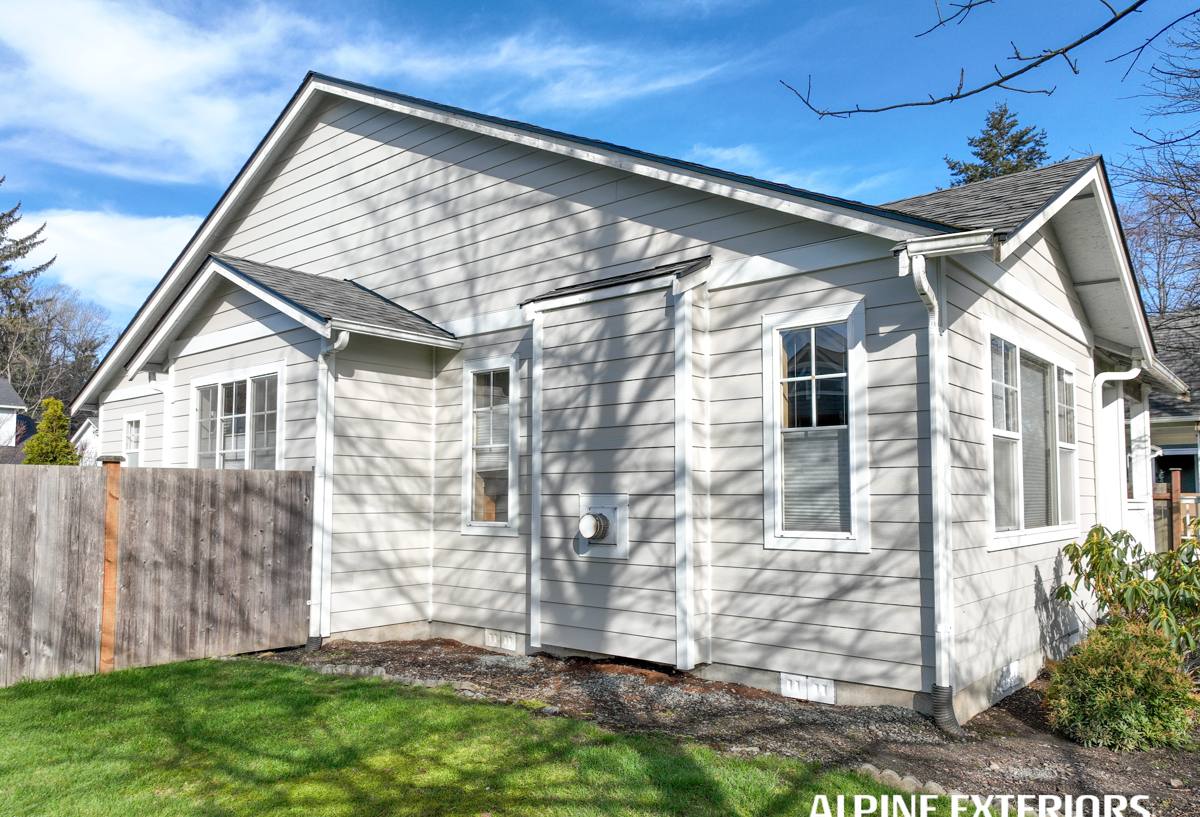
What York's Climate Asks of a New Siding Installation
Salt Air Off Bellingham Bay
Proximity to the bay means homes in and around York take in a steady, low-grade dose of salt-tinged marine air, even on days that feel calm. That kind of exposure isn't dramatic day to day, but over years it corrodes exposed fasteners, degrades lower-quality caulking, and wears down a weak finish faster than a drier inland climate would. An installation that doesn't account for that from the start is setting the wall up to fail early, regardless of which siding material sits on the surface.
Driving Rain, Not Just Rainfall
Wind off the water pushes rain sideways into wall assemblies more often here than in sheltered inland areas, which means the water isn't just landing on the siding face, it's testing every joint, seam, and penetration for a way in. A siding installation built for calm, straight-down rain leaves those spots vulnerable. One built for wind-driven rain treats every seam, window opening, and trim transition as a place that needs deliberate water management, not just a place where two pieces of material happen to meet.
A Moss Season That Runs Most of the Year
Whatcom County's mild, damp climate keeps moss and mildew active on shaded and north-facing walls for most of the year, and mature tree cover common in older neighborhoods like York only extends that. Any installation detail that traps moisture against the wall, a tight caulked seam instead of a properly lapped one, a missing drainage gap, gives moss a head start it doesn't need.
What a Correct Siding Installation Actually Involves
The finished look of new siding tells you almost nothing about whether it was installed correctly. The parts that determine how the wall performs over the next twenty or thirty years are mostly hidden once the job is done, which is exactly why they're the parts worth understanding before you hire anyone.
Weather-Resistive Barrier and Rainscreen
Before any siding goes up, the wall needs a properly lapped house wrap or weather-resistive barrier, installed so every seam sheds water downward rather than catching it. Behind the siding itself, a rain screen gap gives any moisture that does get past the surface a path to drain and evaporate instead of sitting against the sheathing. In a climate this wet, that gap isn't optional detailing, it's one of the main things standing between a wall that dries out after a storm and one that stays damp long enough to cause real damage.
Fastening to Spec
James Hardie publishes specific fastener types, sizes, and spacing for its siding, and those specs exist for a reason. Loose spacing, undersized fasteners, or the wrong fastener material are among the most common issues we find on older siding failures, and they're entirely avoidable when the installation follows the manufacturer's own requirements instead of a shortcut.
Flashing and Trim Transitions
Every window, door, corner, and roofline intersection is a place where two different materials meet, and each of those meeting points needs flashing that's lapped correctly so water moves down and away from the wall rather than behind it. This is where a rushed installation shows up first, usually as staining or soft trim within a few wet seasons, long after the crew that did the work has moved on.
Why We Install Only James Hardie Fiber Cement
We used to work with a broader range of siding products. What changed our approach wasn't a supplier deal, it was watching what actually held up on tear-offs and repair calls in exactly this kind of marine, high-moisture climate.
- Non-combustible core: Fiber cement doesn't feed a fire the way wood-based siding products can, which matters for both household safety and insurance considerations.
- Factory-applied ColorPlus finish: The color is baked on under controlled factory conditions rather than field-applied, so it resists fading, chalking, and moisture intrusion far longer than site-painted finishes.
- Climate-engineered HZ5 formulation: Built specifically for regions with sustained moisture and freeze-thaw cycling, which describes coastal Whatcom County more accurately than a generic national product spec.
- Dimensional stability: Fiber cement doesn't swell, cup, or warp the way engineered wood products can after repeated wet-season exposure.
- Strong transferable warranty: Hardie backs its products with one of the stronger warranty structures in the industry, provided the installation follows spec.
We don't install LP SmartSide, vinyl siding, Cemplank, Allura, primed spruce, or cedar. Those are legitimate products, and other contractors install them competently. Our decision to standardize on one system came from wanting to fully stand behind every installation rather than offer a cheaper option with trade-offs, moisture sensitivity, warping, or an ongoing paint and sealing schedule, that we'd have to explain away later.
| Material | Behavior in Marine, Wet Climates | Ongoing Maintenance |
|---|---|---|
| James Hardie fiber cement | Dimensionally stable; resists moisture-driven swelling and warping | Low; factory finish holds color and resists moss |
| LP SmartSide (engineered wood) | More sensitive to moisture at cut edges and fastener penetrations | Moderate; edge sealing and repainting needed over time |
| Vinyl | Can warp in direct sun or crack in a cold snap; hides moisture problems behind the panel | Low visible upkeep, but hidden issues are hard to catch |
| Cedar / primed spruce | Absorbs moisture readily without regular sealing or painting | High; ongoing paint or sealant schedule required |
Our Installation Process
Walkthrough and Assessment
We start by walking the specific home, not a generic checklist. Which walls take the most direct wind and rain, which stay shaded and slow to dry, whether there's already moisture damage behind the existing siding that needs addressing before new material goes up. New siding over an unresolved moisture problem just buries it.
Tear-Off vs. Overlay
Some homes can take new siding over sound existing material; many older York homes need a full tear-off, especially if there's any sign the wall assembly has been taking on moisture for years. We'll give you a straight read on which situation your home is actually in rather than defaulting to whichever option is faster for us.
Installation to Manufacturer Spec
Every fastener, gap, and flashing lap follows James Hardie's published installation requirements for this climate zone. That's what keeps the manufacturer's warranty valid, and it's the same detail work that determines whether the wall is still performing well in twenty years or showing problems in five.
Final Walkthrough
We walk the finished job with you, explain what little ongoing maintenance the material actually needs, and make sure you know what a well-installed wall looks like if you ever want to check it yourself down the road.
Cost Factors for a York Siding Installation
| Factor | Why It Matters |
|---|---|
| Home size and wall complexity | More corners, dormers, and trim details mean more cuts, seams, and flashing work |
| Tear-off vs. overlay | Tear-off adds labor but exposes and allows repair of any hidden substrate damage |
| Substrate condition | Rot or moisture damage found once old siding comes off needs to be repaired before new siding goes on |
| Trim and profile selection | Lap siding, board and batten, and trim detailing carry different material and labor costs |
| Site access | Tight lots, mature landscaping, or limited staging room can add labor time |
These are general drivers, not a quote. Two homes of similar size in York can need very different scopes of work depending on what's actually behind the existing siding, which is why we walk the property before putting a real number on anything.
Signs a York Home May Need New Siding
- Moss or dark staining that returns quickly after cleaning, especially on shaded or north-facing walls
- Soft or spongy siding, particularly low on the wall or around window and door trim
- Peeling, bubbling, or chalking paint on siding boards or trim
- Visible gaps or separation at seams, corners, or trim joints
- Rust staining around fasteners, a common early sign of salt air exposure
- Cracked, warped, or missing siding sections after wind events
- Rising heating bills that may point to a wall assembly that's no longer sealing properly
Why Hiring a Crew That Already Works York Matters
A crew that installs siding across Bellingham and the rest of Whatcom County on a regular basis has already seen how salt air, wind-driven rain, and a long moss season behave on real houses over full years, not just how a product performs on a spec sheet. That experience shows up in the decisions that don't make it onto a written estimate: where an extra flashing detail earns its keep, which wall orientations in a neighborhood like York stay damp longest, and which parts of the manufacturer's spec are worth extra time rather than a quick pass. A neighborhood with York's mix of older housing stock and close proximity to the bay rewards that kind of familiarity, because the failure points are often subtle and slow to show up until a homeowner is the one dealing with a callback.
If your York home needs new siding, or you're just not sure whether what's on the walls now is still doing its job, we're glad to take a look and give you a straightforward, honest assessment. Use the form below to schedule a free, no-pressure estimate.