 Bellingham
 Building New in Blaine Means Building for the Water
Blaine sits right on the Salish Sea, a few miles from the Canadian border, and that location shapes everything about how a new home should be built — windows included. Homes here take on salt-laden air blowing off the water, long stretches of driving rain through fall and winter, and a moss season that can run most of the year on shaded north and west elevations. A new-construction window installed correctly the first time will handle all of that quietly for decades. One installed with shortcuts will show it within a few winters — staining, soft trim, fogged glass, or worse, rot hidden behind the wall.
New-construction windows are different from a replacement job. On a new build, the window goes in before the siding, before the trim, and often before the weather-resistive barrier is fully lapped and taped. That means the window installer isn't just setting a unit into an existing opening — they're building the water management system for that opening, in coordination with the framer, the siding crew, and whoever installs the housewrap. Get that sequence wrong on a Blaine build and you're fighting moisture intrusion in a wall that looks perfect from the outside.
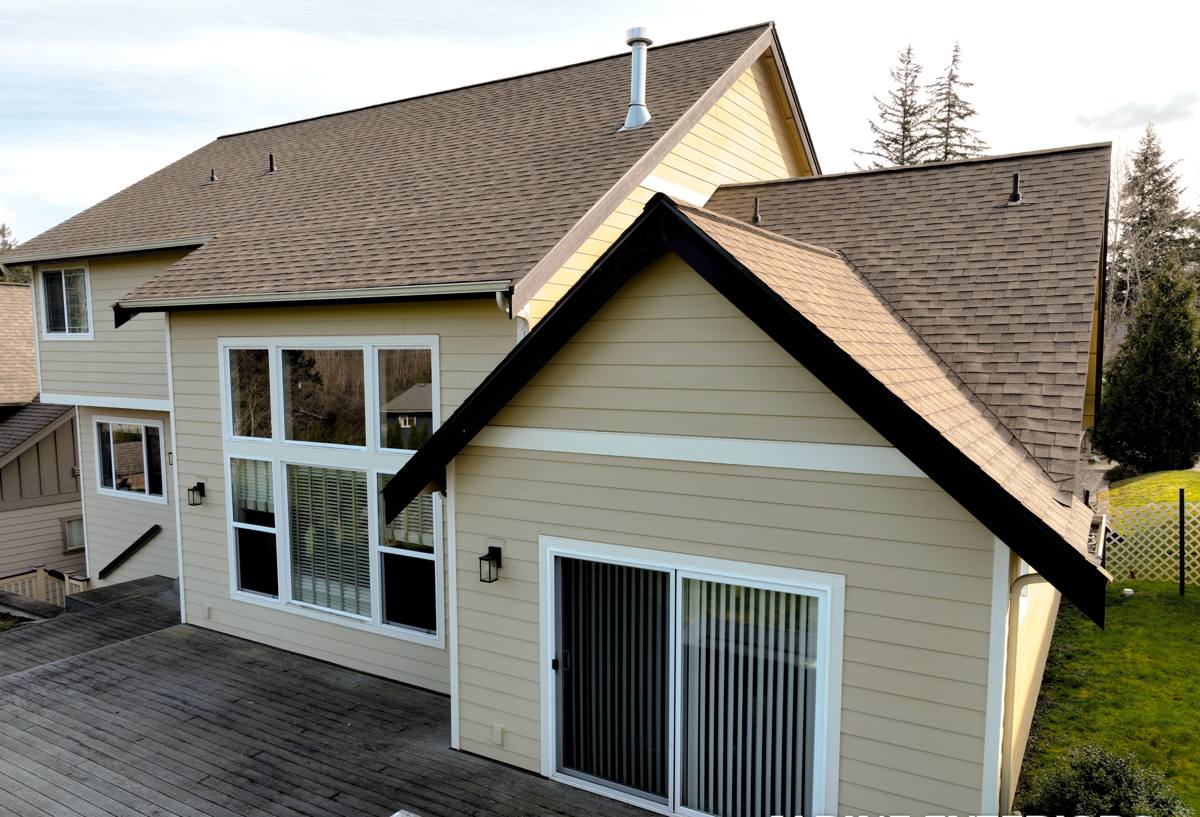
What Salt Air, Driving Rain, and Moss Season Do to a New Install
Three regional conditions drive most of our decisions on a Blaine new-construction window job:
- Salt air — airborne salt accelerates corrosion on fasteners, hinges, and lower-grade cladding, especially on west- and south-facing walls that catch wind off the water directly. Hardware and flashing metals need to be rated for it, not just standard-grade.
- Driving rain — wind-driven rain doesn't just fall on a window, it pushes sideways into any gap in the flashing or sealant. A sill pan and properly lapped flashing aren't optional details here; they're the difference between a dry wall cavity and a slow leak you won't see for a year or two.
- Moss and algae season — shaded elevations and north-facing walls stay damp for extended stretches, and moss holds moisture against trim and cladding. Where window trim meets siding, that sustained dampness will find any weak point in the seal.
None of these are exotic problems — they're just the normal cost of building on the water in Whatcom County. A window package and installation method that would be fine in a dry inland climate isn't automatically fine here.
What a Correct New-Construction Window Installation Actually Involves
The Sill Pan and Flashing Sequence
Before a window ever goes into the rough opening, the sill needs a sloped, sealed pan that directs any water that gets past the window back outside the wall — not down into the framing. From there, flashing tape and the weather-resistive barrier get integrated in a specific shingle-lap order: sill flashing first, then the window, then jamb flashing, then head flashing last, each layer overlapping the one below it so water always sheds outward and downward, never behind the layer under it.
Integrating with the Weather-Resistive Barrier
The window's flashing has to tie into the housewrap or building paper correctly, with the WRB lapped over the head flashing and under the sill flashing. This is where a lot of shortcuts happen on fast-moving new builds — trades working around each other's schedules can leave gaps in the lap sequence. On a Blaine job, we treat this step as non-negotiable, because it's the actual barrier standing between wind-driven rain and your framing.
Fastening and Shimming
New-construction windows are typically nail-fin units, fastened through a flange directly to the sheathing. That flange needs full, even contact with the wall, proper shimming behind it so the frame doesn't rack out of square, and fasteners rated to resist the corrosion that comes with salt air exposure. A window that's out of square by even a small amount will bind, won't seal evenly, and will wear its weatherstripping unevenly over time.
Interior and Exterior Sealant
Sealant is the last line of defense, not the first — it should never be doing the job flashing is supposed to do. We seal the interior air barrier and exterior joints with products rated for the temperature range and UV exposure our winters and summers put them through.
Choosing Materials and Glass for a Blaine Build
Material choice matters more on a coastal, high-rainfall site than it does further inland. Here's how the common options hold up under Blaine's conditions:
| Frame Material | Salt Air Performance | Moisture Behavior | Maintenance |
|---|---|---|---|
| Vinyl | Good — won't corrode | Handles moisture well, no rot risk | Low; occasional cleaning |
| Fiberglass | Excellent — very stable, low expansion/contraction | Excellent moisture and temperature stability | Low |
| Wood-clad | Fair — depends on cladding integrity | Vulnerable if cladding is breached; interior wood needs protection | Higher; watch cladding seams and finish |
| Aluminum (uninsulated) | Poor near salt spray without proper coatings | Prone to condensation without thermal break | Moderate to high |
For most Blaine new builds, we steer clients toward vinyl or fiberglass frames with corrosion-resistant hardware, especially on elevations facing the water or prevailing weather. Wood-clad windows can work well architecturally, but we're upfront that they carry more long-term maintenance obligation in a marine climate — that's a trade-off to go in with eyes open about, not a reason to avoid the look if you're willing to maintain it.
On glazing, double-pane low-E glass is standard and meets Washington State Energy Code requirements for most residential construction; where a home has a lot of west or south glass catching direct sun and weather, we'll talk through upgraded glass packages for comfort and condensation control.
Our New-Construction Window Process
- Plan review and takeoff — we review the architectural plans or work directly with your builder to confirm rough opening sizes, window schedule, and any egress or energy-code requirements before ordering.
- Material and product selection — we walk through frame material, glass package, and hardware options suited to the home's exposure, not a one-size-fits-all spec.
- Coordination with your framer and siding crew — timing matters. We install after the WRB is up to the point of the rough openings and coordinate flashing sequencing with whoever is running housewrap and siding, so there's no gap in the water management plan.
- Sill pan, flashing, and window set — sill pan flashing, window installation, jamb and head flashing, and WRB integration, done in the correct shingle-lap order.
- Fastening, shimming, and sealing — full flange contact, proper shimming, corrosion-resistant fasteners, and interior/exterior sealant appropriate to our climate.
- Final check — we confirm every unit operates smoothly, seals evenly, and is square before we consider the job done.
Common New-Construction Window Mistakes We Fix Before They Become Problems
Most window failures on new builds don't come from a bad window — they come from installation shortcuts that don't show up until the first hard winter. On Blaine jobs, the mistakes we see most often include:
- Flashing installed in the wrong order, so water gets directed behind a layer instead of over it
- No sill pan, or a flat sill pan with no slope to shed water outward
- Housewrap taped over the flange instead of properly lapped under the head flashing
- Standard-grade fasteners used where corrosion-resistant hardware was warranted
- Sealant used to compensate for a poor flashing job instead of as a secondary barrier
- Windows set out of square, causing uneven wear on weatherstripping within a few years
Every one of these is invisible once the siding goes on. That's exactly why the installation sequence matters more than almost any other factor in how a window performs over its lifespan here.
Cost Factors on a New-Construction Window Package
Pricing on a new-build window package depends on more than the number of openings. Rough cost drivers we walk through with builders and homeowners:
| Factor | Why It Affects Cost |
|---|---|
| Frame material | Fiberglass and clad-wood run higher than vinyl; material choice is often the single biggest line-item swing |
| Glass package | Upgraded low-E coatings or triple-pane glass add cost but pay off on west/south exposures |
| Window count and sizing | Larger units and specialty shapes (bays, custom geometry) take more labor and flashing detail |
| Site exposure | Waterfront or wind-exposed elevations may call for upgraded hardware and flashing details |
| Coordination complexity | Tight builder schedules requiring off-sequence work can add labor time |
We give straightforward, itemized estimates rather than a single lump number, so you can see exactly where the money is going and where there's room to adjust the spec.
What to Ask Before You Hire a New-Construction Window Crew
- Do you install a sloped sill pan on every opening, or only when asked?
- What's your flashing lap sequence, and how does it tie into the WRB?
- Do you use corrosion-resistant fasteners and hardware for coastal exposure?
- Can you coordinate directly with my framer and siding contractor on timing?
- What frame materials do you recommend for my home's specific sun and weather exposure?
- Will you walk me through the window schedule against the plans before ordering?
Why a Crew That Already Works Blaine Matters
A crew that installs windows across Whatcom County day in and day out has already seen how salt air, driving rain, and moss season play out over years on real homes — not just at the moment of installation, but two, five, ten winters later. That experience shapes small decisions that add up: which fasteners hold up, how tight a flashing lap needs to be on a west-facing wall, which frame materials are worth the upgrade on an exposed lot. It's the difference between an installer following a generic checklist and one who understands why each step matters on this coastline specifically.
If you're building new in Blaine and want your windows installed by a crew that treats the flashing and water management as seriously as the windows themselves, we'd be glad to walk your plans and give you a straightforward, no-pressure estimate using the form below.