 Bellingham
 Siding Built for Edgemoor's Bluff-Top Exposure
Edgemoor sits above Bellingham Bay on a wooded bluff south of downtown Bellingham, and that setting cuts both ways. The tree cover and elevation give homes some of the best views and most private lots in Whatcom County, but the same location puts exterior walls through a tougher combination of stresses than a typical inland Bellingham block: salt-laden air coming off the water, driving rain that hits west- and south-facing walls at an angle instead of straight down, and deep shade under mature conifers that keeps siding damp long after a storm passes. Any siding installed here has to handle all three at once, year after year, not just survive a single wet winter.
We install and replace siding across Whatcom County, and Edgemoor is one of the neighborhoods where we see the clearest gap between siding that was installed correctly and siding that was installed to look right on the day the crew left. That gap shows up two, five, and ten years later — in swollen panel edges, moss creeping up north-facing walls, and caulk lines that failed long before the paint did.
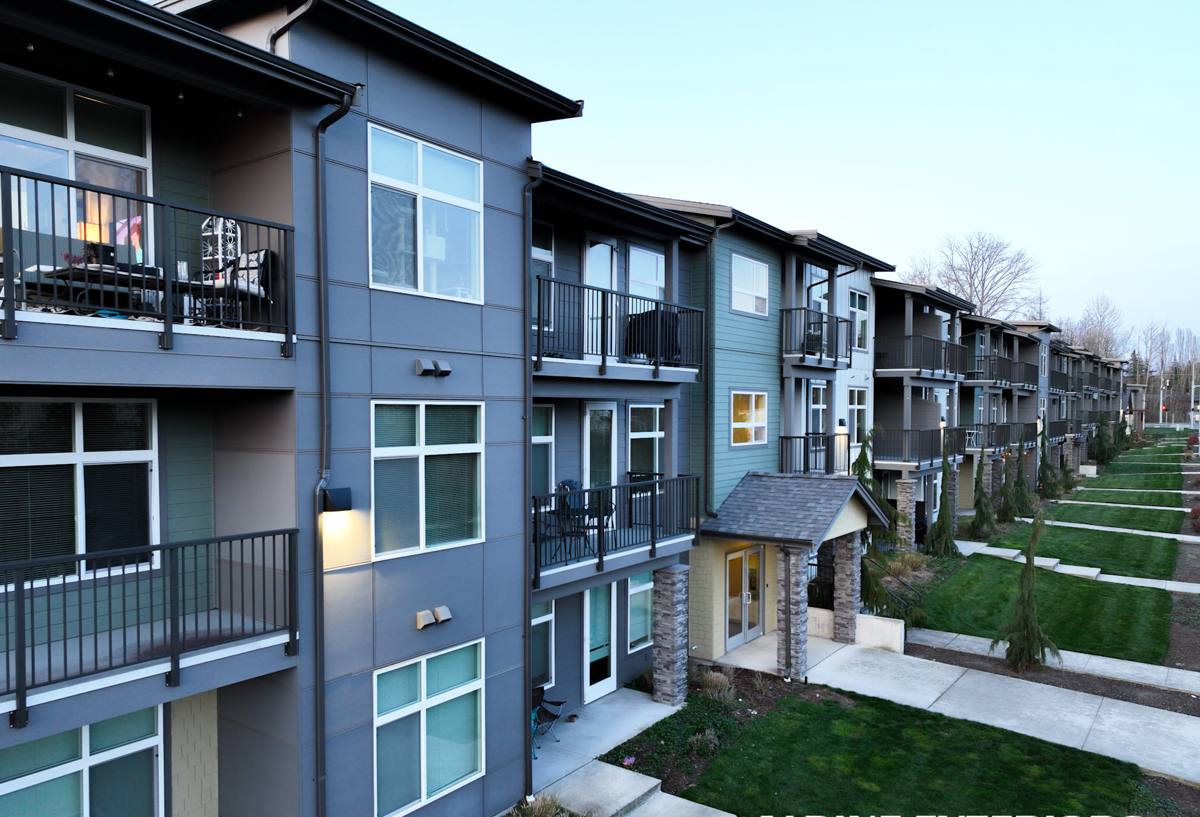
What the Local Climate Does to Siding
Salt air and marine moisture
Homes close to Bellingham Bay stay damp longer after rain than homes a mile inland, and the air itself carries salt that accelerates corrosion on fasteners, flashing, and any exposed metal trim. Siding materials that rely on paint film alone for protection are more exposed here — once a coating is compromised by salt exposure, the substrate underneath is next.
Driving rain on exposed elevations
Bluff-top lots catch wind off the water, which pushes rain sideways into siding rather than letting it run straight down and off. That means laps, seams, and butt joints on west- and south-facing walls take on water pressure that a sheltered inland wall rarely sees. Every seam, corner, and penetration has to be detailed as if it will be tested by wind-driven rain, because in Edgemoor it will be.
Shade, tree cover, and moss season
The same mature trees that make Edgemoor desirable also mean long stretches where siding stays shaded and damp — Whatcom County's moss season runs from fall through spring, and north-facing walls under tree canopy can hold moisture for days after a storm. Moss and algae growth isn't just cosmetic; sustained moisture against a wall surface is what eventually finds its way into seams, fastener holes, and any spot where the water-resistive barrier was cut short.
Why We Only Install James Hardie Fiber Cement
We standardized on James Hardie fiber cement siding for every job we do, including in Edgemoor, and the reasoning comes directly from conditions like these. Fiber cement doesn't absorb and swell the way engineered wood products can, and it doesn't rely on a thin paint film as its only line of defense against salt air and moisture the way vinyl does. James Hardie's ColorPlus factory-applied finish is baked on under controlled conditions rather than field-applied, which matters on a bluff where UV, salt, and moisture all work on a painted surface at once. The HZ5 product line is engineered specifically for the wet, freeze-thaw-prone conditions common in the Pacific Northwest, and the material itself is non-combustible — a real advantage for homes surrounded by the kind of tree canopy Edgemoor has.
We don't carry vinyl, LP SmartSide, or cedar as options, not because those products have no merit anywhere, but because we've made a professional decision that a marine-exposed, tree-shaded, wind-driven-rain environment like Edgemoor is exactly where their trade-offs — moisture absorption, paint-film dependence, or ongoing upkeep — show up fastest. One material, installed correctly, is a better outcome for the homeowner than offering several and hoping the cheaper one holds up.
What a Correct Installation Actually Involves
The siding itself is only part of the system. Most siding failures we're called to repair — in Edgemoor and elsewhere in Bellingham — trace back to what's underneath the panels, not the panels themselves. A correct James Hardie installation includes:
- A continuous, properly lapped water-resistive barrier behind the siding, with every seam and penetration sealed before the first plank goes up
- Correct flashing above windows, doors, and any horizontal trim, so water is directed out and away instead of behind the cladding
- Rain-screen or drainage-gap detailing on walls that take direct wind-driven rain, so any moisture that gets past the outer layer can drain and dry rather than sit against the sheathing
- Fasteners placed and driven to James Hardie's specification — not just "close enough" — since incorrect nailing is one of the most common causes of early siding failure
- Manufacturer-specified clearances at grade, roof lines, and decks, so siding isn't sitting in standing water or leaf litter
- Factory-finished ColorPlus edges and field-cut ends properly sealed, since an unsealed cut edge is the fastest way for moisture to get into the material
Our Process for an Edgemoor Siding Installation
1. On-site assessment
We walk the home and look specifically at exposure: which elevations take direct wind and rain, where tree cover keeps walls shaded, and where existing siding or trim already shows moss, staining, or soft spots. This tells us where extra flashing and drainage detail matter most, not just what the whole house needs on average.
2. Tear-off and sheathing check
Old siding comes off down to the sheathing so we can actually see what's underneath. On bluff-exposed and shaded walls, this is often where hidden moisture damage from a previous installation turns up — soft sheathing, corroded fasteners, or a water-resistive barrier that was never properly lapped.
3. Repair and moisture-barrier installation
Any damaged sheathing gets replaced before we move forward. Then a new water-resistive barrier goes on, lapped correctly from the bottom up, with all seams and penetrations sealed — the step that determines whether the wall stays dry for the next several decades, regardless of how good the siding looks.
4. Flashing and drainage detail
Windows, doors, and horizontal trim get flashed to shed water outward. On elevations exposed to driving rain off the bay, we add drainage-gap detailing so the wall assembly can dry out even after a wind-driven storm pushes moisture past the outer surface.
5. James Hardie installation
Panels or lap siding go up to manufacturer fastening specifications, with cut ends sealed and joints detailed for the exposure of that specific wall. Trim, corners, and color match are finished with the same attention.
6. Final walkthrough
We walk the finished job with the homeowner, point out what was done and why, and make sure every detail — from caulking to touch-up paint — is complete before we consider the job done.
Comparing Siding Options in a Marine, Shaded Environment
| Material | Response to salt air & moisture | Maintenance in shade/moss conditions | Where it fits our standard |
|---|---|---|---|
| Vinyl | Doesn't rot, but relies on surface color that can fade and become brittle under UV and salt exposure over time | Low upkeep but can trap moisture behind it if installed loosely; hard to detail tightly at trim | Not installed by our crew |
| Engineered wood siding | Wood-based core is more sensitive to sustained moisture exposure than cement-based products | Needs consistent paint maintenance, especially on shaded, damp elevations | Not installed by our crew |
| Cedar / untreated wood | Attractive but absorbs moisture readily; salt air and shade accelerate weathering | Highest upkeep — regular staining/sealing and moss treatment needed | Not installed by our crew |
| James Hardie fiber cement | Non-combustible, dimensionally stable, factory ColorPlus finish holds up to UV and salt exposure | Occasional wash-down for moss/algae; no repainting cycle required with ColorPlus | What we install on every job |
What Drives the Cost of a Siding Job in Edgemoor
Every home is different, and we'll always give you an exact number after walking your property — but these are the factors that move the price up or down:
| Factor | Why it matters here |
|---|---|
| Extent of hidden moisture damage | Bluff and shaded lots more often need sheathing repair once old siding comes off |
| Number of stories and roof lines | More elevations and intersections mean more flashing and cut detail |
| Trim and architectural detail | Custom trim, corner boards, and accent bands add labor beyond a plain lap-siding wall |
| Access and tree cover | Wooded lots can require more careful staging and protection of landscaping during tear-off |
| Product line and profile | Lap, panel, and shingle-profile Hardie products carry different material costs |
| Color and finish | Factory ColorPlus finishes vs. field-applied paint affect both upfront cost and long-term upkeep |
Signs Your Edgemoor Home May Need New Siding
- Moss or algae staining that returns within a season of being cleaned, especially on shaded or north-facing walls
- Soft, spongy, or bubbling spots when you press on the siding, particularly near the bottom courses or under windows
- Paint that's peeling or chalking faster than it should, a sign the surface below is no longer sealing out moisture
- Visible gaps at seams, corners, or trim where wind-driven rain could be getting behind the siding
- Rising energy bills with no other explanation, which can point to a failing weather barrier behind the siding
- Siding that's original to a home more than 20-25 years old and has never been inspected behind the surface
Why a Crew That Already Works Edgemoor Matters
Bellingham's permitting requirements, typical framing and sheathing practices, and the way homes were built in different decades all vary block to block, and a bluff-top neighborhood like Edgemoor has its own quirks — narrower access on some lots, mature trees that need protecting during tear-off, and wall assemblies that were often built before rain-screen detailing was standard practice. A crew that's already worked in the neighborhood knows what to expect before the first piece of old siding comes off, which means fewer surprises, fewer change orders, and a tighter, more accurate estimate from day one.
It also means we've already seen how the local exposure — the salt air, the wind-driven rain, the shade and moss — plays out over years on homes just like yours, not in a manual, but on actual jobs across Whatcom County. That's the experience we bring to every Edgemoor estimate.
If your Edgemoor home's siding is showing its age, or you're planning ahead before a small problem becomes a bigger one, we're happy to take a look. Reach out for a free, no-pressure estimate — we'll walk the property, tell you honestly what we see, and explain exactly what a correct James Hardie installation would involve for your home.