 Bellingham
 Why Siding Fails Faster in the Puget Area
Homes in the Puget area of Bellingham sit right in the path of everything Whatcom County weather can throw at a house. Salt-laden air off the water accelerates corrosion on fasteners and trim. Driving rain, pushed sideways by wind off the Sound, finds every gap in flashing and caulk that a calmer climate would never expose. And because the Pacific Northwest gives siding surfaces months of shade and damp air every year, moss and algae get a long runway to take hold on north-facing walls, under eaves, and anywhere sun doesn't reach.
None of this means Puget homes are somehow badly built. It means the siding on them is doing more work, year after year, than siding does in drier inland climates. A wall assembly that would coast for decades in eastern Washington can start showing real problems in twelve to fifteen years here if the original installation had any weak points at all. That's the reality we're called in to deal with, and it's why we don't treat "siding repair" as a generic service — a repair that holds up in Puget has to account for salt exposure, wind-driven rain, and a moss season that runs longer than most homeowners realize.
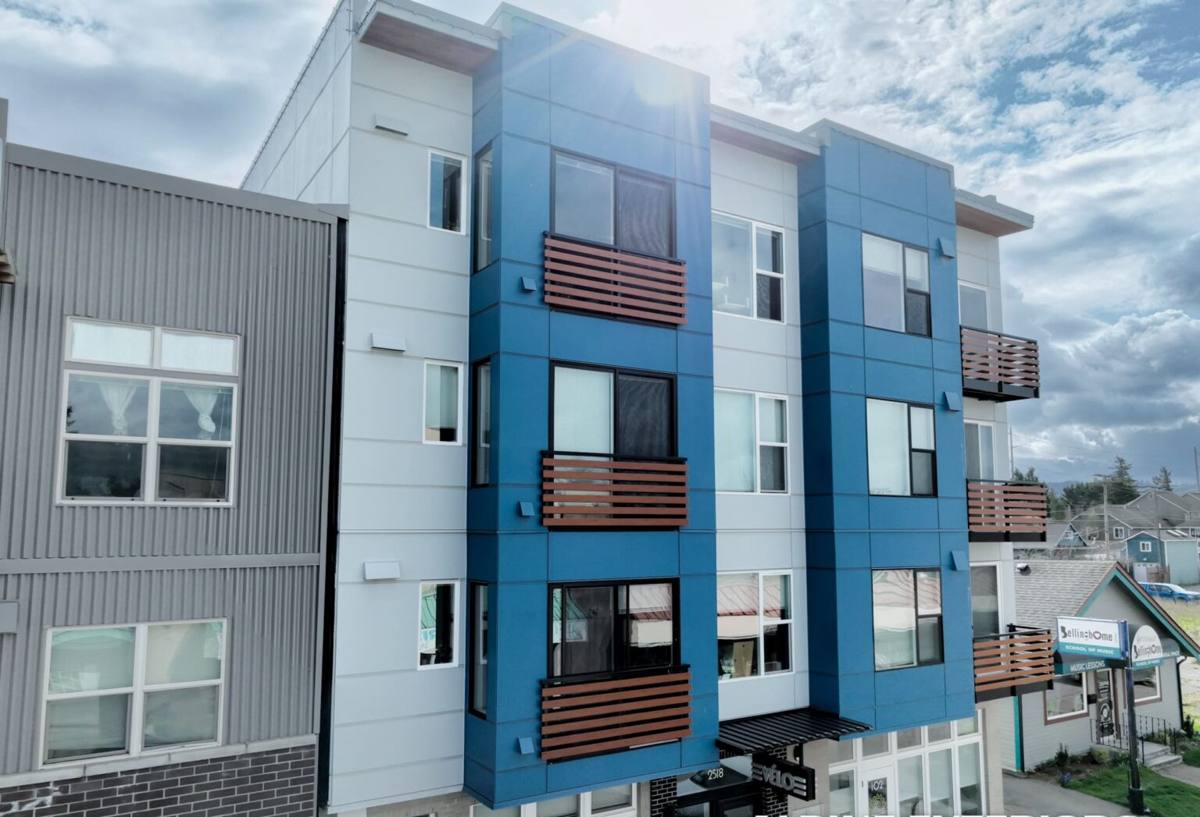
What We're Actually Seeing on Puget-Area Homes
Moisture Intrusion Behind the Siding
This is the one that matters most and shows the least from the curb. Wind-driven rain doesn't need a big gap to get behind siding — a hairline crack in caulking, a nail that's backed out, or a seam that was never properly lapped is enough. Once water gets behind the cladding, it sits against the sheathing and framing, and depending on the material, either the siding itself or the structure underneath starts to break down. By the time it's visible as a soft spot, discoloration, or a bulge, the damage has usually been building for a while.
Moss and Algae Buildup
Green and black staining on shaded walls is mostly cosmetic on its own, but it's rarely just cosmetic. Moss holds moisture against the siding surface far longer than bare material would, which is exactly what accelerates rot in wood and hardboard products and can degrade caulk and finish over time. We see the heaviest buildup on north- and west-facing walls, under roof overhangs, and anywhere landscaping keeps a wall in shade most of the day.
Fastener and Trim Corrosion
Salt air oxidizes exposed metal faster than homeowners expect. Nail heads that were meant to be hidden or caulked over can rust and telegraph through paint, and corroded fasteners lose their holding power, which lets siding panels shift, gap, or loosen at the edges.
Caulk and Sealant Failure
Caulk is the first line of defense at every joint, seam, and penetration, and it's also the shortest-lived material on the wall. UV exposure and constant damp-dry cycling break it down faster in this climate than the manufacturer's rated lifespan usually assumes. Failed caulk is one of the most common single causes of the moisture problems above.
Impact and Age-Related Damage
Cracked or split boards, warped panels, and sections that no longer sit flush against the wall usually trace back to either physical impact, freeze-thaw cycling on already-saturated material, or simply age catching up with a product that wasn't built for this level of moisture exposure in the first place.
Repair or Replace? How We Make That Call
Not every problem needs a full re-side, and we're not going to sell you one. But there's a real line between a repair that solves the problem and one that just covers it up for a season. Here's how we evaluate it on site:
| Situation | Usually a Repair | Usually Replacement |
|---|---|---|
| Damage extent | Isolated to one or two sections, clear boundary | Scattered across multiple walls or elevations |
| Underlying sheathing | Sound, dry once opened up | Soft, delaminated, or showing rot |
| Cause | Impact, a single failed seam, isolated caulk failure | Systemic moisture intrusion, chronic under-siding wetting |
| Product on the wall | Fiber cement or comparable, still structurally sound | Original material at or past its realistic service life |
| Match-ability | Same product and finish still available or a clean transition is possible | Discontinued product, visible patchwork unavoidable |
We'll tell you honestly which category your home falls into. A patch that's going to fail again in three years because the real problem is upstream of it isn't a favor to anyone.
What a Correct Repair Actually Involves
A repair that's done right isn't just "swap the bad board." It's a sequence, and skipping steps is how a repair turns into a callback:
- Find the actual source, not just the symptom. Stained or damaged siding is often downstream of a flashing gap, a roofline detail, or a penetration somewhere else on the wall.
- Open it up and check the substrate. Damaged siding almost never gets replaced without first confirming the sheathing and water-resistive barrier behind it are sound — or repairing them if they're not.
- Correct the water path before closing it back up. Flashing, house wrap laps, and drainage details get fixed, not just the visible board.
- Match the replacement material properly. Panel size, exposure, and finish need to line up with the surrounding siding, or the repair will read as an obvious patch.
- Reseal and refinish to spec. Fasteners, joints, and trim get sealed with products rated for this climate, not whatever's fastest.
Our Process for Puget-Area Repairs
We keep this straightforward on purpose:
- On-site assessment — we look at the damaged area and the surrounding wall assembly, not just the spot you called about.
- Honest scope and estimate — repair, partial replacement, or full re-side, explained in plain terms with the reasoning behind it.
- Moisture check before any board goes back on — if sheathing or framing needs attention, we address it, not paper over it.
- Repair executed to match — profile, reveal, and finish matched as closely as the existing siding allows.
- Walkthrough when it's done — you see exactly what was fixed and why, before we consider the job closed.
Why We Repair and Replace with James Hardie Only
When a repair calls for new siding — whether it's a few boards or a full wall — we install James Hardie fiber cement, and only James Hardie. It's a deliberate standard, not a default. Fiber cement doesn't absorb and swell the way wood-based products can, it holds up to salt air and constant damp exposure far better than materials that rely on a factory coating alone, and it's non-combustible, which matters more each year in this state. Hardie's ColorPlus factory finish also means a repaired section can be color-matched with far more consistency than a job-site paint match usually achieves, and it carries a strong transferable warranty when installed to spec.
We don't install LP SmartSide, vinyl, Cemplank, Allura, or primed wood siding, even when a customer asks for a like-for-like patch in one of those materials. If your existing siding is one of those products and it's failed in a way that needs more than a spot repair, we'll say so plainly and walk you through what a transition to Hardie would look like — no pressure, just the honest tradeoffs.
Cost Factors on a Typical Repair
| Factor | Why It Moves the Price |
|---|---|
| Scope of damage | A few boards vs. an entire elevation changes labor and material significantly |
| Substrate condition | Sound sheathing costs far less to close back up than rotted sheathing that needs replacing |
| Accessibility | Second-story walls, tight setbacks, and steep grading add time |
| Color and finish matching | Matching an existing ColorPlus finish is more precise, and more affordable long-term, than field-painting a patch |
| Root-cause fixes | Flashing or house-wrap correction adds a step but prevents the same failure from recurring |
Why a Crew That Already Works in Puget Matters
Siding repair isn't just a materials question — it's a judgment call about what this specific wall, in this specific microclimate, actually needs. A crew that regularly works Puget-area homes already knows which elevations take the worst of the wind-driven rain, how long moss really takes to become a moisture problem instead of just a stain, and what corrosion on fasteners looks like at six years versus sixteen. That's not something you get from a repair crew that mostly works inland and treats every job the same way. Local experience also means fewer surprises once a wall gets opened up — we've seen what's usually behind Puget-area siding, and we plan the job accordingly instead of guessing.
Keeping Repaired Siding in Good Shape
A correct repair should last, but a little upkeep protects that investment:
- Rinse moss and algae off shaded walls before it builds a thick mat — a soft wash, not a pressure washer aimed point-blank at seams and joints.
- Trim back landscaping that keeps any wall in constant shade or holds moisture against the siding.
- Walk the exterior once a year and check caulking at trim, windows, and penetrations — it's the cheapest thing to maintain and the most common point of failure.
- Have any new staining, soft spots, or gapping looked at early. Small problems here stay small; ignored ones don't.
- Keep gutters and downspouts clear so roof runoff isn't dumping extra water down a wall it wasn't designed to handle.
Get an Honest Look at Your Siding
If you're seeing staining, soft spots, gapping, or you just want a second opinion on siding that's starting to show its age, we'll come take a look and tell you straight what's going on and what it'll take to fix it right. Reach out for a free, no-pressure estimate — the form below gets you started.