 Bellingham
 South Hill's Roofs Take a Different Kind of Beating
South Hill sits above Bellingham Bay, and that position brings a specific mix of weather to every roof on the hill. Salt-laden air drifts up off the water and settles into exposed metal — fasteners, flashing, vent stacks — corroding it well before the shingles themselves would normally wear out. Driving rain, often pushed sideways by wind coming off the bay, finds its way under poorly lapped flashing and around chimneys and skylights in a way calmer inland climates never test for. And the tree cover that makes South Hill's lots so pleasant also keeps roofs shaded and damp long after a storm has passed, which is exactly the condition moss needs to take hold.
None of this is unique to one house on the hill — it's the baseline every roof up here has to be built to handle. A shingle roof installed the same way you'd install one on a dry, open, inland lot in Whatcom County will not perform the same way on a shaded South Hill slope facing the bay. The materials, the flashing detail, and the ventilation all need to account for it.
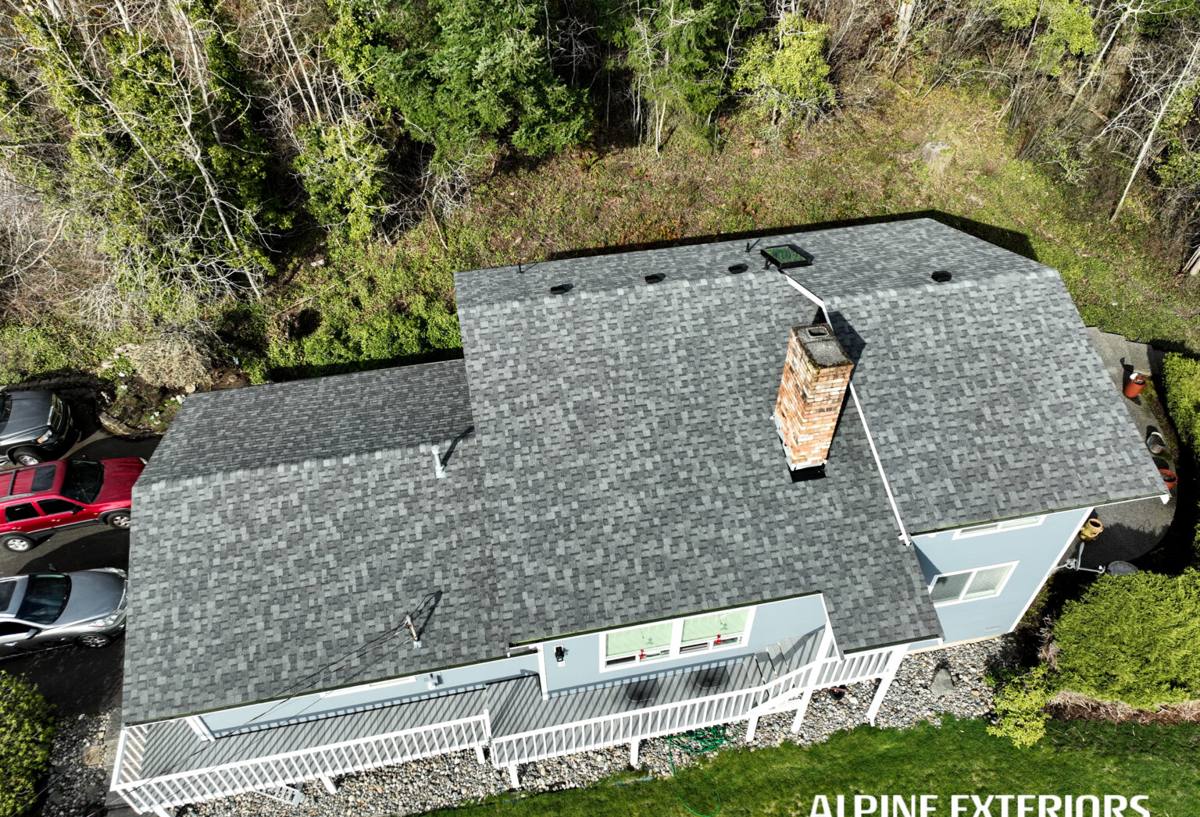
What a Correctly Built Asphalt Shingle Roof Includes Here
Starting From the Deck Up
Every re-roof starts with the deck, not the shingles. Plywood or plank sheathing that's gone soft or delaminated from years of trapped moisture gets replaced before anything else goes down — shingles nailed over a compromised deck will never perform correctly no matter how good the product is. From there, we run a self-adhered ice-and-water membrane along the eaves, valleys, and around every penetration, not just standard felt paper. Given how much standing moisture this region sees over a wet season, that membrane is the difference between a leak staying contained and a leak finding its way into the attic. A synthetic underlayment covers the rest of the field for added wind and rain resistance before the shingles go on.
Ventilation Matters as Much as the Shingles
An attic that can't breathe traps moisture underneath the roof deck, and on a shaded, damp lot that moisture has nowhere to go. Over time it causes the deck to rot from the underside — a failure mode that has nothing to do with shingle quality and everything to do with airflow. A correctly vented roof balances soffit intake with ridge or high exhaust venting, using one consistent venting system rather than mixing types that fight each other. We check this on every inspection, not just on full replacements, because a poorly vented attic will shorten the life of even a brand-new roof.
Flashing That Actually Sheds Water
Step flashing at sidewalls, counter-flashing at chimneys, and kickout flashing where a roof edge meets a wall all matter more here than in a dry climate, because wind-driven rain will find any gap and push through it. Kickout flashing in particular is one of the most commonly missed details on older re-roofs, and when it's missing, water gets funneled straight down behind the siding instead of into the gutter — a problem we see often enough as a siding contractor that we treat it as a checklist item on every roofing job, not an afterthought.
Moss, Algae, and South Hill's Shade
Moss and algae get treated as the same problem, but they behave differently and call for different responses. Moss is a physical problem — it roots into the granule surface, holds water against the shingle mat, and over time lifts shingle edges, creating a path for water to get underneath. Algae is mostly cosmetic: dark streaking from airborne spores that discolors a roof without necessarily damaging it structurally, though it does age a roof's appearance faster than it should.
On a shaded lot, both are more likely, so the response has to be proactive rather than reactive. Algae-resistant shingles use copper-infused granules that suppress regrowth for years longer than standard granules. Copper or zinc strips installed near the ridge do the same thing over time as rain washes trace metal down the slope. Where moss has already established, we remove it by hand or with a soft wash rather than a pressure washer — power-washing strips the protective granule coat off the shingle and shortens its life, even though it looks like a quick fix.
Choosing the Right Shingle for a Wet, Shaded, Salt-Air Climate
Not every shingle tier is worth the upcharge on every roof, but on South Hill the gap between a basic shingle and a mid-tier one shows up faster than it would in a drier, sunnier location. Here's how the common options compare for this specific climate:
| Shingle Type | Typical Lifespan | Moss/Algae Resistance | Best Fit for South Hill |
|---|---|---|---|
| 3-tab strip shingle | 15–20 years | Standard granules only, no built-in resistance | Simple, low-slope sections on a tight budget |
| Architectural (laminate) shingle | 25–30 years | Algae-resistant granule options available | Most South Hill homes, especially heavily shaded lots |
| Impact-rated (Class 4) shingle | 30+ years | Algae-resistant options available | Homes under mature trees with a history of falling branches or debris |
Architectural shingles are our default recommendation for most South Hill homes — the added cost over a 3-tab is modest relative to the added years of service, and the algae-resistant granule option is worth having on any lot with real tree cover. Impact-rated shingles make the most sense specifically where large trees overhang the roof, since falling limbs and cones do more damage to a standard shingle mat than weather alone.
How We Handle a South Hill Re-Roof or Repair
- On-site inspection from both the attic and the roof surface — checking deck moisture, flashing condition, and existing ventilation before anything is quoted.
- A written estimate that breaks out material and labor so you know exactly what you're paying for and why.
- Tear-off down to the deck, with any soft or rotted sheathing replaced and documented before cover-up.
- Ice-and-water membrane at eaves, valleys, and penetrations, followed by synthetic underlayment across the field.
- New flashing at all walls, chimneys, and roof-to-wall transitions — not reused flashing, which is a common shortcut that fails early in this climate.
- Shingle installation following the manufacturer's specified nailing pattern and exposure, which matters for both wind performance and keeping any manufacturer warranty valid.
- Ventilation correction if the inspection found an imbalance.
- Full cleanup, including a magnetic sweep for stray nails, and a final walkthrough before we consider the job done.
Repair or Full Replacement: What Actually Drives the Cost
Two roofs of the same size on South Hill can come in at very different price points once you account for the site itself. These are the factors that move the number most:
| Cost Factor | Why It Matters Here |
|---|---|
| Roof pitch and steepness | Steeper roofs need more fall-protection rigging and slow the work down |
| Number of existing shingle layers | Tear-off cost rises with each layer, and most manufacturers won't warranty new shingles installed over old ones |
| Deck condition | Years of moss holding moisture can hide rot that isn't visible until tear-off begins |
| Site access | Tree-heavy lots and steep driveways can limit where a dumpster or material trailer can sit, adding labor time |
| Flashing complexity | Chimneys, skylights, and multiple valleys each need custom flashing work |
| Shingle tier chosen | Architectural and impact-rated shingles cost more up front but resist moss and wind longer |
A straightforward repair — replacing a section of damaged flashing or a patch of wind-lifted shingles — is a different scope entirely from a full tear-off, and we'll tell you plainly which one your roof actually needs rather than defaulting to the bigger job.
Maintenance Checklist for South Hill Homeowners
- Clear gutters and downspouts every fall, before the heavy rain sets in, so water has somewhere to go besides under the shingle edge
- Trim back branches overhanging the roof — less shade and debris means slower moss growth and fewer impact points
- Check shaded, north-facing slopes and valleys for moss lines each spring; address it early, before it lifts shingle edges
- Inspect flashing around chimneys and vent stacks for rust, which shows up faster here because of salt air
- Watch for interior signs of poor ventilation — condensation in the attic or ice damming along the eaves in a cold snap
- Never power-wash a shingle roof to remove moss; it strips the protective granule layer and shortens the roof's remaining life
Why Hiring a Crew That Already Works South Hill Matters
A roofing crew that's worked this neighborhood before isn't guessing at how much moss buildup is normal for a shaded slope here versus somewhere drier — they've seen it and already know where it tends to start. They've planned around the site-access issues that come with tree-heavy lots and steeper driveways, so a dumpster and material staging get worked out before the day of the job instead of becoming a problem on-site. They're familiar with the roof pitches and construction styles common to the hill, and with Bellingham's permitting and inspection expectations, so nothing holds up the schedule. Most importantly, they've already fixed the recurring failure patterns particular to this stretch of Whatcom County — missing kickout flashing, undersized ventilation, shingle tiers that weren't a good match for the shade — so those mistakes don't get repeated on your roof.
If you're weighing a repair against a full replacement, or you just want an honest read on what your South Hill roof actually needs, we're glad to take a look. Fill out the form below for a free, no-pressure estimate.