 Bellingham
 Fiber Cement Siding Built for South Hill's Exposure
South Hill's elevation and tree cover make it one of the more distinctive pockets of the Bellingham area to side correctly. Homes up here catch more open wind than sheltered valley lots, sit under heavier tree canopy on shaded sides, and deal with the same salt-tinged air moving in off the Sound as the rest of Whatcom County. That combination, wind exposure on one side of a house and deep shade on the other, means a single home can have two very different moisture problems happening at the same time. Getting the siding right here isn't about picking a product off a brochure. It's about understanding how this specific hillside handles water and choosing a system that holds up under all of it, not just the easy elevations.
We install James Hardie fiber cement siding exclusively, and this page walks through what that actually means for a South Hill home: what the climate demands, what a correct installation involves, and how our process works from first walk-through to final inspection.
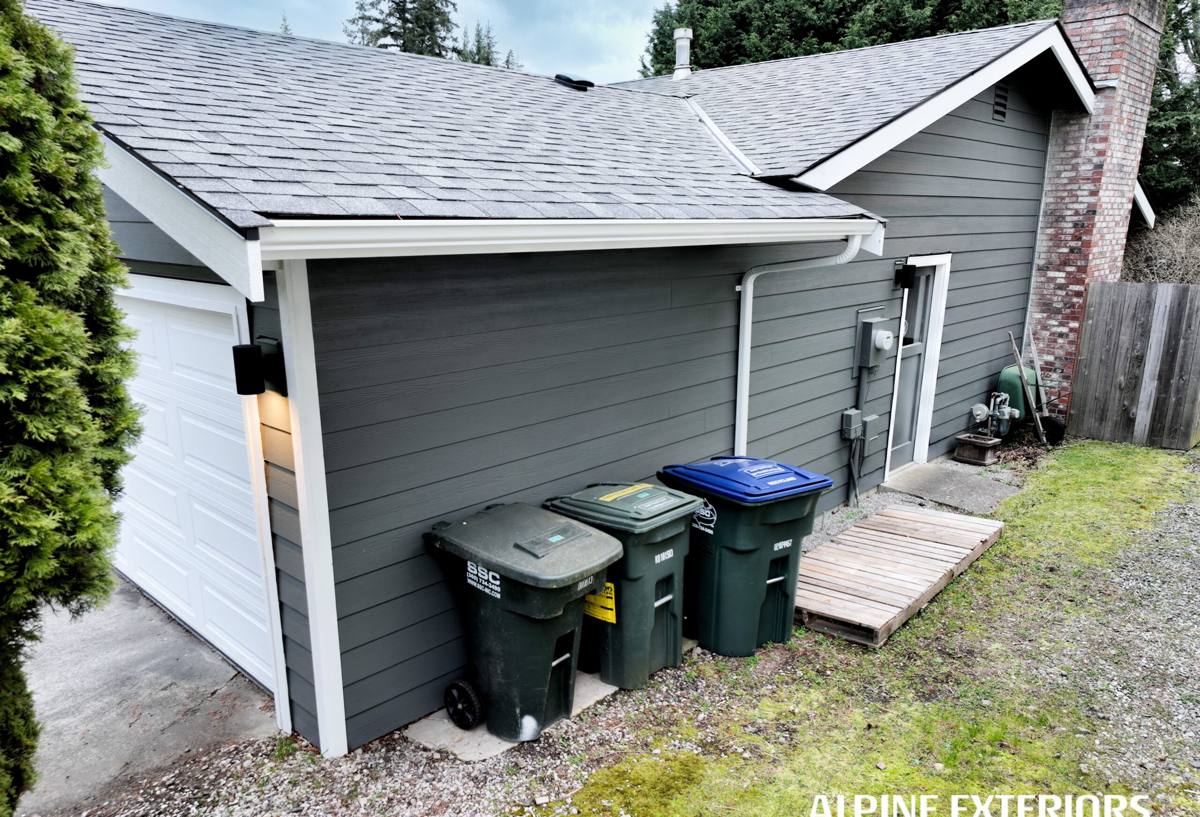
What South Hill's Climate Actually Does to an Exterior
Salt Air and Coastal Moisture
Even set back from the water, South Hill homes get regular exposure to salt-laden air drifting in off the Sound. Salt accelerates finish breakdown and speeds up corrosion in fasteners, flashing, and trim hardware well before most homeowners notice it happening. A siding system's outer finish is the first line of defense against that kind of slow chemical wear, and not every finish holds up the same way over ten or twenty years.
Driving Rain and Wind Exposure
Elevation means wind, and wind means rain rarely falls straight down here. It gets pushed sideways into lap joints, trim edges, and butt seams, working its way into any gap a wall assembly leaves open. That's a heavier water-management load than a simple rainfall total suggests, and it's exactly the condition where sloppy flashing or a rushed caulk joint turns into a moisture problem two or three years down the road instead of twenty.
A Long Moss and Mildew Season
The tree cover that makes South Hill attractive also means shaded, north-facing walls stay damp for long stretches of the year. Moss and mildew take hold on any surface that holds moisture at the surface, and on a hillside lot with mature trees, that season can run nearly year-round on the shadiest elevations. Left unaddressed, sustained surface moisture works its way past a compromised finish and into whatever's underneath it.
Why the Material Underneath the Finish Matters
A lot of siding conversations focus on color and trim style and skip past the more important question: what happens to the core material when it gets wet, over and over, for years. James Hardie fiber cement is a cement-based composite of portland cement, sand, and cellulose fiber. The core is inorganic, so it doesn't absorb water and swell, warp, or cup the way wood-based products can after repeated wet-season cycling. It's also non-combustible, which matters for household safety and can matter in insurance conversations regardless of which side of the state a home sits on.
Most Hardie products we install carry the factory-applied ColorPlus finish, a baked-on coating cured under controlled plant conditions rather than brushed or sprayed on site after the siding goes up. That distinction matters more on an exposed, wind-driven-rain site like South Hill than it does on a sheltered lot, because a factory finish holds its seal at the surface far longer than field-applied paint exposed to the same salt air and UV cycling.
Product Line: Matching the Right Hardie System to the Site
James Hardie doesn't sell one product; the line is built around different climate zones and application needs, and picking the right one for a South Hill home is part of doing the job correctly.
| Consideration | Why It Matters for South Hill |
|---|---|
| HZ5 climate-engineered formulation | Built for regions with heavier sustained moisture exposure and freeze-thaw cycling, a closer fit for exposed hillside lots than a generic formulation |
| Lap siding vs. panel systems | Lap profiles shed wind-driven rain differently than panel seams; the right choice depends on the home's elevation and wall geometry |
| ColorPlus factory finish | Reduces field-painting seams and holds color and moisture resistance longer under salt air and UV exposure |
| Trim and accessory matching | Corner boards, soffits, and fascia need to be detailed as one water-managed system, not siding plus mismatched trim |
We walk each South Hill property before recommending a specific product line, because a shaded, wind-sheltered back wall and an exposed, wind-facing front elevation on the same house sometimes call for different detailing, even when the siding product itself stays consistent.
What a Correct Installation Actually Involves
Material choice is only half of the equation. Fiber cement performs the way it's engineered to only when the installation follows Hardie's specifications closely, and that's where a lot of the long-term difference between a good re-side and a problem re-side actually comes from.
- Tear-off and substrate inspection: Removing the old siding down to the sheathing so any hidden rot, trapped moisture, or failed house wrap gets found and fixed before new siding goes on, not sealed in behind it.
- House wrap and flashing integration: A weather-resistive barrier and properly lapped flashing at every window, door, and penetration, so water that gets past the siding surface has a way out instead of a place to collect.
- Correct fastening pattern: Hardie specifies fastener type, spacing, and placement precisely; deviating from that spec is one of the most common ways an otherwise good product ends up performing poorly.
- Proper clearances: Minimum gaps from grade, decks, roofline, and other transitions, so splash-back and standing water don't sit against the bottom edge of the siding.
- Joint and seam detailing: Lap joints and butt seams sealed and lapped correctly, which is exactly where wind-driven rain finds its way in in this climate if it's rushed.
Our Process for a South Hill Job
- Walk-through and assessment: We look at the home's actual exposure, elevation, tree cover, and existing siding condition in person, not off a satellite photo.
- Honest estimate: A written scope and price based on what we actually find, including likely substrate repair if the existing siding shows signs of trapped moisture.
- Tear-off and substrate repair: Full removal of the old siding, with any rot or moisture damage repaired before anything new goes up.
- House wrap, flashing, and installation: Hardie siding installed to manufacturer spec, with fastening, clearances, and joint details handled the same way whether it's a visible front elevation or a shaded back wall.
- Final walk-through: We go over the finished job with you before calling it done, not just before invoicing it.
Cost Factors for a South Hill Re-Side
| Factor | What It Affects | Why It Matters on South Hill |
|---|---|---|
| Substrate condition at tear-off | Repair scope before new siding goes on | Shaded, moss-prone walls are a common spot for hidden moisture damage behind older siding |
| Elevation and wind exposure | Flashing and joint detailing time | More exposed elevations need more careful water management at every seam |
| Home complexity | Labor time and trim work | Dormers, corners, and multiple rooflines multiply the number of joints exposed to driving rain |
| Product line and finish selection | Material cost per square | Climate-engineered lines and factory finishes cost more upfront but hold up longer under salt air and moisture |
| Access and site conditions | Equipment and labor needs | Hillside lots can require different staging and access planning than flat-lot jobs |
Exact numbers depend on the specific home, which is why we give a real, walked estimate rather than a number off a generic price sheet.
Why Hiring a Crew That Already Works This Hill Matters
South Hill isn't a uniform lot. A crew that's worked the area knows that a home two streets apart can have completely different exposure profiles, one catching wind straight off the water, another tucked under enough tree cover to stay damp most of the year. That local pattern recognition shows up in small decisions: which elevations get extra attention at the joints, where moisture tends to hide behind old siding, which product line actually fits a given wall instead of a one-size answer. It's the difference between a crew executing a spec sheet and a crew that's seen what actually happens to a house on this hill over the years that follow.
A Quick Checklist Before You Hire
- Ask which specific siding product and product line is being quoted, not just "fiber cement" in general.
- Ask how the crew handles tear-off and what happens if they find rot or trapped moisture behind the existing siding.
- Ask about fastening pattern, clearances, and flashing details, since that's where installation quality actually shows up.
- Ask for proof of active Washington contractor licensing, bonding, and insurance.
- Ask how the warranty works and what it requires of the installation to stay valid.
If you're weighing a siding project on South Hill, we're happy to walk the property, look at what your home's actual exposure is doing to the existing siding, and give you a straight answer about what we'd recommend. Reach out using the form below to schedule a free, no-pressure estimate.