 Bellingham
 Why Sunnyland Roofs Wear Out Faster Than the Warranty Sticker Suggests
Every asphalt shingle and every roll of underlayment sold in this country carries a manufacturer's expected service life, and almost none of those numbers were calculated with a neighborhood like Sunnyland in mind. Sitting close enough to Bellingham Bay to catch salt-laden air, and shaded by the mature tree cover that gives the area its character, roofs here take on three kinds of punishment at once: corrosive moisture in the air, wind-driven rain off the water, and a moss season that runs longer than almost anywhere else in Whatcom County.
None of those factors alone would be a big deal. Together, over ten or fifteen years, they compound. Fasteners corrode a little faster than the box predicted. Flashing seams that would stay tight in a drier climate start weeping. Moss gets a foothold in the fall and doesn't fully dry out until late spring, holding moisture against the roof deck for months at a stretch. A repair that ignores any one of those realities tends to fail again within a year or two — which is exactly the kind of repeat callback we're trying to prevent when we look at a roof.
The Repair Calls We Actually See in Sunnyland
Moss-Related Damage
This is the single most common reason we get a call from this neighborhood. Moss doesn't just sit on top of shingles looking bad — it grows under the shingle tabs, lifts them slightly off the roof deck, and holds standing moisture against the granule surface and the fasteners underneath. Over a few seasons that lifting action loosens the shingle's seal strip, and once wind gets under an edge, water starts finding its way to the decking.
Flashing and Transition Leaks
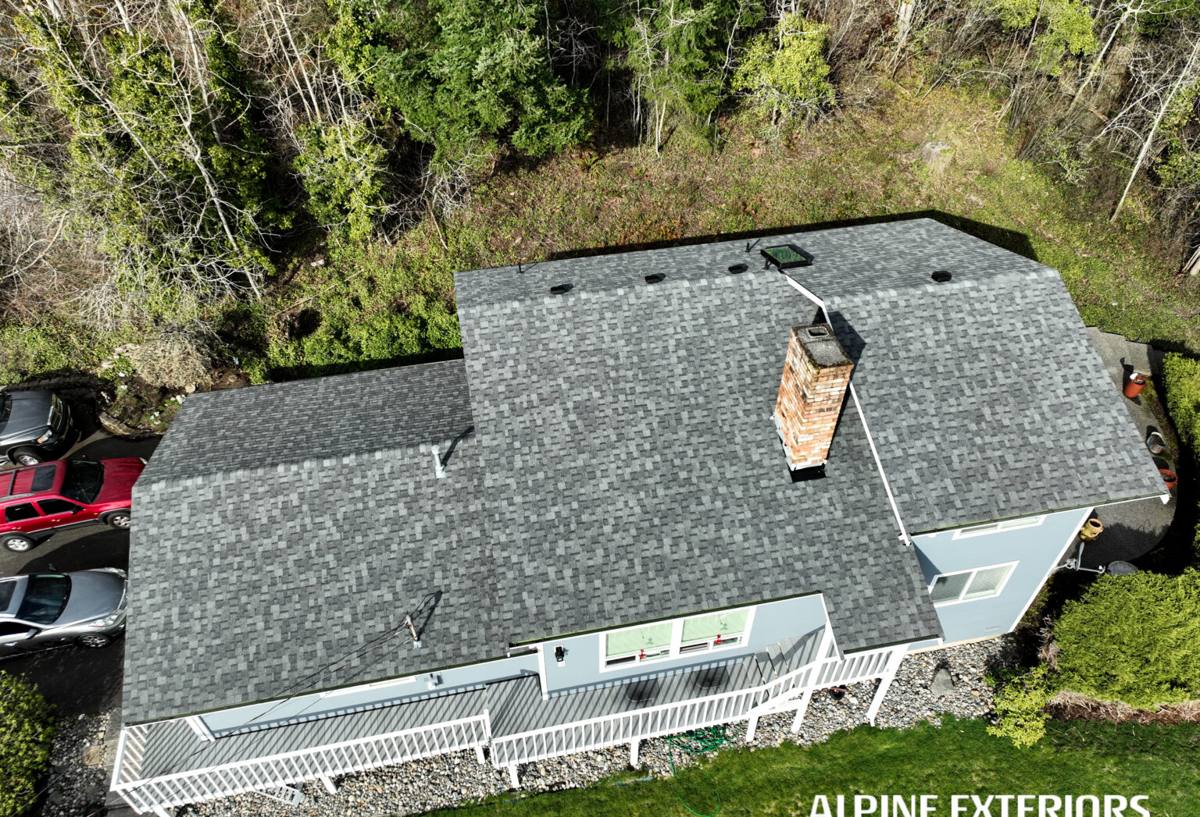
Chimneys, skylights, roof-to-wall junctions, and valley flashing are where the great majority of real leaks start — almost never in the open field of shingles themselves. Salt-influenced air accelerates corrosion on lower-grade flashing metal and on exposed fasteners, and once a flashing seam opens even slightly, driving rain during a fall or winter storm will push water sideways and upward under it, not just straight down.
Wind and Storm Damage
Bellingham gets its share of windstorms off the Strait, and older homes in established neighborhoods like Sunnyland often have roofs that were installed under older code, with less wind-resistant sealing than current products require. A handful of lifted or missing shingles after a storm is common, and if it's not addressed before the next system rolls through, the exposed underlayment underneath rarely holds up for long.
What an Honest Roof Repair Actually Involves
A repair that's done right isn't a tube of roofing cement smeared over a stain. It starts with figuring out where the water is actually entering — which is often several feet from where it shows up on a ceiling or in an attic, because water travels along the underside of decking and rafters before it drips. That means pulling back shingles around the suspected area, checking the underlayment's condition, and looking at the decking itself for soft spots, delamination, or rot before anything gets replaced.
It also means matching materials honestly. If the existing roof is an older architectural shingle in a specific color and profile, we tell you upfront whether a close match is realistic or whether a patch will be visibly different — and we'd rather flag that before starting than have you discover it afterward. The same goes for flashing metal, fastener type, and sealant: matching what's already there is often more important to a durable repair than whatever the newest product on the shelf happens to be.
Our Sunnyland Roof Repair Process
- Inspection and diagnosis. We get on the roof (or use a camera on steep or unsafe sections) and trace the actual water path, not just the visible damage.
- Written estimate. You get a clear explanation of what's failing, why, and what it will take to fix it correctly — no vague line items.
- Moss and debris clearing. Any repair area gets cleared of moss and organic buildup before work starts, since patching over it just traps the moisture problem underneath the fix.
- Repair execution. Damaged shingles, underlayment, decking, or flashing are replaced with materials suited to a wet, salt-influenced climate — not just whatever's cheapest.
- Protective treatment where appropriate. On roofs with a heavy moss history, we'll talk through options like zinc or copper strips that slow regrowth going forward.
- Cleanup and walkthrough. We don't leave nails, granules, or torn-off material in your gutters or yard, and we walk the repair with you before we call it done.
- Documentation. You get a record of what was repaired and the workmanship warranty terms in writing.
Repair or Replace? How to Tell the Difference
Not every roof problem in Sunnyland calls for a full replacement, and we won't tell you it does just because that's a bigger job. But a repair only makes sense if the underlying roof structure and the bulk of the shingle field still have useful life left. Here's roughly how we think through it:
| Situation | Repair usually makes sense | Replacement usually makes sense |
|---|---|---|
| Age of roof | Under roughly 15 years, materials still supple | Approaching or past manufacturer's expected lifespan |
| Extent of damage | Localized — one valley, one flashing point, a small wind-damaged section | Multiple areas failing independently, or granule loss across large sections |
| Decking condition | Solid, dry, no soft spots found during inspection | Soft, delaminated, or rotted decking in multiple areas |
| Moss history | First real infestation, caught early | Repeated heavy moss growth that's already lifted shingles in several spots |
| Cost trend | Repair cost is clearly proportional to remaining roof life | You'd be repairing the same roof again within a year or two |
Moss and Algae: Managing Bellingham's Longest Season
In a lot of the country, moss is treated as a cosmetic nuisance. In Sunnyland's climate, it's a structural issue in slow motion. Shaded lots and the region's mild, wet weather mean moss can take hold as early as September and stay damp well into spring — months longer than the growing season in drier parts of the state. That extended damp period is what turns a cosmetic problem into a repair call: the moisture held against the shingle surface and fasteners doesn't just look bad, it accelerates the exact corrosion and lifting we described earlier.
Zinc or copper control strips near the ridge are a reasonable long-term prevention step on roofs with a heavy moss history — rain washing over them carries trace metal ions down the roof that slow regrowth. They're not a substitute for periodic cleaning, and they won't undo existing damage, but they buy time between cleanings. We're honest that no treatment eliminates moss entirely in this climate; the goal is managing it before it causes damage, not promising it'll never come back.
Materials and Our Standards for This Climate
We don't chase whatever product is newest or cheapest for repair work — we use materials suited to conditions we actually see in this neighborhood. That means corrosion-resistant fasteners rather than standard-grade ones, flashing metal that holds up against salt-influenced moisture rather than the thinnest gauge available, and sealants rated for sustained damp exposure rather than short-term patch products that harden and crack within a season or two.
It's worth understanding the difference between a manufacturer's material warranty and a contractor's workmanship warranty, because they cover different things. The manufacturer warranty covers defects in the shingle or underlayment itself. The workmanship warranty — the one that actually matters most on a repair — covers whether the work was installed correctly. A cheap repair with a long-sounding material warranty is no guarantee if the installation itself is what fails first.
Why a Crew That Already Works in Sunnyland Matters
Roofing generalists who cover all of Whatcom County without a real base in specific neighborhoods tend to treat every roof the same way. A crew that already works in Sunnyland regularly has a feel for the age and construction of homes here, the roof pitches and material choices common in the area, and the tree canopy conditions that drive moss and debris buildup on a given block. That local familiarity shortens the diagnosis step and reduces the chance of a repair that solves the symptom but not the cause.
It also means practical scheduling judgment. Roofing repairs — especially anything involving underlayment or open decking — need a dry work window, and a crew that knows this area's weather patterns plans around Bellingham's wetter months rather than gambling on a forecast. Permitting and code requirements through the City of Bellingham and Whatcom County also come into play on larger repairs involving structural decking, and it helps to work with a crew that already knows that process rather than learning it on your project.
Signs You Need a Roof Repair Now, Not Later
- Granules collecting in gutters or at downspout outlets
- Visible moss growth along shingle edges, ridges, or in shaded valleys
- Curling, cracked, or missing shingles after a windstorm
- Water stains on interior ceilings or in the attic, even faint ones
- Daylight visible through the roof deck from inside the attic
- Rusting or visibly deteriorated flashing around chimneys, vents, or skylights
- Sagging sections anywhere along the roofline
- A musty smell in upper rooms or the attic, which often points to trapped moisture before a leak is even visible
What Affects the Cost of a Roof Repair
We won't quote a number without seeing the roof, but these are the factors that most often move a repair estimate up or down, and it's worth understanding them before you get quotes from anyone:
| Factor | Why it matters |
|---|---|
| Size and location of damage | A single valley or flashing point costs far less than repairs spread across multiple roof planes |
| Decking condition | Rotted or soft decking has to be cut out and replaced before any new shingle goes down, adding material and labor |
| Roof pitch and access | Steep or high roofs require more safety setup and take longer to work on |
| Material match | Discontinued or specialty shingle profiles can be harder to source than standard products |
| Moss and debris removal | Heavy buildup adds cleanup time before the actual repair can begin |
Most straightforward, localized repairs land in a modest range measured in a few hundred dollars; jobs involving significant decking replacement or extensive flashing work run higher, often into four figures. Anyone who quotes a firm number sight unseen is guessing, and we'd rather look first.
Getting Started
If you're seeing moss buildup, a stubborn stain on a ceiling, or storm damage on a roof in Sunnyland, it's worth having someone look before the next round of Whatcom County rain makes the problem bigger. We offer free, no-pressure estimates — fill out the form below and we'll take a look and tell you honestly what the roof actually needs.