 Bellingham
 Windows in Columbia Take a Different Kind of Beating
Columbia sits close enough to Bellingham Bay that homes here deal with a mix most inland neighborhoods never see: salt-laden air off the water, wind-driven rain that hits siding and window openings sideways rather than straight down, and a wet season that stretches long enough to grow moss on anything that stays damp too long. None of that is exotic for Whatcom County, but it does mean a window installation done to a generic national standard often underperforms here within a few years. The window itself is rarely the weak point. The weak point is almost always what's underneath it — the flashing, the sealant lines, and how the window ties into the wall's water-resistive barrier (WRB).
We install windows across greater Bellingham, and Columbia jobs get the same approach we'd use anywhere near the water: treat every opening as a place water is trying to get in, and build the installation to redirect it back out, every time, for the life of the window.
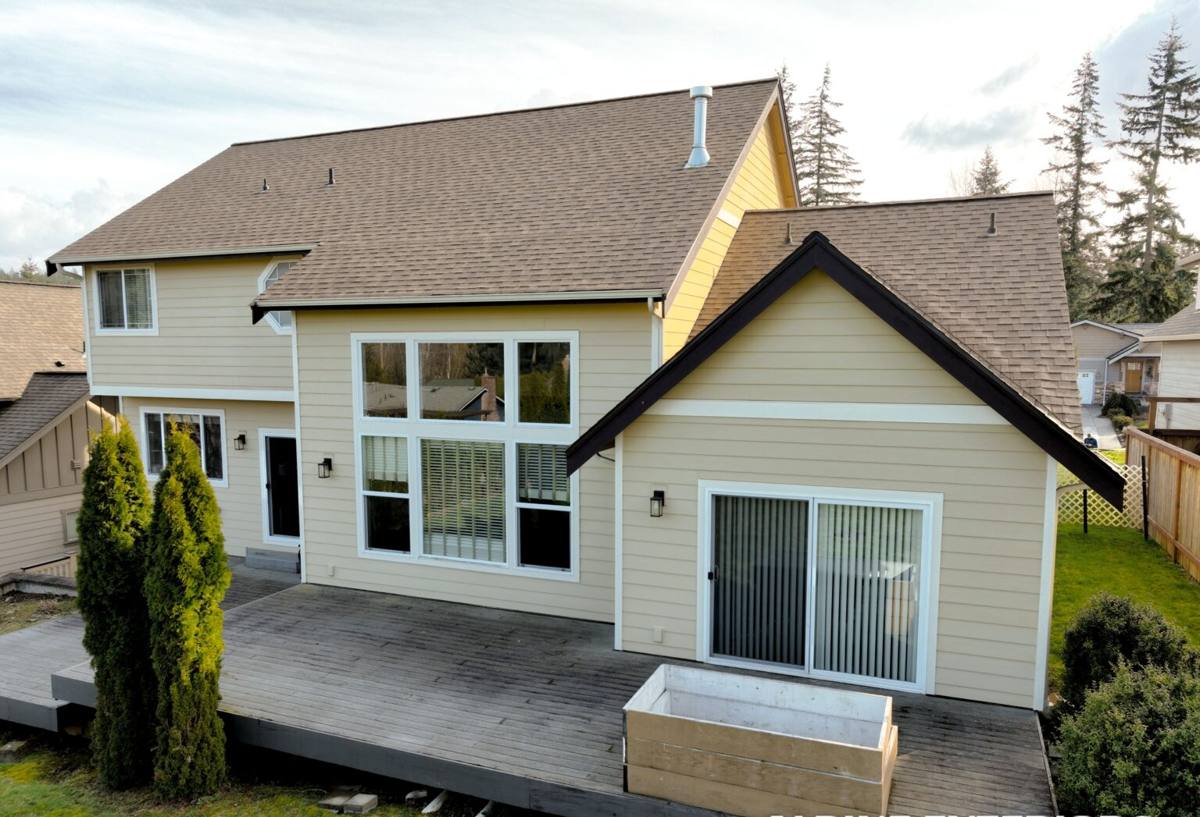
What Driving Rain and Salt Air Actually Do to a Window Opening
Wind-Driven Rain
Vertical rain is easy to shed — gravity does most of the work. Driving rain off the bay pushes water sideways and upward under trim, behind J-channel, and into any gap in the sealant bead. Over time, even a pinhole gap becomes a path for water to migrate behind the window flange and into the wall cavity, where it can sit against sheathing and framing for weeks without ever showing up as a visible leak indoors.
Salt Air
Airborne salt accelerates corrosion on unprotected fasteners, aluminum cladding, and hardware. It also breaks down cheaper sealants and gaskets faster than the manufacturer's stated service life would suggest. This is one of the reasons we're selective about fastener coatings and sealant chemistry on jobs close to the water.
Moss and Prolonged Dampness
Whatcom County's moss season isn't just a roof problem. Moss and algae take hold on horizontal window sills, sloped trim, and any surface that stays wet for extended stretches without full sun exposure. Beyond the cosmetic issue, moss holds moisture against wood trim and caulk joints, which shortens their life and can hide early rot before it's visible.
What a Correct Window Installation Actually Involves
A window installation is judged on what you can't see once the trim goes back on. The steps below are non-negotiable on any job we do in Columbia or elsewhere in Bellingham:
- Opening inspection — check the existing sheathing, framing, and sill for rot, soft spots, or prior water damage before anything new goes in.
- Sill pan flashing — a sloped, sealed pan under the window directs any water that gets past the window itself back outside rather than into the wall.
- WRB integration — the window flange has to be shingle-lapped correctly into the house wrap or building paper, so water sheds over each layer instead of behind it.
- Flashing tape at jambs and head — self-adhering flashing at the sides and top, lapped in the correct order, closes off the remaining gaps.
- Backer rod and sealant — the right foam backer rod plus a compatible, salt-air-rated exterior sealant on the final joint, not just a bead of caulk over a gap.
- Shimming and fastening — the window has to sit plumb, level, and square, with shims at the right points so the frame doesn't rack and the sash operates smoothly for years.
- Interior air sealing — a proper air seal on the interior side prevents condensation from forming inside the wall cavity during our wetter, cooler months.
Skip or shortcut any one of these steps and the window can look fine for a year or two before a slow leak starts showing up as peeling interior paint, a musty smell, or soft trim.
Signs a Columbia Home Needs New Windows or a Reinstallation
- Visible gaps, cracked caulk, or daylight around the window frame
- Fogging or moisture between the panes of a double-pane window (a failed seal, not fixable with caulk)
- Soft or discolored trim, especially at the bottom corners and sill
- Windows that are hard to open, close, or lock — often a sign the frame has shifted or swelled
- Noticeable drafts near the window during windy, wet weather
- Moss or persistent green staining building up on sills or lower trim
- Higher heating bills than similar-sized homes nearby, with no other obvious cause
Frame Material Comparison for a Salt-Air, High-Rain Climate
There's no single "best" window material for every home — the right choice depends on budget, exposure, and how much upkeep you want to take on. Here's how the common options hold up for a coastal Whatcom County property:
| Frame Material | Moisture & Salt Air Performance | Maintenance | Typical Lifespan |
|---|---|---|---|
| Vinyl | Won't corrode or rot; good baseline performance near the water | Low — occasional cleaning | 20-30 years |
| Fiberglass | Very stable in temperature and moisture swings; strong option for exposed sites | Low | 30-40+ years |
| Wood (unclad) | Handsome, but needs a sound paint or finish system to hold up against driving rain and salt | High — repainting/refinishing on a cycle | Varies widely with upkeep |
| Wood-clad (vinyl or aluminum exterior) | Good exterior protection if the cladding and flashing are done right; the interior wood side still needs normal care | Moderate | 25-35 years |
| Aluminum (uncoated or poorly coated) | More prone to pitting and corrosion in salt air without a quality factory finish | Moderate to high | Varies with coating quality |
For most Columbia homes, we lean toward vinyl or fiberglass for the exterior-exposed rooms — they simply ask less of the homeowner over the next two decades. If you want the look of wood inside, a wood-clad unit with a solid factory-applied exterior finish is a reasonable middle ground.
Our Process for Columbia Window Installation
1. On-Site Assessment
We look at each opening individually — sun and wind exposure vary block to block, and a window on the bay-facing side of a house needs more attention to flashing detail than one tucked under an eave.
2. Straightforward Quote
You get a clear estimate covering the window units, the installation labor, and any trim or siding repair the opening needs — no surprise change orders for work we should have caught up front.
3. Removal and Opening Prep
Old windows come out carefully, the opening gets inspected for hidden damage, and any rot or compromised sheathing is repaired before a new window goes in. We don't install a new window into a wet or damaged opening.
4. Installation to Full Flashing Spec
Sill pan, WRB lapping, flashing tape, and sealant — done in the correct order every time, as described above.
5. Final Walkthrough
We check operation, sightlines, and sealant lines with you before calling the job finished, and we clean up the site.
Why a Crew That Already Works in Columbia Matters
Window installation isn't just about the product — it's about how it's installed for the specific conditions on your street. A crew that regularly works Columbia and the rest of Bellingham already knows which directions catch the worst of the wind-driven rain off the bay, how fast moss builds up on north-facing trim in this neighborhood, and which sealant and flashing products actually hold up to salt air rather than just meeting a minimum code spec on paper. That local pattern recognition is hard to replicate with a crew that installs a handful of windows in Whatcom County a year and moves on. It also means someone is genuinely local if a warranty question or adjustment comes up down the road — not a distant office that has to schedule a special trip.
What to Ask Before Hiring Anyone for the Job
- Do you install a sloped sill pan flashing on every window, or only "if needed"?
- How do you lap new flashing into the existing house wrap or building paper?
- What sealant do you use, and is it rated for coastal/salt-air exposure?
- Are you licensed and insured to work in Washington, and can you show proof?
- What's the warranty on the window itself versus the labor and installation?
- Will you inspect the framing and sheathing before installing, not just swap the window?
A contractor who answers these clearly and specifically, without hesitating, is usually one who does this correctly as a matter of habit rather than as an afterthought.
Cost Factors Worth Understanding
Window installation pricing depends on more than the window brand. The main drivers we see on Columbia jobs are: the number and size of openings, whether it's a like-for-like replacement or a resize, the condition of the existing framing and sheathing once we open things up, the frame material you choose, and how much trim or siding repair is needed around each opening. We'll always walk you through these factors on-site rather than quoting blind from a phone call, since a home near the water with visible sealant failure often needs more opening repair than a similar-sized inland home.
If you're weighing window replacement in Columbia or anywhere else in Bellingham, we're happy to take a look and give you a straightforward, no-pressure estimate — just fill out the form below and we'll get in touch.